Mobile County Democrats Set a Goal of Turning Blue by 2020
Mobile County Democratic leaders told supporters the party could gain the upper hand as soon as 2020 if it solves a persistent problem: turnout in its own strongholds.
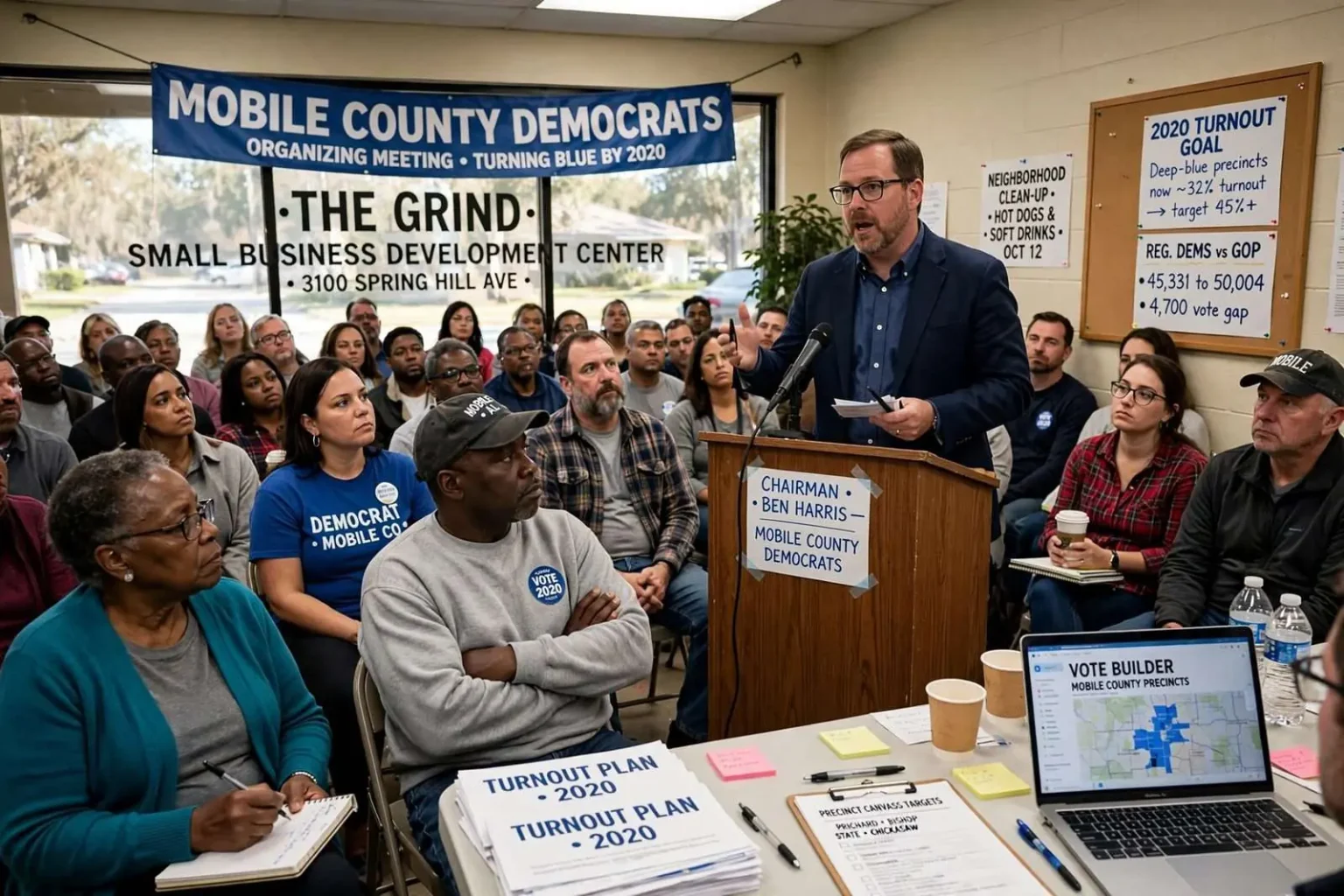
Mobile County Democratic leaders told supporters at a recent gathering that the party could pull even with, or ahead of, local Republicans as soon as 2020, but only if it finally cracked the problem that had dogged it for a generation: getting its own voters to the polls. About 35 people met on a Saturday morning at The Grind Small Business Development Center on Spring Hill Avenue, a modest setting for a discussion of how one of Alabama’s largest counties might be flipped back into the Democratic column. Party chairman Ben Harris framed the stakes in blunt terms. Democrats would overtake the local GOP within 10 to 15 years even if leaders did nothing, he said, but a sound, well-executed strategy could deliver the advantage far sooner.
“We want to go blue in two years,” Harris said. “It’s a turnout thing and to some extent a registration thing.” The two-year timeline was ambitious by any measure. Mobile County, once a dependable Democratic stronghold in the era when county politics revolved around the courthouse and the state’s Democratic machine, had shifted steadily Republican as the South realigned over the past three decades. Every countywide constitutional office and the legislative delegation’s majority now sat with the GOP. Harris’s argument was that the shift was shallower than it looked — a matter of participation, not persuasion.
The lay of the land
By Harris’ reckoning, the “real split” between the parties in straight-ticket voting favored Republicans by roughly 4,700 votes, about 50,004 to 45,331 among reliable partisans. That gap, he argued, was smaller and more surmountable than many assumed. Straight-ticket voting — the option that lets a voter pick a party’s entire column with one mark — had been available in Alabama for years and made up a large share of every countywide tally, so the difference between the parties’ straight-ticket columns was the closest thing Mobile County had to a registration-adjusted measure of partisan strength.
He pointed to recent contests as evidence. Democratic congressional nominee Robert Kennedy actually led in Mobile County for much of election night before Republican strongholds reported, though incumbent Republican Bradley Byrne was never in real danger given the GOP’s wide edge across Alabama’s First Congressional District. Byrne carried Mobile County by about 12,000 votes, 54.6 percent to 45.4 percent — a solid margin, but one that reflected Baldwin County’s weight in the district as much as Mobile’s own preference.
The party split showed more plainly in a race for a vacant circuit judgeship between two first-time candidates. Democrat Karlos Finley led for much of the evening before Republican Brandy Hambright pulled ahead to win, 52 percent to 48 percent. Judgeship races, stripped of national context and campaign money, are often the purest read of a county’s partisan balance, and a four-point margin in a county the GOP considers safely red was, to Harris’s audience, evidence of how close the ground game could get.
And Harris reminded the room that a Democrat could win countywide under the right conditions, citing Doug Jones’ 56 percent showing in Mobile County in the December 2017 special U.S. Senate election. Jones’s victory — an upset that sent an Alabama Democrat to the Senate for the first time in a generation — was powered by extraordinary turnout in urban precincts, and it served as the chairman’s proof of concept: when Mobile’s Democratic precincts vote at full strength, the county’s arithmetic changes.
A turnout problem, not a registration problem
The hurdle, Harris said, was participation. He put average countywide turnout at 44.5 percent, while heavily Democratic precincts often turned out at just 32 or 33 percent. “We can’t win if Republican districts are turning out at 55 percent” and Democratic precincts lag near half that, he said. “A pure turnout thing is all it is. Pure turnout.” The imbalance compounds at every level of the ballot: a precinct that sits out a municipal or county election often sits out the next one too, and campaigns that read the prior turnout numbers tend to skip those neighborhoods entirely, deepening the cycle.
He singled out deep-blue precincts anchored at Vigor High School and Bishop State Community College, where thousands of registered voters had not been fully mobilized. Those precincts — covering Prichard, parts of Chickasaw and the neighborhoods around Bishop State in downtown Mobile — hold some of the largest concentrations of Democratic voters on the county’s rolls. When those strongholds underperformed, he said, the Democratic candidate was “virtually doomed.” If the party could simply raise turnout in key precincts to something near the county average, he argued, a number of losses would become wins, because the raw Democratic vote was already there on paper.
The distinction Harris drew between turnout and registration was deliberate. A registration drive adds names to the rolls, but Alabama’s electorate is already heavily skewed by the state’s closure of polling places, its ID requirements and the natural churn of an urban county; the party’s problem, as he presented it, is not that Democratic voters are missing but that they are dormant. Mobilizing existing registrants in a handful of precincts costs less than registering new voters across the county, and it pays off faster in a two-year window.
Next steps for the county party
Leaders acknowledged that seeing the problem was not the same as solving it. The party was purchasing Vote Builder, a voter-registration and organizing software program, and planned to begin using it that month. The tool — built around the national voter file — lets county parties slice precincts by performance, identify consistent voters who missed the last election, and route canvassers door to door with more precision than printed lists ever allowed. For a county committee accustomed to operating with volunteers and spreadsheets, it represented a genuine upgrade in capacity.
Harris also faulted a habit of waking campaigns up only around Labor Day rather than months earlier. In most Alabama general elections, the decisive organizing window closes long before the traditional fall campaign season begins: absentee voting opens, early decision-making hardens, and the precincts that decide close margins are won by whoever knocked on their doors in the spring. Waiting for the last ten weeks, he suggested, guaranteed that the party would always be trading away its home-field advantage in its own strongest precincts.
Among the ideas floated were an earlier start, an immediate run of re-elect Doug Jones bumper stickers, community clean-ups followed by hot dogs and soft drinks, and door-to-door distribution of concise talking points in targeted neighborhoods. The mix was intentionally unglamorous. Bumper stickers keep a candidate’s name circulating between elections; neighborhood clean-ups put party volunteers on the streets of the precincts they need to turn out, visible to voters who never attend a fundraiser; and simple, repeatable talking points make it possible for a part-time volunteer corps to speak with one voice at the door.
Kennedy urged the party to build a lasting relationship with residents, pointing to disgruntled city public-service workers as a group Democrats should be engaging. Municipal workers — sanitation crews, transit employees, city clerks — have historically been among the most reliably organized constituencies in urban Southern politics, and Kennedy’s point was that the party’s natural coalition already exists in Mobile’s public payroll and union halls, waiting to be asked.
“We have the people right now,” Harris said. “We just have to get them to the polls.” The line captured the entire thesis of the morning: Mobile County’s Democratic deficit is not a persuasion problem requiring a new message, but a logistics problem requiring phones, lists, drivers and calendars.
The longer odds behind the optimism
The chairman’s 2020 target sits against a difficult regional backdrop. South Alabama has trended Republican at every level for two decades, and the First Congressional District that includes Mobile has not sent a Democrat to Congress since the 1990s. County parties that have watched their statewide influence shrink have often responded by retreating to a handful of urban precincts; Harris’s argument to the room was that Mobile’s Democratic future depends on the opposite — treating the whole county as winnable territory and treating every election, however small, as a turnout rehearsal for the next one.
What the meeting produced, concretely, was a plan of small, repeatable steps: new software, earlier campaign starts, neighborhood-level visibility, and a focus on the specific precincts where the gap between registered Democrats and actual Democratic votes was widest. None of it guarantees that Mobile County turns blue in two years. But the arithmetic Harris laid out — a 4,700-vote straight-ticket gap, a 44.5 percent countywide turnout rate, and deep-blue precincts voting at two-thirds the county average — is at least the arithmetic of a county that is closer than it looks.
The county committee was scheduled to meet again Feb. 18 at the same Spring Hill Avenue center, where the first test of the new approach — whether Vote Builder data translates into precinct captains and completed canvass routes — will begin to fill in the answer.