Mobile County Deputies Reported Major Drug Seizure in 2008
In April 2008, Mobile County deputies reported seizing thousands of Ecstasy pills, cocaine, firearms and electronics during an investigation in West Mobile.
Originally reported April 30, 2008.
Mobile County Sheriff Sam Cochran described a West Mobile narcotics case as a major seizure after deputies raided a Savannah Drive home in April 2008, pulling one of the larger drug hauls of the year off the streets of the county.
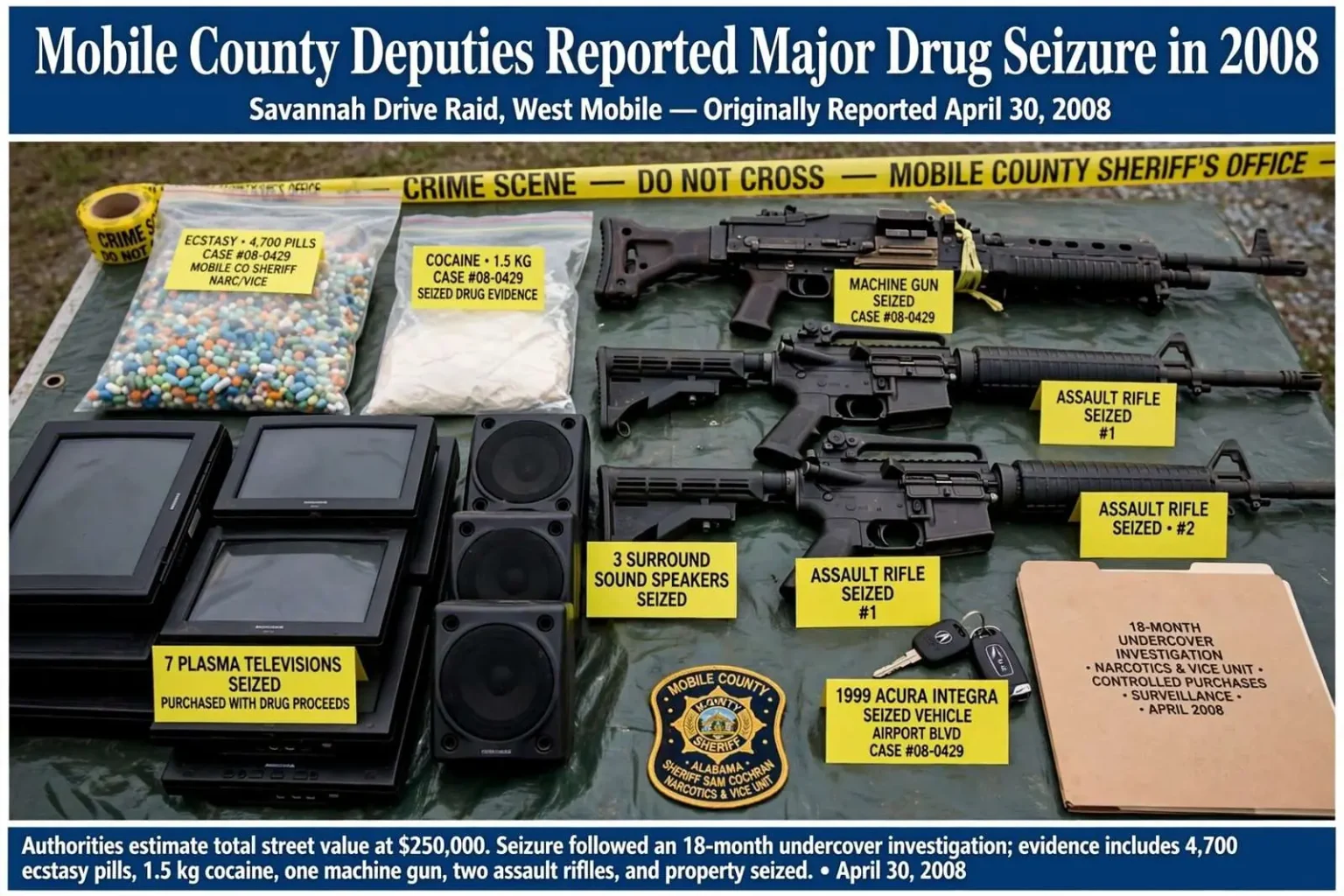
According to the report, members of the sheriff’s office narcotics and vice unit seized more than 4,700 Ecstasy pills, about 1.5 kilograms of cocaine, a machine gun and two military-style assault rifles from the West Mobile residence. Authorities valued the drugs at $250,000, a figure that put the case in the category of significant regional seizures rather than routine street-level arrests.
The volume of Ecstasy alone made the case unusual for Mobile County in 2008. The drug, popular in club settings, typically arrived in the region through distribution networks based in larger cities, and finding thousands of pills in a residential neighborhood house suggested a supply operation rather than personal use, the kind of stash that feeds sales across multiple jurisdictions.
An 18-Month Investigation
Deputies said the raid followed an 18-month undercover investigation, a timeline that indicates the case began well before the drugs reached the Savannah Drive home. Narcotics investigations of that length typically involve informants, controlled purchases, surveillance and coordination with other agencies, as officers work their way up from street-level contacts toward the people holding the supply.
The narcotics and vice unit that ran the case handles the sheriff’s office’s long-term drug investigations across the county, work that operates largely out of public view until an arrest makes it visible. Units of this kind balance patience against risk: every month of an investigation builds the evidence needed for prosecution, but also extends the time a supply operation continues selling.
They later arrested a 26-year-old man at an Airport Boulevard pool hall and seized a 1999 Acura Integra, according to the report. Airport Boulevard runs the commercial length of the city, and its pool halls and nightlife businesses had long been places where undercover officers made contact with the people they were investigating. The vehicle seizure suggested investigators believed the car was connected to the operation, either used in the trade or bought with its proceeds.
What Deputies Took From the Home
At the home, investigators also took seven plasma televisions and three surround-sound systems that they believed had been purchased with drug proceeds. The detail, flat-screen electronics stacked in a residential living room in 2008, was a signature of the era, when plasma televisions sat at the top of the consumer price range and a stack of them represented months of street-level profit.
Seizing property believed bought with drug money serves two purposes for investigators. It strips assets from the operation, and it provides physical evidence of the scale of the enterprise for prosecutors. Under Alabama’s forfeiture statutes, property connected to drug trafficking can be seized and subject to court proceedings, and items like vehicles and electronics routinely appear on the evidence lists in such cases.
The guns elevated the danger of the case. A machine gun, a weapon capable of automatic fire, and two military-style rifles in a residential home drew particular attention from investigators, since federal law tightly restricts machine gun ownership and prosecutors treat armed drug operations as a distinct tier of offense. The combination of a quarter-million dollars in drugs and automatic weaponry is what prompted the sheriff to describe the seizure as major.
The Charges and Their Limits
The man was charged at the time with trafficking cocaine and trafficking a controlled substance and was released after posting bond. Alabama’s trafficking statutes impose weight thresholds that trigger mandatory minimum sentences, and the quantities involved in the Savannah Drive raid, more than a kilo of cocaine and thousands of pills, fell squarely into trafficking territory rather than simple possession with intent.
These were allegations and charges reported at the time; this archived account does not state the later outcome of the case. Bond release is a routine early step, and the charges as filed in April 2008 represented the beginning of the legal process, not its conclusion. What the raid itself established, and what Sheriff Cochran emphasized in announcing it, was the size of the operation: an 18-month investigation ending in a West Mobile home, a quarter-million dollars in drugs, automatic weapons and the profits of the trade stacked in televisions and sound systems.
The case fit a pattern the sheriff’s office has pursued across its modern history: long investigations aimed at supply rather than sales, announced with the evidence laid out for the public to see.
Sam Cochran and the Sheriff’s Office in 2008
Sam Cochran served as Mobile County’s sheriff through this period, leading an office responsible for patrol, investigations and jail operations across Alabama’s second-most-populous county. Drug enforcement held a prominent place in the office’s public profile, and the sheriff regularly presented major seizures in person, walking reporters through the evidence, the weapons, the drugs, the cash and the vehicles, to show what an investigation had produced.
The narcotics and vice unit’s caseload in that era spanned cocaine, marijuana, methamphetamine and the club drugs moving through the region’s nightlife. Each drug carried its own distribution pattern, and Ecstasy, the drug at the center of the Savannah Drive case, was tied to networks that pressed pills in other states and moved them south for sale in clubs and parties. A seizure of more than 4,700 pills meant an operation with wholesale supply, and investigators typically follow such cases with an eye toward the sources rather than only the sellers.
West Mobile and the Neighborhood Context
Savannah Drive sits in the residential fabric of West Mobile, an area of subdivisions, schools and commercial corridors that grew rapidly through the late twentieth century. A drug operation inside an ordinary neighborhood house is the scenario deputies describe as among the most dangerous to find, both because it puts armed trafficking next to families and because residential rentals give operations cover that a commercial location cannot.
Raid planning reflects that risk. Units serving a search warrant on a house suspected of holding drugs and automatic weapons stage carefully, account for who may be inside and coordinate medical staging in case of gunfire. The presence of a machine gun in the Savannah Drive home meant the raid carried stakes well beyond a typical search warrant, and its execution without reported injuries was itself part of the operation’s success.
How Drug Cases Move After the Raid
Once the evidence is seized, the case passes to prosecutors, who weigh the quantities, the weapons and the investigative record when deciding what charges to pursue and how to resolve them. Weapons found in drug operations can add federal exposure, since gun crimes connected to drug trafficking fall under federal statutes that prosecutors in the Southern District of Alabama routinely take up. The 18 months of undercover work that preceded the raid typically generate recordings and controlled buys that give prosecutors leverage well beyond the seizure itself.
The seized pills, cocaine, firearms and electronics become evidence, held and documented until the case concludes, and the forfeiture process for the car and the household items runs on its own track through the courts. The man arrested at the Airport Boulevard pool hall faced the trafficking charges as the case moved forward, with bond conditions in place after his release.
These were allegations and charges reported at the time; this archived account does not state the later outcome of the case.
The Anatomy of an Undercover Investigation
The 18 months that preceded the Savannah Drive raid represent the standard arc of a long-term narcotics case. Investigators begin with low-level information, a tip, an informant, an arrest that points upward, and spend months building a picture of who supplies whom. Controlled purchases, in which an undercover officer or informant buys marked money’s worth of drugs under supervision, document the trade and identify the sellers. Surveillance ties locations together, showing where product is stored and how it moves.
The decision of when to raid is a balance. Raid too early and the case stops at the buyer level; wait too long and the operation may relocate or arm itself further. In the Savannah Drive case, the payoff of patience was evident in the haul: thousands of pills, bulk cocaine and automatic weapons that would never have surfaced in a street-level arrest. The seizure of the Acura Integra and the household electronics added the financial dimension that lets prosecutors describe the case as an enterprise rather than a series of transactions.
Multi-agency cooperation runs underneath cases like this one. Municipal drug units, the sheriff’s office, federal partners and the district attorney’s office share intelligence on the networks moving product through Mobile, and a raid in one jurisdiction often draws on surveillance conducted in another. The courthouse outcome of a trafficking case begins with that coordination long before the first officer approaches the door.
Ecstasy’s Era on the Gulf Coast
The seizure’s composition tells its own story about 2008. Cocaine had long been the volume drug of South Alabama’s trade, but Ecstasy, MDMA pressed into pill form, had become the growth market of the club scene, carried up the coast from distributors in Florida and beyond. Pills sold individually at prices that made a 4,700-pill stash worth a significant share of the quarter-million-dollar valuation authorities placed on the drugs seized.
Law enforcement responses to that market emphasized the pills’ deceptive strength and the health risks of unregulated dosing, warnings that anticipated later concerns as the pill market evolved. For the sheriff’s office, a seizure of that size interrupted the supply not just for Mobile but for the surrounding counties whose buyers sourced through the city, one reason agencies value these cases beyond the local street impact.
The archived report of the Savannah Drive raid preserves a snapshot of that enforcement landscape: a West Mobile home, an 18-month investigation, a quarter-million dollars in drugs and weapons, an arrest across town at an Airport Boulevard pool hall, and a sheriff presenting the results as a measure of the office’s reach into the county’s drug trade. The case’s later outcome belongs to the court record this archived account does not attempt to reconstruct.