Mobile County Approves $801K Contract for Jon Archer Agri-Ed Pavilion Equestrian Upgrades
Mobile County approved an $801,000 contract to add a second horse arena, new parking and gated access at the Jon Archer Agri-Ed Pavilion.
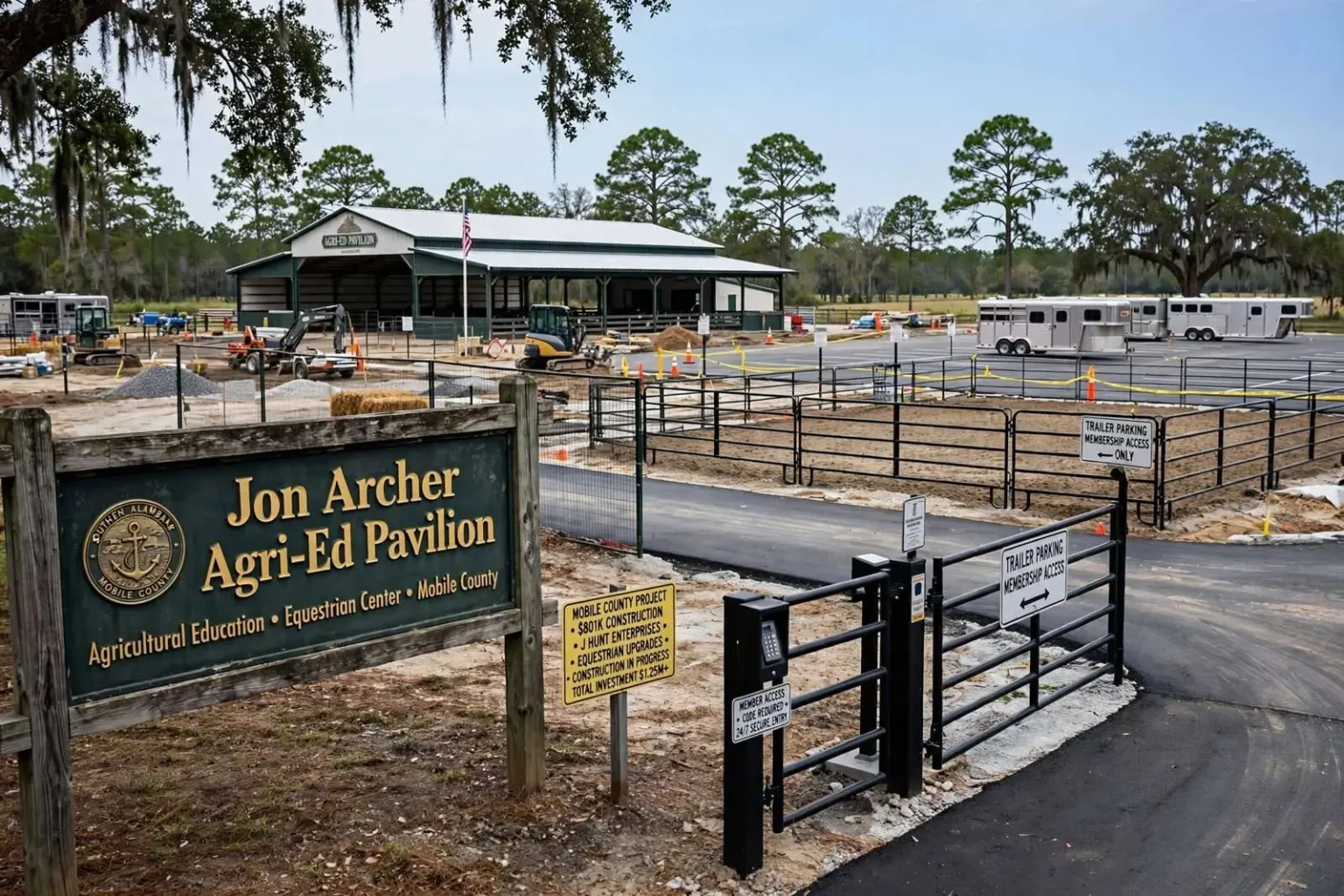
Mobile County commissioners have authorized an $801,000 construction contract for improvements at the Jon Archer Agri-Ed Pavilion, awarding the work to J Hunt Enterprises. Commissioners also approved nearly $450,000 for related capital improvements and design services, bringing the total investment in the project to well over a million dollars.
The project will add a second outdoor horse arena to the facility, construct a new parking area, install an access drive, create dedicated trailer parking, and add new fencing with coded automatic gates. The gated system is intended to support a membership program offering controlled facility access — a structure that lets regular users come and go for riding and training without requiring a staffed gate, while keeping the facility secure when it is not in use.
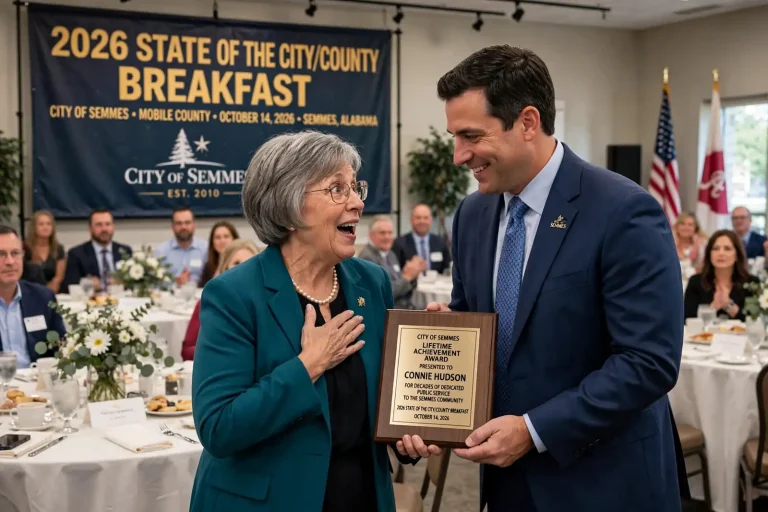
County Commissioner Connie Hudson said the upgrades respond to long-standing demand from the area’s equestrian community. “We have quite a large community of equestrians in the Mobile area. The facilities have been lacking,” Hudson said, adding that the project is meant to give residents a shared amenity. “The whole point of this is for the community to have an asset they can use and enjoy.”
Local equestrians had pushed for facility upgrades for some time to bring the pavilion in line with contemporary needs. The demand Hudson described reflects the shape of horse ownership in Mobile County: a large, dispersed community of riders — from 4-H families to show competitors to recreational trail riders — with few public facilities designed for their use. Private boarding barns serve those who can pay for them, but a public arena with trailer access has been the missing piece.
What the Project Adds
The second outdoor arena is the centerpiece. Outdoor arenas are the workhorse spaces of equestrian sport — used daily for schooling and training, and for the shows, clinics, and competitions that bring spectators and entries to a facility. A second arena allows the pavilion to run events and keep the other space available for practice, which is the difference between a facility that hosts an occasional show and one that serves the community year-round.
The supporting infrastructure matters as much to daily users. A new parking area and access drive handle the vehicle traffic an equestrian event generates, and dedicated trailer parking addresses the single most common complaint at multi-use facilities — horse trailers competing with passenger cars for spaces that were never designed for them. Trailers need wide turning radii and room to park without unhooking, and building that in from the start avoids the conflicts that plague improvised setups.
The coded automatic gates introduce a management model the pavilion has not had. Membership-based access systems are common at well-run public equestrian facilities: riders pay a modest annual fee, receive a gate code, and use the arenas during open hours. The model pays for maintenance through the membership rolls, deters after-hours misuse, and gives the county a usage record it has never had for the site.
How the Project Is Funded
The project is funded using American Rescue Plan Act dollars. ARPA, the federal relief package enacted in 2021, gave counties across Alabama broad latitude to invest in qualifying public projects, and Mobile County has directed its allocation toward infrastructure and community assets. Using one-time federal money for capital construction is a deliberate choice — it builds a durable asset without drawing on the county’s operating budget or requiring a bond issue.
The Jon Archer Agri-Ed Pavilion carries the name of the former Mobile County Commission chairman and has long served as the county’s flagship agricultural venue — a facility built for the stock shows, rodeos, horse events, and 4-H and FFA gatherings that anchor the agricultural tradition of south Alabama. The agri-ed mission — agricultural education alongside public events — is what distinguishes the pavilion from a private arena, and the county’s investment is in that public role.
The construction contract with J Hunt Enterprises covers the arena, parking, drive, trailer lot, and fencing work. County construction contracts of this size are competitively bid, with the commission awarding to the responsive bidder and the project moving on the contractor’s schedule. Design services and related capital improvements, funded in the companion appropriation of nearly $450,000, cover the engineering and site work that precede and surround the visible construction.
The Commission’s Role and Hudson’s Advocacy
Mobile County is governed by a three-member commission, and commissioner districts give each member a portfolio of community projects. Connie Hudson’s advocacy for the pavilion reflects the equestrian community’s footprint in her district and across the county — an organized constituency of riders, trainers, and show families who have made their case to the county for years.
“The whole point of this is for the community to have an asset they can use and enjoy,” Hudson said — language that frames the pavilion as public infrastructure rather than a specialized venue. Counties invest in ball fields, boat ramps, and community centers on the same theory: a shared amenity that residents could not build for themselves, maintained at public expense and open to the public that funded it.
The membership component puts a practical limit on that openness without closing the facility. By reserving controlled access for members while keeping events open to the general public, the county gets the best of both models — daily availability for the riders who sustain the place, and public shows and exhibitions that remain the pavilion’s civic face.
What It Means for Mobile’s Equestrian Community
For the riders who pressed for the upgrades, the new construction answers a long wishlist. A second arena means show days no longer shut out daily training; trailer parking means hauling in from across the county no longer means a parking hunt; and the coded gates mean a member can ride at daylight without arranging staff access. Facilities of this kind, once built, tend to anchor a regional calendar — clinics, series shows, and youth programs that had driven past Mobile for lack of a venue now have a home.
The youth side of the agri-ed mission stands to benefit most directly. 4-H and FFA horse programs across Mobile County depend on public facilities for their shows and qualifying events, and the pavilion’s expansion gives those programs room to grow alongside the private users. Agricultural education at the school level has contracted across Alabama over the decades, which makes the county’s public agri-ed facilities more, not less, important to the families who still raise and show livestock.
Construction will proceed on the county’s schedule, with the commission’s contract award setting the project in motion. When the work is complete, Mobile County will operate one of the more complete public equestrian complexes on the Gulf Coast — two outdoor arenas, purpose-built parking and trailer access, and a controlled-access system funded by federal relief dollars and championed by a commissioner who took the equestrian community’s word for what was lacking.
The pavilion project also fits into the wider economics of equestrian events on the Gulf Coast. Shows and rodeos bring spending that lands in the host community — hay and shavings, feed stores, motels, restaurants, and farriers — and counties that invest in equine facilities do so partly to capture that traffic. A second arena extends the event capacity of the pavilion and keeps Mobile County in the running for shows that currently book in facilities farther along the coast or inland.
ARPA’s role in the funding deserves a note on timing. Federal relief dollars came with deadlines for counties to commit them to qualifying uses, which accelerated capital decisions across Alabama. Projects that might have waited years for inclusion in a bond package or a budget cycle moved forward on the federal clock — and the pavilion’s expansion, like many county projects of its vintage, is the product of that window.
The contract award to J Hunt Enterprises also keeps the spending local to the region’s construction economy. Site work, arena construction, fencing, and paving are the trades that a project of this scope employs, and the nearly $1.25 million total investment flows through contractors and suppliers in the Mobile area as the work proceeds.
For now, the equestrian community that made its case to the county has its answer on paper: $801,000 for the construction, nearly $450,000 for design and related improvements, a second arena, trailer parking, and coded gates for a membership program. Connie Hudson’s framing of the project — a community asset residents can use and enjoy — will be tested against the finished facility, and the riders who spent years asking for upgrades will be the first to judge whether the pavilion now meets what the county’s large equestrian community has been lacking.
Facility advocates point out that the demand shows up in the county’s own event logs. Equestrian groups have long organized around whatever public space was available, and the pavilion’s existing arena has carried a calendar that outgrew its single-space design. The expansion converts that scarcity into scheduling — two arenas to divide between events and daily use — and the membership gates give the county a way to manage the added traffic it is inviting.
Commission approval also signals continuity for the agri-ed mission the facility was named to carry. The pavilion hosts the stock shows and youth exhibitions that connect south Alabama’s urban population to the region’s agricultural roots, and every upgrade to the complex extends the life of that mission. Jon Archer’s name on the facility reflects a county that has historically treated agricultural education as public infrastructure — and the equestrian expansion is the newest chapter of that commitment, funded by federal dollars and built by a local contractor.