Mobile County Overdose ER Visits Fall 27% as Opioid Cases Tick Up, Health Department Says
Mobile County overdose-related ER visits fell 27% and 911 runs fell 17% from a year earlier, but opioid-related visits rose 18%, prompting a health department reminder to keep naloxone handy.
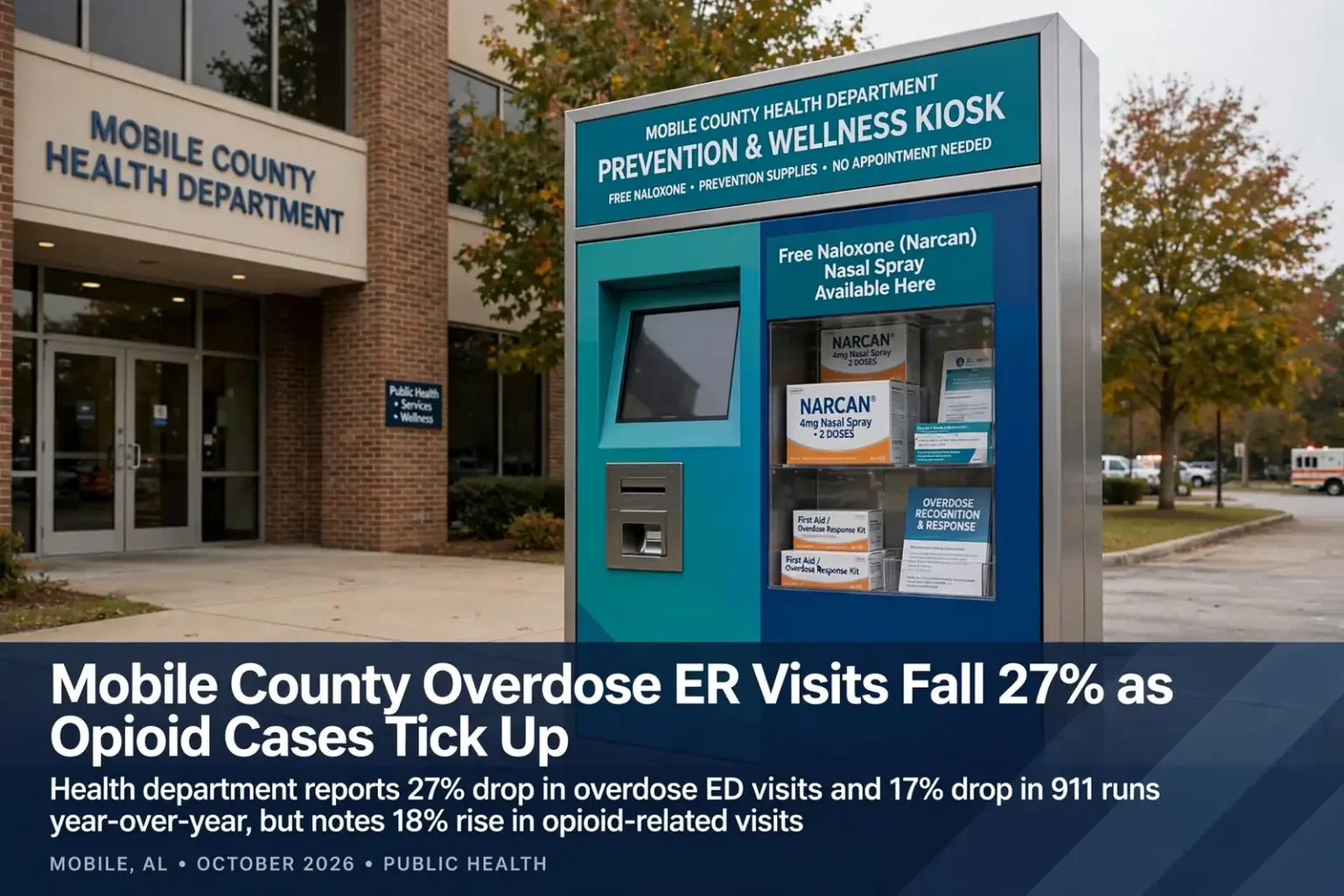
MOBILE, Ala. — Mobile County overdose indicators improved in September compared with a year earlier, but health officials say a rise in opioid-related visits is a reminder that the progress needs protecting. The Mobile County Health Department’s latest Overdose Surveillance report shows a 27% drop in overdose-related emergency department visits and a 17% drop in overdose-related 911 runs from September 2025 to September 2026.
The health department’s message is one of progress without complacency. Fewer overdose visits and calls are encouraging, officials said, but continued vigilance is needed to hold onto those gains.
What the September report shows
The monthly surveillance report tracks two main signals of overdose activity in the county: emergency department visits related to overdoses at the care centers the health department monitors, and 911 calls related to overdoses.
- Overdose-related emergency department visits: down 27% from September 2025
- Overdose-related 911 runs: down 17% from September 2025
- Overall visits and calls, month to month: mostly unchanged from August 2026
- Overdose visits caused by opioids: up 18%
The report does not measure overdose deaths. Instead, it shows how often overdoses are bringing people to emergency rooms and prompting calls for help, which makes it an early indicator of trends in the community. The health department said the numbers show a continued need for intervention even as some indicators improve, pointing in particular to the 18% increase in opioid-related overdose visits.
Why opioids remain the focus
Opioids include prescription pain medicines such as oxycodone and hydrocodone, as well as heroin and illicitly made fentanyl. Fentanyl is a powerful synthetic opioid, and it has driven a large share of overdose deaths nationwide in recent years. It is sometimes mixed into other drugs or pressed into counterfeit pills, so people may be exposed without knowing it.
An opioid overdose slows or stops a person’s breathing. Without help, lack of oxygen can lead to brain damage or death within minutes, which is why public health agencies stress quick action by whoever is on the scene.
Naloxone: what it is and how to use it
Naloxone, known by the brand name Narcan, is a medication that temporarily reverses the effects of an opioid overdose and restores breathing. The nasal spray form is designed for use by people without medical training, and the U.S. Food and Drug Administration approved naloxone nasal spray for over-the-counter sale in 2023, so no prescription is needed.
The health department’s guidance for anyone who suspects an overdose:
- Call 911 immediately and give naloxone if it is available, following the product instructions. Tell the dispatcher where you are and whether the person is unresponsive or not breathing normally.
- Do not wait for naloxone to work before giving needed breathing support. Follow the dispatcher’s instructions for rescue breathing or CPR.
- Give another dose according to the product instructions if normal breathing does not return within two to three minutes.
- Stay with the person until emergency responders arrive. If the person is breathing on their own, place them on their side to help prevent choking.
- Get medical evaluation even if the person wakes up or seems to recover. Naloxone’s effects are temporary, and overdose symptoms can return.
Naloxone works only on opioid overdoses, but it will not harm someone who is having a non-opioid overdose. The health department’s advice: when in doubt, use it.
Signs of an opioid overdose
Common signs that someone may be overdosing on opioids include:
- Unresponsiveness or inability to wake up
- Slow, shallow or stopped breathing
- Choking or gurgling sounds
- Very small, pinpoint pupils
- Pale, blue or gray lips, skin or fingernails
Free naloxone from county kiosks
The health department provides free naloxone at its Prevention and Wellness Kiosks located throughout Mobile County. Residents can pick up naloxone and other prevention supplies without an appointment.
Mobile County launched the kiosks in November 2024 as Alabama’s first program of its kind. As South AL News has reported, the kiosks had dispensed 692 items as of August 2026, including 377 two-dose naloxone packages. First-year data showed the most common reason people gave for taking naloxone was to be ready to help someone else.
Naloxone is also sold over the counter at pharmacies.
Recent prevention efforts
The September report follows a busy stretch for overdose prevention in the county. On National Save A Life Day, Sept. 24, the health department handed out 164 boxes of naloxone nasal spray, or 328 individual doses, and the peer-run nonprofit People Engaged in Recovery, known as PEIR, distributed naloxone across Mobile, Baldwin and Washington counties.
Earlier surveillance data showed why that work continues. In July 2026, Mobile County recorded 146 suspected overdose-related 911 runs, and 19 naloxone administrations were reported, according to the health department.
Progress worth protecting
Health officials stressed that the year-over-year improvement is meaningful, but they said September’s report is not a signal to put naloxone away or hesitate to call for help. Residents can support overdose preparedness by keeping naloxone accessible at home, in the car or in a bag, and by learning how to use it before an emergency happens.
The health department also noted that surviving an overdose can create an opportunity to connect with treatment, recovery support and continued care. “Every timely response matters,” the department said in its report.
For families, that can mean having a conversation about naloxone the same way they might talk about a fire extinguisher or a first aid kit: something to keep on hand and know how to use, in case it is ever needed.
Where to get help
- Emergencies: If you suspect an overdose, call 911, give naloxone if available and stay with the person until help arrives.
- MCHD Overdose Prevention Program: 251-410-6322 or [email protected]
- People Engaged in Recovery (PEIR): 844-307-1760, available 24/7
- SAMHSA National Helpline: 1-800-662-4357, free and confidential, 24 hours a day
- 988 Suicide and Crisis Lifeline: call or text 988 for mental health or substance use crises
- Free naloxone: MCHD Prevention and Wellness Kiosks around Mobile County, or over the counter at pharmacies