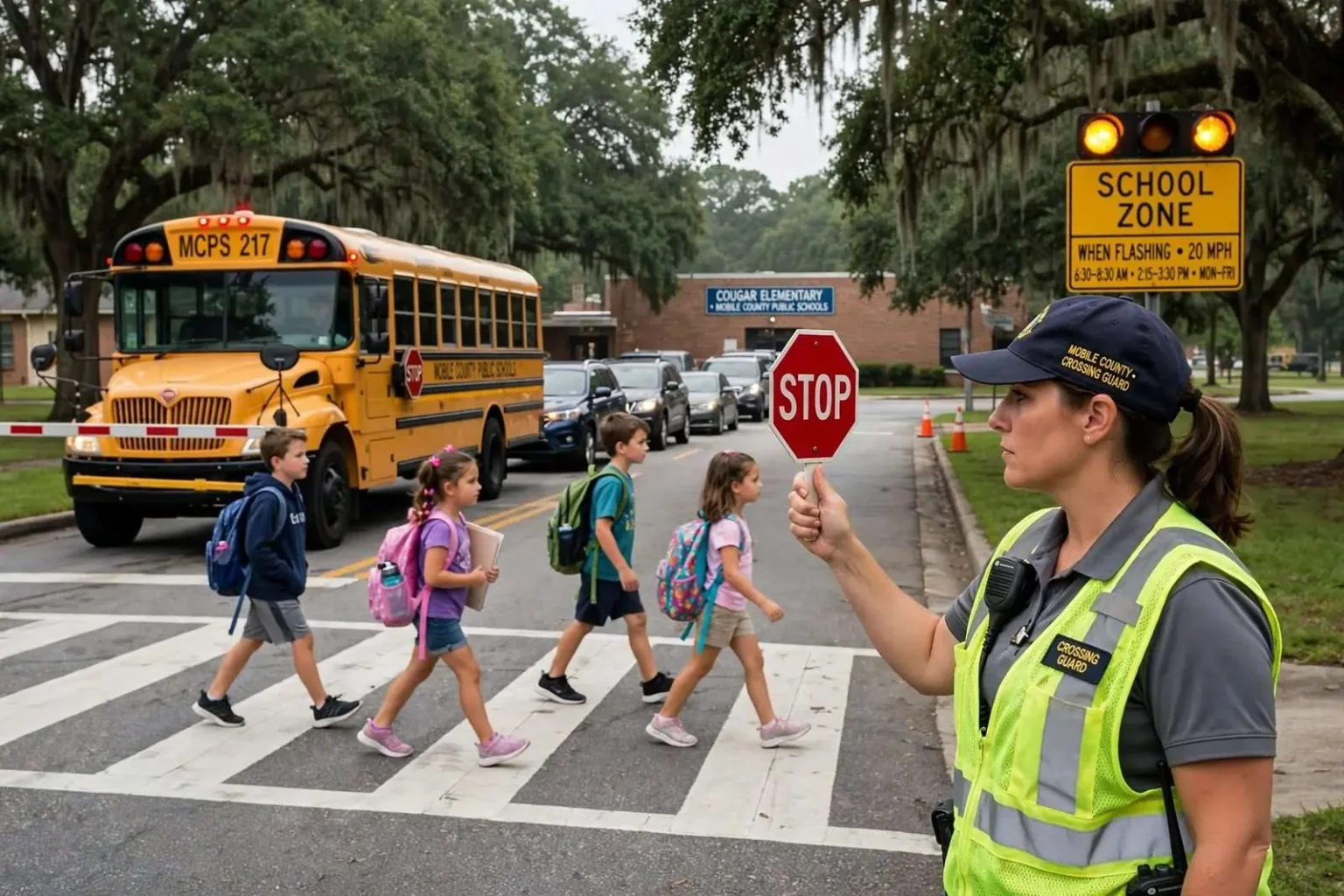
Drivers across Mobile County should brace for slower commutes starting Monday as more than 50 schools in the Mobile County Public School System — the largest school system in Alabama — reopen for the 2026-27 school year.
Mobile Police Department resource officer supervisor Amanda Lutman, who oversees staffing of school resource officers and crossing guards, said the first day back is typically the toughest on local roads.
“On that first day of school, traffic will be backed up over pretty much the whole city of Mobile,” Lutman said.
The scale of the system explains the congestion. With more than 50 schools spread across the city and the county — elementary, middle and high schools whose start and dismissal times overlap with the morning and evening commute — the return of classes adds thousands of school buses, parent drop-offs and teen drivers to roadways that already carry the daily load. Routes near campuses that are quiet in July turn into slow-moving lines in August, and drivers who have not adjusted their routines in months are often the ones most surprised by it.
Crossing Guards on the Front Lines
Crossing guards will be stationed at schools throughout the county to direct traffic, help children safely cross streets and make sure students get where they’re going without incident, Lutman said.
“We’re in charge of your little ones, and we just want them to get to and from school as safely as possible,” she said.
The guards’ work is easy to overlook until it is missing. Standing at intersections and crosswalks in the early morning heat and afternoon storms, they stop traffic, wave lines of students across and keep drivers honest at the moments of highest risk in a child’s commute. In Mobile’s summer weather, that means hours outdoors in temperatures and humidity that most jobs would call weather emergencies — work that police officials describe as essential to making walking to school viable for families without transportation.
Lutman urged drivers to slow down and stay off their phones as school zones become active again.
“Watch your speed, please. Put your phones down. Be aware and watch for the school zones,” she said.
When the Zones Are Active
Flashing lights will alert drivers to upcoming school zones and reduced speed limits. Most school zones in the county will be active from 6:30 to 8:30 a.m. and 2:15 to 3:30 p.m., Lutman said, and she encouraged commuters to plan accordingly.
Those windows matter for anyone who drives in Mobile on weekdays. The morning zone overlaps with the peak of the commute, which is why so many drivers feel the school year arrive at once; the afternoon window catches the early end of the evening rush. Speed limits in active school zones drop sharply, and Alabama law treats speeding in an active zone as an offense with enhanced penalties — but the enforcement that matters most, officers say, is simply drivers expecting the slowdown and building it into their plans.
“You’re going to think five minutes is enough. Leave 10 to 15 minutes early,” she said.
Tips for Parents and Students
Lutman also had guidance for families dropping children off or walking to class. Children should always cross at the designated crosswalk and follow the crossing guard’s instructions rather than darting across the street.
“Make sure your children know to walk across the school crosswalk, listen to the crossing guard. We never want students to run across the road,” she said. “Let’s have our heads on a swivel.”
Parents dropping off children by car should pull past the crosswalk rather than releasing kids into the roadway. The instruction sounds small, but it addresses one of the most common hazards at school drop-off lines: a child stepping out of a car directly into a crosswalk, or crossing between vehicles where oncoming drivers cannot see them. Dropping students on the school side of the street, waiting for the line to move rather than stopping mid-lane, and letting children exit on the curb side all cut the risks that come with a crowded curb.
For student walkers, the fundamentals repeat every year because they keep working: use the crosswalk every time, wait for the guard’s signal, look both ways even in a marked crossing, and put the phone away while walking. Drivers, for their part, should treat every crosswalk near a school as occupied until proven otherwise — children are smaller, less predictable and harder to see than adult pedestrians, especially in the early-morning light of the school year’s first weeks.
The First Week Sets the Pattern
Police and school officials say the first days of the year are the roughest for traffic, and the pattern typically eases as families settle into routines. Drop-off lines that take twenty minutes on day one often run half that by the second week as parents learn the flow, figure out arrival timing and stop arriving all at once at the same entrance.
But the hazards do not disappear with the routine. Younger students who are new to a campus, kindergartners walking to school for the first time and teens driving themselves for the first time all concentrate in the opening weeks, which is why officers urge experienced commuters to treat the whole first month as a school-zone month and stay alert even outside the flashing-light windows.
Bus riders add another layer. Motorists are required to stop for school buses loading and unloading students, watching for the flashing red lights and extended stop arms that signal children crossing the road. On multi-lane roads, traffic in both directions must stop for a bus on the roadway — a rule that catches unfamiliar drivers every fall and that officers emphasize as classes resume.
What Drivers Should Remember
The reminders from the Police Department distill to a short list. Slow down in school zones and obey the reduced limits when lights are flashing. Put the phone down — Alabama law bars texting while driving, and a school zone is the last place a driver’s eyes belong on a screen. Leave 10 to 15 minutes early during the morning window. Watch for crossing guards and obey their signals, which carry the force of traffic direction. Stop for school buses, and never pass one with its red lights flashing.
Behind each rule is the same goal Lutman described: getting the county’s students to school and back home safely, on roads shared with tens of thousands of commuters who are adjusting, all at once, to the rhythm of the school year. With more than 50 campuses reopening Monday, Mobile County’s roads will tell the story of how well the region learned last year’s lessons.
The Scale of the Challenge in Mobile County
Coordinating safety for a district the size of Mobile County Public Schools is a logistical undertaking few systems in the state face. As Alabama’s largest school system, it serves students across the city of Mobile, the surrounding suburbs and the county’s more rural stretches, meaning traffic conditions vary enormously from a downtown campus surrounded by four-lane traffic to a neighborhood school where a single residential street becomes a sea of cars at 7:30 a.m.
Staffing reflects that variation. School resource officers are assigned to campuses based on need, and crossing guard posts are concentrated where student walkers meet the busiest roads. Every school year begins with a review of those assignments, and the department adjusts in the opening weeks as real-world traffic patterns reveal where the pressure points are.
The district’s bus fleet adds its own rhythm to county roads. Dozens of routes converge on campuses within a narrow window each morning, and a single late bus can back up a drop-off line for blocks. Drivers who share the road with buses — stopping when required, giving them room to merge, expecting frequent stops in school areas — do as much for the first week’s safety as any other single habit.
Why Distracted Driving Is the Top Concern
Lutman’s emphasis on phones reflects the reality officers see at school zones: drivers moving through familiar neighborhoods on autopilot, glancing at screens just as a child steps toward a crosswalk. The combination of reduced speed limits, heavy pedestrian traffic and driver inattention is what makes school zones the focus of stepped-up enforcement every fall.
Alabama’s texting-while-driving ban gives officers a tool, but education is the first line of defense. A driver who expects a school zone, leaves early enough to absorb the delay and keeps eyes forward through the flashing-light windows is, in practice, the outcome all the warnings are aimed at producing. Officers note that the habit matters beyond the zone boundaries too — children walk, bike and wait for buses well beyond the marked zones themselves.
The department’s message to the community pairs patience with vigilance. The back-to-school slowdown is temporary, predictable and manageable for any driver who plans for it. The danger is not the delay itself but the frustration that leads drivers to speed through zones, roll through crosswalks or pass buses — choices that put the county’s youngest residents at risk for the sake of a minute or two.
A Community Responsibility
Getting students safely through the school year’s start is shared work. Parents rehearse the walking route with children, drivers adjust their commutes, guards stand at their posts, resource officers watch the campuses, and the school system coordinates the schedules that bring it all together. When each part holds, more than 50 schools open Monday the way every community hopes its schools open — busy, loud and safe.