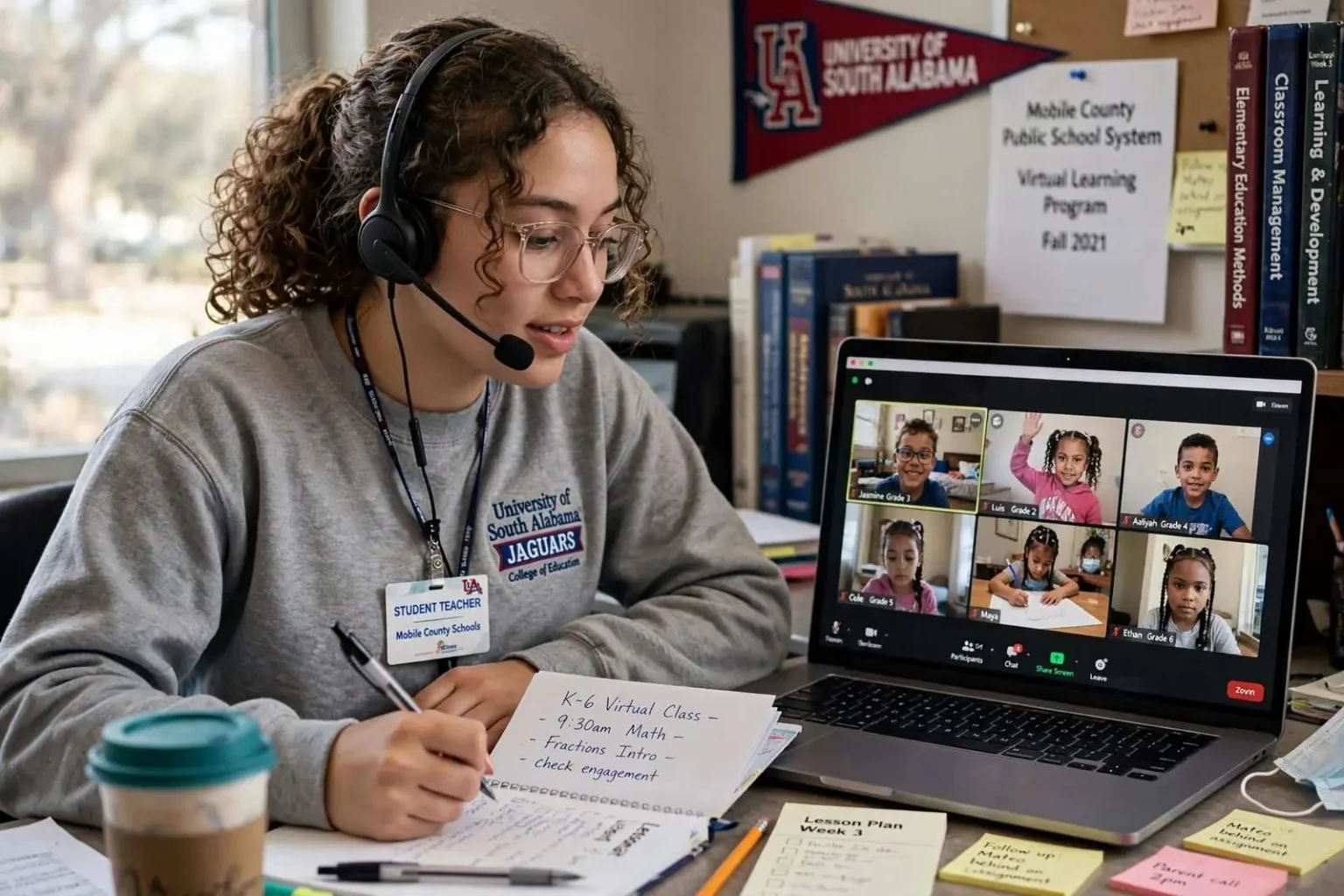
When a wave of COVID-19 cases left the Mobile County Public School System short on teachers just as the 2021 school year began, district officials landed on an unusual solution: putting college students in charge of virtual classrooms. The arrangement, born of necessity during one of the most disruptive stretches of the pandemic, gave the state’s largest school system a way to keep a remote learning option alive when certified teachers were stretched thin across brick-and-mortar campuses.
The district recruited roughly a dozen education students from the University of South Alabama to lead online classes for students in kindergarten through sixth grade. Each of the student teachers was paid for the work and remained under the supervision of a certified teacher, according to the school system. The structure meant that while the college students ran daily lessons and managed the virtual classrooms, experienced educators kept oversight of instruction, grading standards and any issues that arose with students or parents.
Rena Phillips, the district’s director of communications, said the participants had already been flagged by the university and their placement schools as standout candidates.
“They have been identified by South and also at the schools that they worked at last year to be rising stars and people that we want to hire full time,” Phillips said.
The selection process gave district officials a measure of confidence in an arrangement that, on paper, asked a great deal of young educators. Rather than pulling from the general student population, the district drew from a pool that university faculty and host schools had already vetted through coursework and classroom placements.
Why the District Needed a Virtual Option
The program grew out of a survey sent to Mobile County parents asking whether they wanted a remote learning choice during the pandemic surge. The response made clear that demand existed, and the district moved quickly to stand up a virtual track before the first day of school. Families cited a range of reasons for preferring remote instruction, from medically vulnerable household members to anxieties about case counts in crowded school buildings.
Standing up that track in a district the size of Mobile County’s was a logistical undertaking. The system serves tens of thousands of students across more than 90 schools spread from inner-city Mobile neighborhoods to communities like Satsuma, Citronelle and Grand Bay, and its teacher workforce was already strained by the same pandemic pressures felt by districts nationwide — quarantines, resignations and a shortage of substitutes that left classrooms uncovered.
Phillips described the virtual school as self-paced, with lessons delivered online and staff monitoring progress closely. Students who fell behind were slated to receive extra intervention, tutoring, and individual support rather than being left to drift. The model differed from the emergency remote teaching of the previous spring, when districts statewide scrambled to deliver instruction over video with little preparation, and was instead designed as a durable option families could rely on for a full term.
A Creative Answer to a Stubborn Problem
The arrangement gave aspiring teachers hands-on classroom experience months before they would have received it through a traditional student-teaching placement, while giving the district staffing flexibility it badly needed. For the college students, the work meant running real classes with real students, answering to parents and learning classroom management under conditions more demanding than any simulated exercise in a university methods course.
District leaders framed the effort as a way to identify future full-time hires early — students who proved themselves in the virtual classrooms were seen as strong candidates for permanent positions once they completed their certification. The pipeline logic was straightforward: Mobile County, like districts across Alabama, had struggled for years to fill every teaching vacancy, particularly in elementary education and in harder-to-staff subjects, and early exposure to promising candidates created a recruitment advantage no job fair could match.
The University of South Alabama’s College of Education has long been the primary training ground for teachers entering Mobile County classrooms, and its students complete placements in district schools throughout their programs. The virtual arrangement extended that partnership in an improvised direction, letting the district borrow capacity from the university at the precise moment it needed it most, while giving the university’s students paid work directly relevant to their degrees.
The Broader Teacher Shortage Behind the Decision
The staffing squeeze that produced the program was not unique to Mobile County. School systems across Alabama entered the 2021-22 year confronting a teacher shortage that state education leaders described as among the worst in recent memory, driven by pandemic-era retirements, burnout among existing faculty and a declining pipeline of new certified teachers entering the profession. Rural and urban districts alike reported unfilled positions weeks into the school year.
Alabama’s state department of education had responded with initiatives aimed at expanding the teaching pipeline, including scholarships through the Alabama State Aid to Institutions of Higher Education program and grow-your-own models that encourage high school students to pursue education careers. But those pipelines produce teachers on a multi-year timeline, and the delta variant surge that hit the Gulf Coast in the late summer of 2021 created needs measured in weeks, not years.
Against that backdrop, the Mobile County approach stood out for its speed and its candor about the trade-off involved. District officials did not pretend the college students were replacements for certified teachers; the supervision requirement, the paid status of the student teachers and the self-paced design of the virtual school were all acknowledgments that the arrangement was a stopgap — albeit one with the side benefit of cultivating the district’s next generation of hires.
How Virtual Learning Worked in the District
The virtual track enrolled students whose families opted in through the district’s survey process, and it operated alongside the traditional in-person schedule rather than in place of it. Lessons were delivered online, and the student teachers led the daily sessions while certified supervising teachers monitored delivery, stepped in on individual student needs, and handled the evaluative responsibilities that state certification rules reserve for licensed educators.
Progress monitoring was central to the design. Because virtual students were not physically present for teachers to observe, staff tracked engagement, assignment completion and assessment results, flagging students whose work suggested they were falling behind. The intervention and tutoring plan for those students reflected lessons districts learned during the pandemic’s first year, when students in remote settings who received no individual follow-up often lost substantial academic ground.
For younger students in particular — the kindergarten through sixth grade span the program covered — virtual learning placed real demands on families, who had to supervise schedules and technology at home. The district’s outreach to parents through the survey and its emphasis on support services were attempts to account for that reality rather than simply replicating a classroom schedule on a screen.
What the Student Teachers Gained
For the University of South Alabama students, the program compressed years of professional development into a single semester of real experience. Leading an online classroom requires a distinct skill set from in-person teaching — managing digital platforms, holding attention through a screen, communicating with parents by email and phone — and the student teachers who worked through those challenges were learning tools that would remain part of the profession long after the pandemic receded.
The paid structure also mattered. Traditional student teaching placements are famously unpaid, requiring candidates to fund themselves through a semester of full-time classroom work. The district’s decision to pay the students for their virtual classroom work removed a barrier that filters out many potential teachers, particularly those from working families, and signaled that the district regarded their contribution as real labor rather than an internship courtesy.
Education researchers have long noted that the quality of a candidate’s early clinical experience is among the strongest predictors of whether they stay in teaching. A semester running a virtual classroom, with supervision and genuine responsibility, offered the kind of immersive experience that often converts a capable student into a confident first-year teacher — which was precisely the outcome district leaders said they hoped for.
The Pandemic’s Lasting Mark on Mobile County Schools
The 2021 school year was the second consecutive year the pandemic upended normal operations for Mobile County’s schools. The district had closed buildings in the spring of 2020, reopened with a mix of remote and in-person options that fall, and endured repeated quarantines as cases moved through campuses. The delta variant surge that preceded the 2021-22 year forced another round of contingency planning, of which the virtual staffing program was one piece.
The experiences of that period left durable changes in how the district operates. Expanded digital platforms, at-home devices and learning management systems adopted during the emergency became standard infrastructure, and the district’s comfort with non-traditional staffing solutions — of which the college student program was the most striking example — grew out of two years of improvisation under pressure.
For the families who chose the virtual track, the program meant their children could continue learning without the exposure concerns that kept them out of buildings, backed by a monitoring system designed to catch struggling students early. For the district, it meant keeping thousands of enrollment decisions inside the system rather than losing families to virtual charter schools or full withdrawal — a competitive consideration that public school systems across Alabama confronted during the pandemic years.
A Model Other Districts Watched
Districts across Alabama and along the Gulf Coast scrambled through the same staffing crisis with varying strategies: consolidated virtual academies staffed centrally, increased class sizes, long-term substitutes and in some cases four-day schedules. The Mobile County approach of deploying vetted college students under certified supervision attracted attention because it addressed the shortage without diluting oversight, and because it doubled as a recruitment pipeline.
Whether the specific arrangement continued after the pandemic faded, its underlying logic persisted. Districts that identify promising teachers before graduation and get them into paid, supervised work early tend to convert them into full-time hires at higher rates, and Mobile County’s leaders said explicitly that the rising stars in the program were people they wanted to hire full time.
The episode also stands as a case study in how public school systems adapted under the pandemic’s worst pressures — not by lowering standards in ways that were visible to students, but by restructuring who did the work and how it was supervised. The dozen college students who led those virtual classrooms in 2021 were, in effect, asked to grow up fast as educators, and the district bet that they would. By its own framing, the bet was on students who had already proven themselves.
Phillips said the district would evaluate the program’s results as the year progressed, with an eye toward both the students’ progress in the virtual track and the performance of the young teachers staffing it.