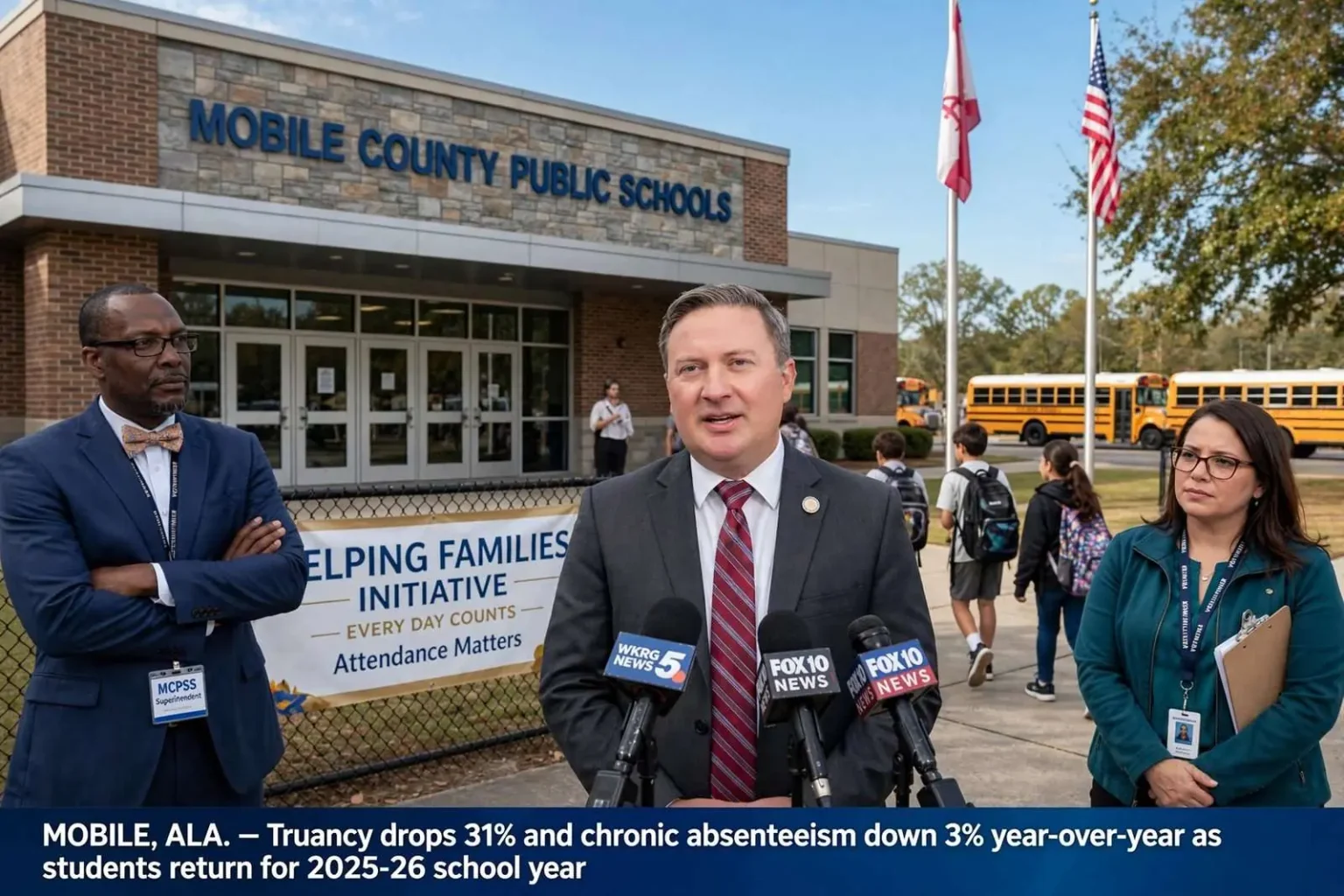
MOBILE, Ala. — As thousands of students across Mobile County return to class for a new school year, District Attorney Keith Blackwood is pointing to a trend line that continues to move in the right direction: fewer students skipping school, and fewer missing class so often that they fall permanently behind. During the 2025-26 school year, Mobile County recorded an additional 31 percent decrease in truancy and a 3 percent decrease in chronic absenteeism compared with the previous school year, according to figures announced by the District Attorney’s Office as campuses reopened.
The latest numbers build on several years of progress since Blackwood reinstated the Helping Families Initiative, a program run out of the District Attorney’s Office that treats chronic absence as a family crisis rather than a criminal one. Since the initiative was brought back, truancy across Mobile County has fallen 66 percent, while chronic absenteeism has dropped 59 percent. Officials describe the two figures as among the clearest available measures of whether early intervention is working, because both are tied directly to the number of instructional days students actually spend in a classroom.
“Those numbers represent thousands of days that students are back where they belong — in the classroom,” Blackwood said. The goal, he said, is to “put them on a path toward success and keep them out of the juvenile justice system.”
A different approach to an old problem
The Helping Families Initiative coordinates efforts between the District Attorney’s Office, local schools and community partners to identify attendance problems early and intervene before issues escalate into the juvenile justice system. Rather than waiting until absenteeism reaches crisis levels, HFI works to identify the underlying barriers that keep children out of the classroom and then connect families with a mix of accountability measures, structured intervention and practical resources.
“Attendance problems rarely begin in a courtroom,” Blackwood said, noting that early intervention offers “an opportunity to change the trajectory of a child’s life.”
That framing reflects a deliberate shift in how the office handles cases that once would have moved straight through the juvenile court system. Under the traditional model, a student who accumulated enough unexcused absences could find themselves referred to a truancy docket, where the remedy was often punitive and rarely addressed the reason the child was missing school in the first place. The Helping Families Initiative instead positions the District Attorney’s Office as a convener — the entity with enough standing to get a family’s attention, and enough connections to route that family toward help.
Truancy versus chronic absenteeism
The two statistics in the latest report measure related but distinct problems. Truancy generally refers to unexcused absences — days a student misses without a valid reason recognized under school policy or state law. Chronic absenteeism is broader: it counts any student who misses a large share of the school year for any reason, excused or unexcused, which is why public health officials and education researchers treat it as a warning sign that reaches beyond discipline and into health, housing and family stability.
Because chronic absenteeism captures excused absences as well, it is typically the harder number to move. A 3 percent year-over-year decline is modest compared with the 31 percent drop in truancy, but officials say both figures matter: a student who is legitimately sick still loses instructional time, and the initiative’s long-term aim is to make sure families have support before a pattern of absence hardens into academic failure.
Why the numbers matter locally
Mobile County Public Schools is the largest school system in Alabama, and its attendance data is watched closely because it spans urban neighborhoods, suburban communities and rural stretches of the county. Attendance patterns in a district of that size tend to mirror the region’s broader challenges — transportation gaps, health care access, economic instability — which is one reason the District Attorney’s Office has emphasized partnership with community organizations rather than prosecution alone.
The office says the multi-year decline shows the model is working, but leaders are quick to note that the start of a school year is when habits are set. Students who fall into an absence pattern in the first weeks are far more likely to still be struggling by spring, which is why the office chose the opening of the school year to publicize the new figures.
What Alabama law requires
Alabama’s compulsory attendance law requires children between the ages of 6 and 17 to be enrolled in and attending school. Parents and guardians are legally responsible for ensuring that happens, and school systems are required to track absences and follow a escalating series of notifications when a student’s unexcused absences pile up. In practice, that means letters home, meetings with school administrators, and — when earlier steps fail — referral to the district attorney’s office or the juvenile court system.
The Helping Families Initiative sits at that last junction. When a school refers a case, the initiative’s staff reviews the circumstances, meets with the family and determines whether the appropriate response is accountability, services or both. Families may be connected to counseling, mentoring, tutoring, health services or assistance with practical obstacles such as transportation. The point, officials say, is to solve the underlying problem before a child becomes a court statistic.
Blackwood has argued that the courtroom should be the last stop, not the first. A child who misses school because of an untreated health condition, a housing disruption or a lack of reliable transportation does not benefit from a delinquency petition, and the community does not benefit either — the underlying absence continues, and the child moves closer to the kind of involvement with the justice system the program exists to prevent.
What happens when attendance slips
Education researchers have documented for decades what classroom teachers see firsthand: attendance is one of the strongest predictors of academic outcomes. Students who miss significant portions of the early grades struggle to master reading, a gap that compounds each year. Chronic absenteeism in middle school is a well-established warning sign for later disengagement, and students who are chronically absent in ninth grade are dramatically less likely to graduate on time.
In Mobile County, school officials have aligned their attendance messaging with the district’s academic priorities, and the District Attorney’s Office has used its platform to reinforce the same point. The message to parents is practical rather than punitive: build routines, schedule appointments outside school hours when possible, communicate with the school when a problem arises, and ask for help early instead of waiting for an official notice.
The community partnership piece
A defining feature of the Helping Families Initiative is that it does not operate in isolation. The program coordinates with schools, courts and community organizations across Mobile County, drawing on faith groups, nonprofits, health providers and volunteer mentors to surround a struggling family with support. That structure reflects a reality district attorneys in the region have acknowledged: no single office can address the causes of chronic absence, which often include poverty, unstable housing, mental health needs and family crisis.
The initiative’s structure also gives schools an alternative to a path they have long found unsatisfying — referring a family to the justice system knowing that a court date alone rarely changes behavior. With a coordinator assessing needs and brokering services, the referral becomes the beginning of a process instead of the end of one.
Keeping the focus on prevention
Officials stress that the program’s design is intentionally front-loaded. The point is to reach a family after the second or third unexcused absence, not after the twentieth. Early contact lets staff distinguish between a family that is indifferent to school and one that is overwhelmed — and those two situations call for very different responses. Accountability remains part of the equation, particularly for cases where parents are unwilling to cooperate, but the default posture is assistance.
That approach, Blackwood has argued, is also the most cost-effective one available to the community. Every student who stays in school and graduates represents a reduced likelihood of future involvement with the criminal justice system, along with the obvious academic and economic benefits to the student and the region’s workforce.
Every Day Counts
As the new school year gets underway, the District Attorney’s Office is encouraging families across the county to prioritize consistent attendance, emphasizing the message that “Every Day Counts.” The slogan captures the arithmetic behind the initiative’s data: in a school year of roughly 180 instructional days, each single absence removes a full day of instruction that the student cannot fully recover, and the losses accumulate quickly once a pattern forms.
Local educators and prosecutors alike note that the first weeks of the school year carry outsized importance. Attendance in the opening month is one of the most reliable predictors of attendance for the rest of the year, because it is when students establish routines and when parents establish the habits of getting children to campus on time. A family that treats the first weeks as negotiable often finds the pattern difficult to reverse by the second semester.
Practical steps for families
Alongside the announcement, the office’s message to households is straightforward. Parents are urged to set consistent bedtimes and morning routines, to schedule medical and dental appointments after school or on breaks whenever possible, and to keep lines of communication open with teachers and administrators when problems arise. Families facing a genuine obstacle — illness, transportation, housing instability, mental health concerns — are encouraged to notify the school early so that resources can be mobilized before absences accumulate.
School officials across the county make the same appeal each August, but the District Attorney’s Office adds a distinctive note: a child who is not in school is not simply missing class, but drifting toward a system no parent wants their child to enter. The initiative exists, in Blackwood’s words, to interrupt that drift while it can still be interrupted.
What the multi-year trend shows
The cumulative numbers are the clearest evidence of the program’s trajectory. A 66 percent reduction in truancy and a 59 percent reduction in chronic absenteeism across multiple school years represents a structural change in how the county handles absence, not a one-year fluctuation. Officials attribute the sustained improvement to the reinstated initiative’s early-intervention model, the cooperation of school leaders, and the willingness of community partners to take referrals from the program.
Still, the office has been careful not to declare victory. Attendance data tends to worsen as students age into high school, where disengagement is harder to reverse, and the COVID-19 era showed how quickly attendance norms can erode when routines are disrupted. Maintaining the current trajectory will require the same coordination between the District Attorney’s Office, schools and community partners that produced it.