Mobile DA Ashley Rich urges victims of clergy abuse to come forward
Mobile County DA Ashley Rich is urging victims of clergy abuse to come forward after the Archdiocese released names of 29 credibly accused priests.
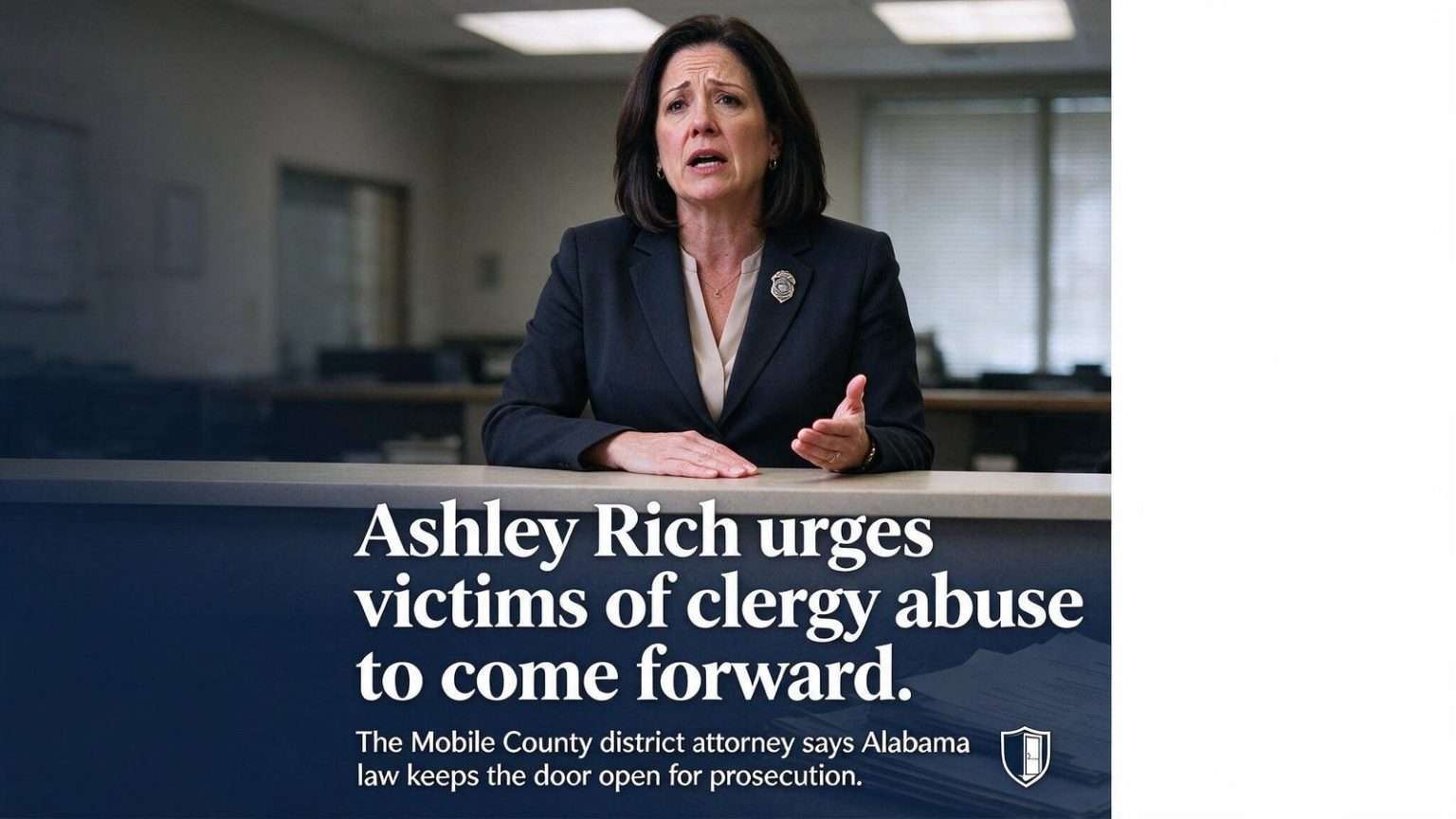
Mobile County District Attorney Ashley Rich is urging victims of priest and clergy abuse to come forward so her office can pursue prosecution, a call that came days after the Archdiocese of Mobile released the names of 29 priests and deacons who have been “credibly accused” of abuse since 1950. The release of names — part of a wave of similar disclosures by Catholic dioceses across the country — placed south Alabama’s archdiocese squarely inside a reckoning that has been unfolding nationally since the early 2000s.
Several of those named in the archdiocese’s list are still living, Rich noted, and that fact drives the urgency in her message. Living accused clergy can still face charges; dead ones cannot. The distinction converts a historical list into a live legal matter, and Rich made clear that her office is prepared to treat it as one, telling victims that the door to prosecution remains open and that her office needs their cooperation to walk through it.
Rich said victims must come forward and ask her office to prosecute, and she is also asking anyone with evidence to contact authorities. The request reflects an uncomfortable arithmetic in clergy abuse cases: prosecutions rarely begin on their own. Victims who have carried their experiences privately, sometimes for decades, hold the testimony and often the corroboration that cases require, and without their decision to report, files remain closed.
The archdiocese’s list
The Archdiocese of Mobile, which covers the southern third of Alabama and is seated at the Cathedral-Basilica of the Immaculate Conception in downtown Mobile, released its list on a Thursday, naming priests and deacons credibly accused of sexual abuse spanning from 1950 up until at least 2012. The seven-decade span illustrates how long the problem ran before the public reckoning began, and how recently some of the allegations extend — well into the era when national reforms were supposedly in place.
The word “credible” carries specific weight in these disclosures. Dioceses composing such lists review personnel files, prior complaints, and reports made to church authorities, and designate as credible those accusations judged substantiated after that review. Critics note the reviews are conducted by the institution itself, and victims’ advocates have long pressed for independent investigation; supporters of the releases argue that naming names, however imperfectly, finally acknowledges what happened and helps victims understand they were not alone.
The Mobile archdiocese’s disclosure followed a pattern set by dioceses across the United States, beginning in earnest after a Pennsylvania grand jury report in 2018 documented decades of abuse and cover-up in that state and prompted calls for every diocese in the country to publish its own accounting. Lists have varied in length and in the standards used, but the practice became, in effect, the American church’s collective confession.
The law Alabama gives prosecutors
The district attorney emphasized that there is no statute of limitations on any sex offense in which the victim was under 16, regardless of whether force or serious injury was involved. That provision of Alabama law is the foundation of any prosecution built on the archdiocese’s list, because it removes the barrier that forecloses most cold cases: time. An offense committed decades ago against a child remains chargeable, which means the passage of years does not itself protect an offender.
The law’s design matches the realities of child sexual abuse. Children frequently do not disclose abuse until well into adulthood — delayed disclosure is so common that it is the expectation rather than the exception in the clinical literature — and statutes of limitations built on adult timeframes effectively erased most victims’ access to the courts. Alabama’s carve-out for offenses against victims under 16 acknowledges that reality, keeping the courthouse door open for as long as a victim needs it.
Prosecution still requires evidence: testimony from the victim, corroboration where available, witnesses, documents, and sometimes the statements of others who were abused by the same offender. But the absence of a limitations period means the decision to prosecute belongs to victims and prosecutors, not to the calendar.
Why the DA’s call matters
District attorneys cannot usually initiate clergy abuse prosecutions on their own momentum. Unlike an aggravated assault reported to 911, abuse committed against children decades ago surfaces only when a victim, or someone close to a victim, brings it to authorities. That is why Rich’s public message — that victims must come forward and ask her office to prosecute — matters procedurally as much as it matters symbolically. It tells victims in Mobile County exactly which office to contact and commits that office publicly to taking those contacts seriously.
The call also serves a second purpose: it signals to people with evidence short of victim testimony that their information is wanted. Documents, contemporaneous letters, personnel records, or the recollections of parishioners and former seminarians can corroborate a victim’s account, and prosecutors building a decades-old case assemble what they can from every direction. Rich’s invitation to anyone with evidence to contact authorities extends the request beyond victims themselves.
The district attorney’s office works such cases with the assistance of law enforcement investigators, and victims who come forward can expect to be interviewed by trained investigators experienced in delayed-disclosure abuse cases. Modern interviewing practice is built around the understanding of how trauma affects memory, an approach far removed from the skepticism victims of earlier generations often encountered when they first tried to report.
A crisis decades in the open
The national scandal that led to the archdiocese’s list has a long arc. Reports of clergy sexual abuse surfaced publicly in the United States as early as the 1980s, but the crisis became a sustained public reckoning in 2002, when The Boston Globe’s investigation of the Archdiocese of Boston documented how church leaders had quietly reassigned accused priests for decades rather than removing them. That reporting won a Pulitzer Prize, and its consequences reshaped the American church: the bishops adopted a Charter for the Protection of Children and Young People, dioceses created review boards, and thousands of claims were settled.
The second wave arrived in 2018, when the Pennsylvania grand jury’s report named more than 300 priests across that state and detailed systematic cover-up, prompting dioceses nationwide — Mobile’s among them — to release their own lists of credibly accused clergy. The decades covered by the Mobile archdiocese’s disclosure, 1950 to at least 2012, track the span of that entire history.
For south Alabama, the list’s release converted a national story into a local one. Parishes across the archdiocese — in Mobile, Baldwin County, and the other counties of the region — have long histories, and the names on the list correspond to assignments across those decades. Congregants who spent lifetimes in the church have been left to reconcile the institutions they knew with the record now acknowledged.
What victims who come forward can expect
A victim who contacts the district attorney’s office can expect the first conversation to be informational rather than adversarial: what happened, when, where, and whether any evidence exists beyond memory. Investigators will assess whether the accused is living, whether the offense falls within Alabama’s charges for child sex abuse, and what corroboration might be developed. Where multiple victims were harmed by the same cleric, their accounts can strengthen one another — a pattern that has driven many of the successful clergy prosecutions elsewhere in the country.
Support resources exist alongside the legal process. Victim service programs connected to prosecutors’ offices and to advocacy organizations provide counseling referrals and support through the criminal justice process, and victims are never required to decide about prosecution in a single conversation. The door Rich described is open, but walking through it happens at the victim’s pace.
For the wider community, the district attorney’s message and the archdiocese’s list together have settled a factual threshold: the abuse happened here, across seven decades, and the institution itself has said so. What remains — prosecution, accountability, and healing — depends on the victims Rich is asking to come forward and on the evidence anyone else may hold.
The church’s response in Mobile
The archdiocese’s decision to publish names placed it among the American dioceses that chose disclosure over silence, and whatever the limits of a self-conducted review, the release gave south Alabama a documented starting point that it had never had before. Victims who spent years believing their abuser’s conduct was an isolated secret could now see it named; parishioners could understand that the problem was systemic rather than incidental; and prosecutors, for their part, received a roster to work from.
Institutions that publish such lists also accept a continuing obligation. Review boards, reporting channels, and safe-environment programs are part of the modern architecture the church built after 2002, and their credibility is measured by how complaints made today are handled — not only by how the records of past decades were sorted. For the Catholic community of southern Alabama, the list’s release was an ending of one kind and a beginning of another.
Understanding “credibly accused”
The phrase deserves a careful explanation for readers weighing what it does and does not mean. A “credible” allegation, as dioceses use the term, is one the church’s reviewers judged substantiated — supported by more than rumor, whether through prior admissions, records, or corroborated reports. It is not a criminal conviction, and it is not a finding by any court. At the same time, it is not mere accusation: the designation implies a review process that found the account believable.
The gap between what the designation is and what the public often assumes it to be has generated criticism from both directions. Victims’ advocates argue self-review understates the problem and press for independent investigators and law enforcement access to files. Defenders of the process note that dioceses have no power to prosecute and that releasing names at all — with the legal exposure that entails — represents a significant break from the institutional behavior of past decades.
The path from list to courtroom
Converting a name on a list into a prosecution requires the elements any criminal case requires, assembled decades after the fact. Prosecutors will look for living offenders first; then for victims willing to testify; then for corroboration — church records, contemporary complaints, other witnesses, or patterns involving multiple victims. Cases built on that foundation have been won elsewhere in the country even decades after the offenses, which is why Rich’s emphasis on victims coming forward is not a formality but the mechanism by which accountability happens.
Alabama’s elimination of the limitations period for offenses against victims under 16 means the courtroom door stays open. What happens at the trial table, however, depends on the evidence victims and witnesses bring. Every account matters, Rich’s office emphasized, including those from people who are unsure whether what they remember qualifies — that determination belongs to investigators and prosecutors, not to victims alone.
The district attorney’s appeal stands: victims of priest and clergy abuse in Mobile County are urged to come forward, and anyone holding evidence — letters, records, recollections, or knowledge of others who were harmed — is asked to contact authorities. The archdiocese has named the history; the work of justice now depends on what the community brings forward in response.