
Mobile DA to Seek Life in Prison for Man Accused of Shooting Gas Station Clerk Weeks After Release
The Mobile County DA's office will seek life in prison for Reginald Blevins, accused of shooting a gas station clerk weeks after serving three years for.
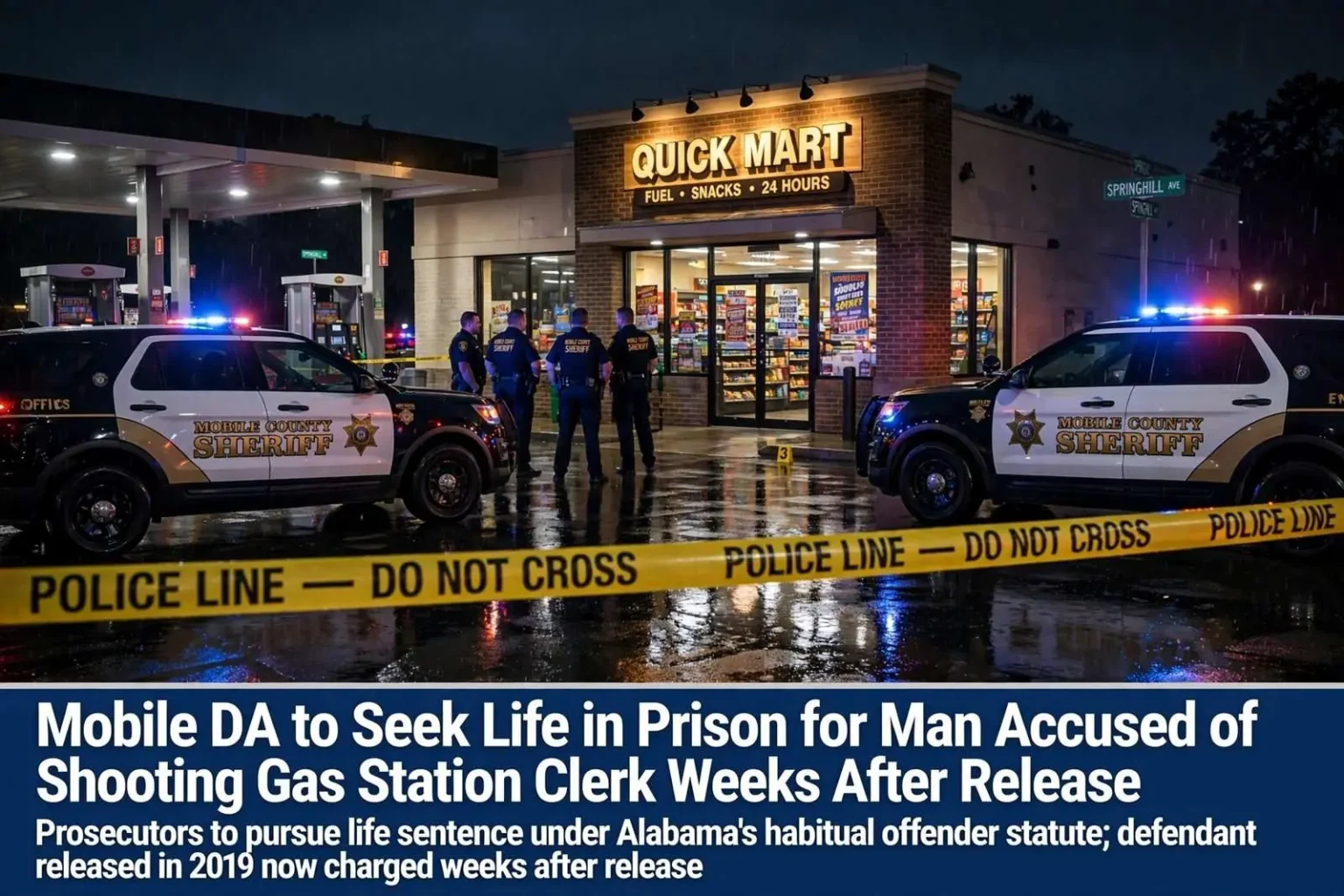
Mobile County prosecutors say they will pursue life in prison for a man accused of shooting a gas station clerk during an attempted beer theft — less than two months after he walked out of prison having served just three years for murder.
Reginald Blevins was on probation when police say he shot a clerk at a Mobile gas station while trying to steal a pack of beer. The clerk is expected to survive. Blevins is being held without bond ahead of trial, and the District Attorney’s office plans to invoke his habitual offender status if he is convicted.
The case has become, almost overnight, the local embodiment of a debate that prosecutors across Alabama have been waging for years: what happens when the state’s sentencing and parole systems release a violent offender at the earliest possible date, and what the justice system can do the second time around. District Attorney Ashley Rich’s office has made clear that the answer, in this case, will be pursued with every tool the statute books provide.
A Family’s Frustration With the ‘Revolving Door’
Blevins previously pleaded guilty to killing Joey O’Brien, who was found shot to death outside the Springhill Avenue post office in 2013 after witnesses reported seeing him riding his bicycle when gunfire erupted. Blevins was arrested in 2016 but served only three years under a plea deal, walking free in November 2019.
O’Brien’s sister, Kelly Poole, said her family had prayed Blevins would not hurt anyone else, and questioned how many more families must grieve because repeat violent offenders are released early. She noted this would be the third time Blevins has been accused of shooting someone.
The arithmetic of that history sits heavily on the case. A man convicted in connection with a killing in 2013 spent three years in custody, emerged in November, was arrested on drug charges within weeks, and now stands accused of shooting a working clerk over a six-pack before the new year was out. Poole’s question — how many families must grieve — is the one that victims’ advocates across Alabama have carried to Montgomery in steadily louder tones.
Chief Assistant District Attorney Deborah Tillman defended the earlier plea as a difficult call made on the law and facts, but said District Attorney Ashley Rich has long criticized the state’s sentencing guidelines and pushed for truth in sentencing. “There will be no more revolving door for him, the door will be slammed shut if we are able to convict him,” Tillman said.
The distinction Tillman draws matters. Plea agreements are negotiated under the constraints of what the evidence will support and what the sentencing structure at the time allows, not under the wishes of prosecutors. What the office can control is the charge and the sentencing posture it brings to the new case — and there, the habitual offender designation changes everything.
The Habitual Offender Path
Alabama’s habitual felony offender statute allows prosecutors to seek dramatically enhanced sentences for defendants with prior felony convictions, and Blevins’s record — including a prior homicide conviction — places him squarely within its heaviest provisions. If he is convicted of the new offense, the enhancement can mean a sentence of life without the possibility of parole, taking the question of early release off the table entirely.
That is the strategic significance of the office’s announcement. A standard conviction might again produce a sentence measured in a handful of years with parole eligibility arriving far sooner than the public expects. The enhancement forecloses that outcome by design, and Rich’s office has framed its pursuit of the designation as the direct answer to the case’s most disturbing fact pattern: a man given a short sentence for a killing, released early, and accused of shooting again within weeks.
Prosecutors’ use of the statute has drawn renewed attention statewide as Alabama debates the pace of parole releases. Victims’ families and district attorneys have argued that the parole system’s calendar too often outruns its caution, releasing offenders whose records suggest the risk was foreseeable. Defense advocates counter that enhanced sentencing has filled Alabama’s prisons with aging inmates and that parole exists precisely to correct sentences that prove excessive. The Blevins case supplies both camps with exactly the kind of example that shapes legislation.
Back Behind Bars
The quick return to crime followed a familiar pattern: weeks after his November release, Blevins was arrested on drug charges in December, and prosecutors filed a motion to revoke his bond one day before the shooting. Even if a judge sets bond at his Wednesday hearing, a probation hold keeps him jailed until a judge rules on revocation.
“He’s not going anywhere,” Tillman said.
The procedural layers stacked on top of the criminal case illustrate how the system catches repeat offenders — eventually. A new arrest triggers the probation file from the old case; a motion to revoke sets an independent proceeding in motion; and a hold from one judge keeps a defendant in custody regardless of what another decides about bond. None of those mechanisms prevented the December arrest or the shooting that followed, but together they ensure the accused remains off the street while the serious case is prepared.
For the clerk who was shot, the recovery is expected, but the office’s pledge to seek a life sentence makes the upcoming trial one of the most consequential on Mobile County’s criminal docket. For O’Brien’s family, the proceedings will revisit a loss they have now carried through a decade and a plea deal they continue to question. And for a community watching the revolving door spin one more time, the case will test whether the state’s sentencing structure can finally hold what it catches.
Truth in Sentencing and the Alabama Debate
The phrase Rich’s office uses — truth in sentencing — refers to a reform concept with a long history in Alabama’s Statehouse. Its advocates argue that a sentence should mean what it says: someone sentenced to fifteen years should serve something close to fifteen years, and the public should be able to rely on that number. Alabama’s current structure, with its split sentences, parole eligibility, and credit calculations, frequently produces outcomes in which the years actually served bear little resemblance to the years announced in court.
The plea deal in the O’Brien case illustrates the gap from the other direction. Whatever the law and facts permitted in 2016, the result was three years of custody for a killing — an outcome Poole and her family have never accepted, and one Tillman acknowledged came from a difficult calculation rather than an easy one. Prosecutors weighing a plea must estimate what a jury will do, what evidence will survive challenges, and what sentence the judge can impose, all without knowing what the parole system will do years later.
Rich has carried that criticism to legislative hearings for years, joining district attorneys across Alabama in pressing for sentencing structures that keep the most violent offenders imprisoned for the terms their crimes draw. The Blevins prosecution, with its habitual offender enhancement, represents the office working inside the existing law to reach the outcome it believes the legislature’s reforms should deliver more reliably.
What the Case Means for Mobile County
Beyond the courtroom, the case lands in a community that has watched the same pattern repeat across neighborhoods for years. Springhill Avenue, where O’Brien was found in 2013, threads through some of Mobile’s oldest districts; the gas station where the clerk was shot serves the everyday traffic of a city working to shed its reputation for violent crime. Each case like this one — a short sentence, an early release, a new victim — hardens the public’s demand that the system’s arithmetic change.
The coming trial will answer the immediate question of guilt, but the policy questions will outlast the verdict. Whether Alabama restructures its parole practices, rewrites its sentencing guidelines, or simply enforces the enhancements already on the books, cases like this one will be the exhibits cited on every side. Mobile County’s prosecutors have chosen their exhibit and their posture; the habitual offender designation they plan to invoke ensures that, this time, the revolving door they describe will at least attempt to stop turning for one man.
For now, the accused sits in the county jail without bond, held by the combined weight of a new charge, a pending revocation, and a probation hold — exactly where prosecutors said he would stay. “He’s not going anywhere,” Tillman repeated, and in a case defined by how easily its defendant once went everywhere, those words carry the weight of the office’s whole argument.
The victim’s survival shapes the charging calculus as well. An attempted-murder or first-degree assault case built on a wounded clerk expected to recover presents a different set of proofs than a homicide, and prosecutors will prepare their witnesses and evidence accordingly. The clerk’s expected recovery is the single merciful note in the file — and the reason the defendant’s accusers this time include a living witness to what happened.


