
Mobile Daycare Damaged by Fire Plans to Reopen Within a Day
Creative Kids Daycare on Azalea Road in Mobile planned to reopen just a day after a night fire damaged its main building; no one was hurt.
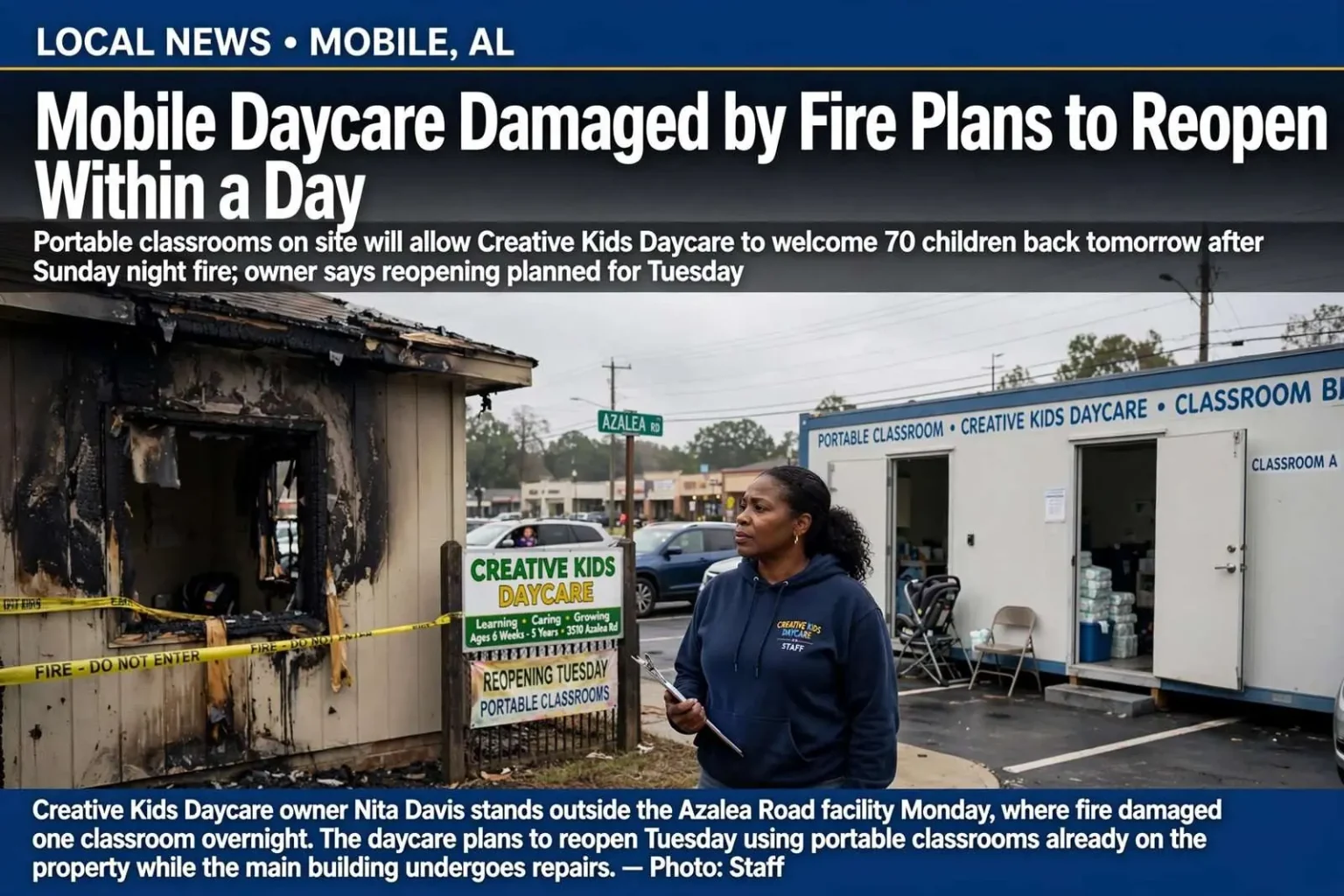
A Mobile daycare forced to close after a weekend fire was already planning its comeback, with an owner determined not to let a burned classroom cost her families more than one day of care. Creative Kids Daycare on Azalea Road shut down Monday after flames broke out in its main building Sunday night, but owner Nita Davis said she hoped to welcome children back the very next day — a timetable that, remarkably, looked achievable thanks to portable classrooms already standing on the property.
The fire struck the main building of the daycare, one of many child care operations along the Azalea Road corridor in west Mobile, where businesses of every kind line the busy street between Airport Boulevard and Government Street. By the time crews finished their work Sunday night, one room of the building was heavily damaged and the rest was left with the smoke and water damage that follows any structure fire. No children or staff were inside — the blaze hit after hours — and investigators began combing the scene Monday morning to determine how it started.
“It’s a mess, it can be fixed, but it’s a mess,” Davis said, summarizing the situation in the days after the fire with the practicality of an owner who had already moved on to logistics. Her immediate problem was not the damage itself but the gap it created: roughly 70 children attend Creative Kids on a typical Monday, and every one of those families needed somewhere for their children to be while the building was out of service.
The reopening timeline had already slipped once. Davis initially expected to open Monday morning, but held off as fire investigators combed through the damaged building — a standard precaution, since investigators must clear a fire scene before normal activity can resume inside. Parents who drove up to drop off their children found the doors closed instead, and word of the overnight fire spread quickly through the pickup line and the neighborhood phone tree.
Parents Scramble After a Closed-Door Monday
The sudden closure caught families with no backup plan. Daycare schedules are built around parents’ work shifts, and a Monday morning closure meant missed work, emergency calls to relatives and improvised arrangements across dozens of households.
“My youngest daughter has been going here since she was six weeks and I didn’t know,” said Eboni Kelley, a Creative Kids parent. “I’m just pulling up and I hate that it happened.” Her daughter’s history with the daycare — enrolled as an infant and still there — reflected the kind of long relationships the center has built with the families it serves, the sort of trust that makes a closure like Monday’s feel personal rather than merely inconvenient.
Other families expressed sympathy along with the inconvenience of scrambling for last-minute childcare. “It’s a good daycare and it’s just a real inconvenience for me,” said Vatrinka White. That note — sympathy for the owner first, complaint second — was common among parents at the door. In Mobile’s tight child care market, where waiting lists are common and quality openings are hard to find, a daycare that families like is not something parents want to lose, even for a day, even over a fire.
The closure also underscored how fragile a working family’s schedule is. A single fire in a single building can idle seventy households in an hour, because child care is a dependency with no slack in it: a parent cannot simply arrive at work two hours late while investigators finish their sweep. The scramble that Monday morning was a small-scale preview of what communities face when larger disasters close child care centers — a problem employers and emergency planners across the Gulf Coast have learned to take seriously.
Davis’s solution was already sitting in her parking lot. Portable classrooms on the property would provide enough space to keep operating while the main building is repaired, letting the daycare reopen its program without waiting on contractors, permits and reconstruction. The portables — common additions at expanding Alabama daycares and schools — would absorb the rooms lost to the damaged building, and staff could move supplies and equipment over in a matter of hours once investigators cleared the site.
The plan depended on the fire’s footprint staying small. The fire appeared to have started in one room of the main building, though investigators had not determined a cause. Containment in a single room meant the rest of the structure was largely salvageable, and it meant the licensing and safety questions that follow a daycare fire — smoke contamination, structural integrity, fire marshal approval — could be resolved quickly for the spaces children would actually use. Had the flames spread further, the portable-classroom plan might not have been enough, and the seventy-family scramble would have lasted weeks instead of a day.
The one point of agreement all around: the timing. The fire broke out when no one — staff or children — was inside. That fact transformed the story from potential tragedy to property problem. Sunday night fires in commercial buildings are dangerous precisely because they burn unattended, discovered late and sometimes well developed before a passerby or alarm brings crews; that no one was hurt at a facility serving infants and toddlers was the outcome every parent at the closed door Monday was relieved to hear.
What Comes Next for the Center
Reopening on portables carried its own checklist. Alabama’s child care licensing requirements do not pause for fires: a daycare must maintain its staff-to-child ratios, its space standards and its fire safety certifications wherever it operates, and moving seventy children into portable classrooms means re-certifying those spaces for occupancy. Davis’s quick timeline suggested the portables had previously served the program and already met the relevant requirements, which would spare her the slower path of inspections from scratch. State and local fire officials would still need to sign off on the arrangement before children crossed the threshold.
The repair work on the main building would run on a slower clock. Fire damage in a single room still means smoke throughout the structure — soot in ductwork, odor in carpets, water from firefighting in rooms below and beside the burn — and remediation companies typically need days to clean, dry and deodorize before reconstruction can even be priced. Insurers would assess, contractors would bid, and the main building would likely sit closed while the portables carried the program. For a small business owner, the costs stack quickly even in a best-case fire: lost equipment, remediation bills and the licensing risk of any interruption in service.
But Davis’s own framing — “it can be fixed” — captured the difference between a setback and a catastrophe. The center had its staff, its enrolled families and its physical space on site to bridge the gap, and it had the goodwill of parents who, standing in the parking lot Monday with their children, described the inconvenience in the same breath as their sympathy. The fire damaged one room of a building on Azalea Road. It did not damage the operation, and by Tuesday, if the owner’s plan held, most of the families affected would be dropping their children off within sight of the repair work — the fastest kind of recovery there is.
For the families of Creative Kids, the episode was a reminder of how much rides on a single building. West Mobile parents who depend on the Azalea Road corridor’s child care options — a stretch dense with daycare centers, preschools and after-school programs serving neighborhoods from Spring Hill to Crichton — know that an opening at a good center is not easily replaced. Mobile&rsquos child care market has run tight for years, with infant slots especially scarce, and the arithmetic of a Monday closure is unforgiving: a parent who cannot find a same-day spot loses pay or uses leave, and employers lose the hours with them.
Community response in situations like this typically moves fast. When a local daycare goes dark, area churches and fellow providers often field calls from affected families, and parents trade recommendations through neighborhood groups within hours. Mobile’s network of child care providers is small enough that many operators know each other’s programs, and a fire at one center sends families looking not for a new daycare permanently but for a bridge — a few days of coverage until the usual place reopens. Davis’s one-day plan promised exactly that bridge, provided investigators finished their work in time.
The fire also illustrated the quiet role of after-hours risk in child care operations. A daycare building is designed around the safety of children present — outlets covered, exits marked, ratios enforced — but the hours when the building is empty are when structural risks smolder unnoticed. Fire officials across Alabama urge commercial property owners to maintain alarm monitoring overnight precisely because an unattended blaze discovered at 9 p.m. is manageable while one discovered at midnight may not be. That the Creative Kids fire was contained to one room suggests it was caught relatively early; the alternative, in a building with cribs and nap mats, does not bear thinking about.
For the owner, the days ahead would be a test of the same quality that made her families loyal. A daycare’s reputation rests on consistency — the same teachers, the same routines, the same doors opening at the same hour — and a fire tests every one of those at once. Davis’s bet was that parents would forgive a one-day closure in a building with visible fire damage if the program itself came back immediately and unchanged. The sympathy expressed at the curb Monday suggested the bet was a sound one. Seventy children, one burned room, and a plan to reopen by Tuesday: in the ledger of bad days a small business can have, Creative Kids Daycare came out ahead — and its families, with their own disrupted Mondays behind them, appeared ready to return the moment the doors unlocked.


