
Mobile demonstrators call for repeal of Alabama’s monument protection law
Demonstrators in downtown Mobile called for repealing the Alabama Memorial Preservation Act and renaming the Wallace Tunnel during a Mardi Gras Park rally.
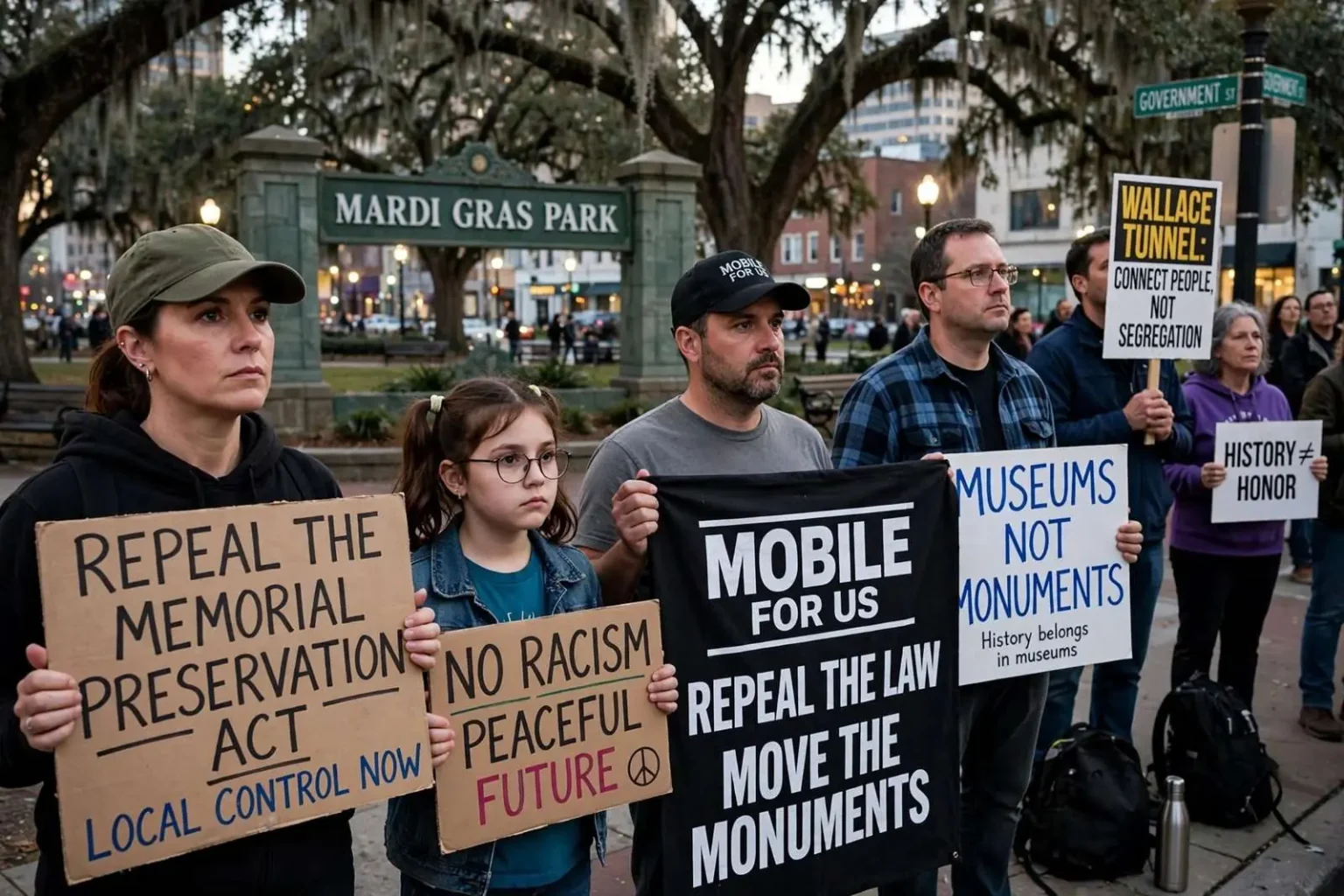
A small group of demonstrators gathered in downtown Mobile on a Sunday evening to call for the repeal of the Alabama Memorial Preservation Act and the removal of statues and monuments tied to segregation or the Confederacy. The event was organized by Mobile For Us.
Turnout was modest, but organizers said the size of the crowd did not dilute the message, which they framed as part of a broader statewide push against the law.
The Wallace Tunnel as a Local Example
Organizers pointed to the George Wallace Tunnel as the clearest local application of the statute, since the law shields the name from being changed. “Tunnels are meant to connect two things, George Wallace was against that connected people. We don’t need a tunnel named after a person that doesn’t reflect what Alabama is today,” said Antione Moore, one of the organizers.
Another participant, Travis Abshear, argued that preserving a historical record does not require honoring the figures in it. “It’s important for us to acknowledge our history, but that doesn’t mean it has to be celebrated,” Abshear said. Moore made a similar point about where such monuments belong. “They don’t need a statue, they don’t need a monument named after them. They need to be in a museum,” he said.
The tunnel they singled out is one of Mobile’s most recognizable landmarks. Carrying Interstate 10 beneath the Mobile River in twin bores, it links downtown with the eastern shore and Blakeley Island, and every driver crossing the city on the interstate passes through it. The naming honors George Wallace, the four-term Alabama governor whose defiant segregationist politics defined the state’s image for a generation, and whose career included the 1963 stand in the schoolhouse door at the University of Alabama against federal integration orders. To the demonstrators, attaching that legacy to a piece of infrastructure whose entire function is connection struck the law’s protection as misplaced.
Under the Memorial Preservation Act, passed by the Alabama Legislature in 2017, monuments, memorials, and named buildings on public property that have stood for forty years or more may not be removed, altered, renamed, or relocated, and local governments that defy the ban face substantial fines. The law was written in the wake of national debates over Confederate symbols, and it removed the authority that cities like Mobile, Birmingham, and Montgomery had begun exercising over their own memorials. Because the act operates as a state mandate, repeal — not a local council vote — is the only legal route to changing names like the tunnel’s, which is precisely why organizers aimed their demands at the statute itself.
Speeches at Mardi Gras Park, Then a March
Several people spoke during the gathering at Mardi Gras Park, including an 11-year-old participant, Kayla Ellis. “If change doesn’t happen, this country is going to be broken. This country is going to shatter. Change needs to happen. I want this country to be peaceful. I want there to be no racism,” Ellis said.
After the speeches concluded, participants marched along the sidewalks of Government Street, chanting “move the monuments” among other calls. The route placed the march in the middle of the very streetscape the debate is about: Government Street has carried Mobile’s public memory for generations, from its historic churches and courthouses to the monument sites that have come and gone along its length.
Progress and Remaining Goals
Demonstrators said they consider the removal of the Admiral Raphael Semmes statue from downtown Mobile a meaningful step, while maintaining that more remains to be done in the area. The Alabama Memorial Preservation Act, they argue, stands between the city and the rest of the changes they seek, protecting every remaining monument and memorial name that has passed the forty-year threshold.
The Semmes statue had stood in downtown Mobile since 1900, commemorating the Confederate naval officer whose raiding ship, the CSS Alabama, was built on the Mersey and sank off the French coast during the Civil War. Its removal drew national attention when Mobile’s mayor ordered it taken down, and its absence from Government Street is the concrete example demonstrators cite when they describe what is possible even under the state law’s restrictions. For the organizers, though, one statue’s removal is an exception carved out by a city administration, not a change in the legal landscape that governs the rest.
The law itself has been contested in court and in the Legislature since its passage. A series of legal challenges argued the act violated local governments’ home rule authority, and a circuit judge allowed a Birmingham case to proceed after finding the plaintiffs had standing, though the statute has remained in force. In the Legislature, bills to soften or repeal the act — and, on the other side, bills to strengthen it — surface regularly, reflecting the same statewide divide the Mobile demonstrators said they were joining. Cities that want flexibility over their memorials have continued to press the case that decisions about public space belong with the communities that live in it.
The Movement’s Local Shape
Mobile For Us framed the Sunday event as one piece of a larger statewide campaign, part of the wave of demonstrations that followed national attention to Confederate symbols after 2015. Across Alabama, similar gatherings have taken aim at the same statute, from Birmingham’s efforts around its own monument row to Huntsville and Montgomery, where protests have focused on both Confederate markers and segregation-era honors.
The tone of the Mobile event reflected its scale: small, peaceful, and built around testimony rather than confrontation. Speakers ranged in age from elementary school to adulthood, and the appearance of an 11-year-old at the podium underscored the organizers’ argument that the debate is about the community’s future as much as its past. The march that followed kept to the sidewalks of Government Street, passing businesses and apartments in a downtown district that continues to see new investment, and ended without incident.
What remains unresolved is the same question demonstrators have posed in cities across the South since the act became law: whether Alabama’s Legislature will ever return memorial decisions to local governments, and whether the names and statues the act protects — including the name borne by every vehicle that crosses the Mobile River on Interstate 10 — will change through the political process or remain fixed by state statute.
For the organizers, the arithmetic of the campaign is straightforward. The act protects what has stood for four decades or more, so nothing on Mobile’s public landscape can simply be renamed as attitudes shift; each change requires either legislative repeal or an exception granted from above. That is why the Sunday gathering aimed its message at Montgomery rather than at City Hall, and why repeal of the Memorial Preservation Act — a law most Mobile residents encounter only when a monument question arises — sits at the top of the group’s demands.
The Sunday demonstration ended where it began, at Mardi Gras Park in the shadow of Government Street, with organizers promising to keep the pressure on until the law is repealed and the remaining monuments they object to are moved. Whether the Legislature takes up the question in the sessions ahead will determine whether the city’s public landscape — from the tunnel beneath the river to the statuary along its oldest streets — becomes a matter of local decision or stays exactly where state law has fixed it.
The timing and setting of the event were themselves part of the message. Sunday evening downtown draws little traffic, and the park’s location places any gathering within sight of the Government Street corridor where Mobile’s monument debates have played out. Holding the event on a weekend, organizers said, made it easier for working families to attend, and the small turnout reflected a summer schedule rather than a lack of interest in the cause.
The demonstration also highlighted how the argument over monuments has shifted in emphasis over the years. Early rounds of the debate centered on Confederate markers alone; the Mobile organizers’ demands explicitly covered monuments and names tied to segregation more broadly, a category that reaches beyond the Civil War era into the twentieth century and the officials who defended segregation in office. That widening is what pulled the Wallace Tunnel’s name into the discussion, and it is the part of the campaign with the widest reach, since it touches infrastructure every resident uses rather than statuary most pass without a glance.
Legal observers note that even a full repeal would not change anything overnight. Repeal would simply return authority to local governments, leaving each city council and county commission to decide monument questions on its own, with public hearings, budgets, and votes of their own. That local-control outcome is exactly what the demonstrators asked for: not a state-mandated removal from either direction, but the right of Mobile to decide, in Mobile, which figures its public spaces honor.
Until that question is settled in Montgomery, the state’s forty-year rule keeps every qualifying monument and name in place, and gatherings like the one at Mardi Gras Park remain the most visible way the issue stays in front of the public between legislative sessions.


