Mobile District 2 Councilwoman Details $1.4M Infrastructure Plan, Africatown Welcome Center Progress
Mobile Councilwoman Samantha Ingram used her District 2 meeting to detail a $1.4 million infrastructure push, a November road funding referendum, and the latest timeline for the Africatown Welcome Center.
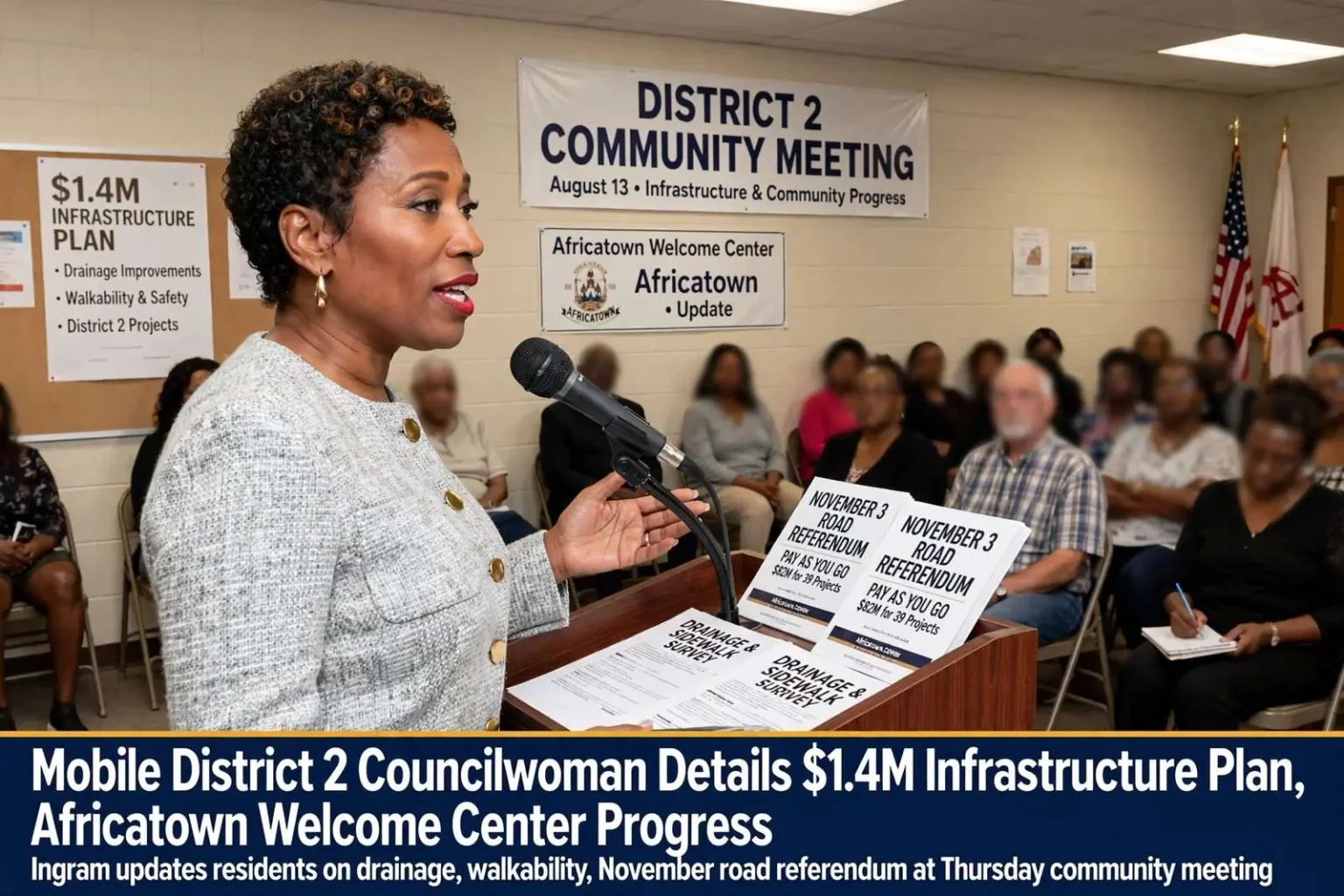
Mobile City Councilwoman Samantha Ingram used her District 2 community meeting on Thursday, August 13, to update residents on infrastructure spending, a countywide road funding referendum, and the latest progress on the Africatown Welcome Center. The quarterly gathering at the Tillman’s Corner Community Center drew residents from across the district, which reaches from parts of West Mobile down through the communities along the Mobile River’s western bank, and Ingram used the session to walk through projects in the current budget as well as items heading to voters this fall.
Ingram told attendees she has directed about $1.4 million in the current budget process toward drainage and walkability improvements in the district. The money comes from the city’s Community Development Block Grant allocations and the council district’s discretionary infrastructure funds, sources that council members use each year to target street-level improvements in their districts. Drainage has been a persistent complaint in parts of District 2, where aging pipes and low-lying streets produce standing water after heavy Gulf Coast rains, and walkability gaps leave many neighborhoods without safe pedestrian routes to schools, churches and bus stops.
She said traditional sidewalks are not a workable fix for many of the district’s narrow streets, so she has requested a study to look at ways to improve walkability “outside of the sidewalks.” Older neighborhoods inside the district were platted with narrow rights-of-way long before modern sidewalk standards, and in many places there is simply no room to pour a compliant walk without removing trees, ditches or fences. The study Ingram requested will look at alternatives used elsewhere, from multi-use paths and shoulder widening to traffic-calming measures that make existing streets safer for pedestrians without new construction.
Ingram also encouraged residents to fill out a Drainage and Sidewalk survey she plans to share through her district newsletter. The survey is designed to build a resident-generated map of problem spots — streets that flood, crossings that lack safe passage, intersections that need attention — that can be used to rank projects when funding decisions come up in future budget cycles. City engineers have long relied on complaint calls and council referrals to identify drainage trouble; a systematic survey gives the district a documented list to work from.
Countywide Road Referendum on the November Ballot
Ingram reminded residents about a “Pay As You Go” referendum that will appear on the November 3 ballot. If approved, the measure would direct $82 million toward an estimated 39 road improvement projects covering roughly 90 miles of roadway across the city. The program would be funded through a dedicated property tax millage that Mobile County voters first approved decades ago and must periodically renew, with the city’s share allocated to paving, resurfacing, drainage repairs and street reconstruction on a pay-as-you-go basis rather than through borrowed money.
“Revitalization starts with infrastructure,” Ingram said. “So, make sure you’re out to vote [on] November 3rd.” The referendum’s project list touches neighborhoods across every council district, with paving schedules and drainage improvements identified through the city’s ongoing street condition assessments. City officials have argued that the pay-as-you-go approach saves taxpayers interest costs and allows the city to respond to street problems as they arise, while opponents of taxes generally have questioned whether the full millage is needed. Ingram’s message to District 2 residents was that the projects matter directly to their own streets, and that turnout in a low-profile fall election will decide the program’s fate.
Neighbors Helping Neighbors
The meeting also included an update on the district’s Neighbors Helping Neighbors Initiative, which Ingram said has led to cleanup efforts in five neighborhoods and the distribution of 80 hygiene kits to unhoused community members. The initiative pairs volunteer groups with neighborhood associations for targeted cleanup days — clearing lots, removing dumped debris and trimming overgrown rights-of-way — in areas where blight complaints have clustered. The hygiene kits, assembled with donated supplies, were distributed through outreach workers and volunteers who work regularly with the city’s unhoused population.
Neighborhood cleanup programs have become a regular tool for Mobile council districts, combining city services such as bulk trash pickup with volunteer labor to address properties that fall between the city’s enforcement code and private maintenance. Ingram’s office has made the initiative a signature of her first term, and the five neighborhoods cleaned so far represent a starting point she told attendees she intends to extend through the rest of the district in coming months.
Africatown Welcome Center Timeline
On the Africatown Welcome Center, Ingram updated residents on a $2 million Request for Qualifications process that will establish a pool of qualified vendors for the project. The RFQ approach allows the city to pre-screen architects, contractors and design firms interested in the work, creating a shortlist from which specific contracts can be negotiated as the project’s scope firms up. The welcome center has been one of the most anticipated pieces of the broader Africatown investment effort, intended to give visitors an anchor for tours and interpretation of the historic community’s story.
Shonnda Smith, the city’s deputy executive director of public works and senior director of parks and recreation, told attendees the department does not yet have a finalized plan for what will go inside the center, since contracts with a landscape architect and interior designer are still being worked out. The building’s shell and site work have progressed while the interior program — exhibits, meeting space and visitor services — awaits the design contracts, a sequencing that city officials said keeps the overall timeline intact. Smith’s department inherited oversight of the project as it moved from the planning phase into construction, coordinating with consultants and city departments on the daily decisions that determine the schedule.
The city is also interviewing candidates for an Operations Manager position to help oversee project planning. The role is intended to give the project a dedicated point of contact who can track contracts, manage the vendor pool and coordinate among the city departments, consultants and community stakeholders involved in the center’s development — a workload that has stretched the staffs managing it so far.
Despite that ongoing contract work, Smith said the building itself is still expected to be completed by October, with the center’s public opening still targeted for December. Meeting that schedule will allow the center to open in the same calendar year as other Africatown heritage projects, a milestone community leaders have sought since the discovery of the Clotilda shipwreck in the Mobile-Tensaw Delta drew international attention to the area.
Africatown’s Place in the City’s Future
Africatown, founded in 1866 by survivors of the slave ship Clotilda, has been the focus of a broader city investment effort in recent years, including the welcome center project and nearby heritage sites. The community just north of downtown Mobile was established by the last known group of Africans brought to the United States aboard the Clotilda, which arrived in Mobile Bay in 1860 — decades after the transatlantic slave trade had been outlawed — and was then scuttled in the delta by its captors to hide the crime. The wreck’s discovery in 2019 confirmed what descendants had passed down orally for more than a century and transformed Africatown into a site of national historical significance.
That recognition has come with a wave of investment: heritage trail markers, improvements to the community’s church cemetery where Clotilda survivors are buried, the neighborhood’s listing on national historic registers, and planning work for an interpretive center that partners the city with the National Park Service and other agencies. The welcome center is designed to serve visitors arriving to see those sites, and community organizations have pressed for local residents — including descendants of the Clotilda survivors — to have a hand in its operation and its storytelling.
For Ingram, whose district includes Africatown, the welcome center’s timeline was the meeting’s most closely watched update. Residents have watched planning documents come and go for years, and the promise of a December opening — with a completed building in October — offered the first concrete schedule the project has had in recent memory. Ingram told attendees she will continue to press for community input as the interior design contracts are finalized, so that the center reflects the history and the people it was built to honor.
The meeting closed with Ingram encouraging residents to stay engaged between quarterly sessions, through the district newsletter and her office’s direct line for service requests. Between the $1.4 million in district infrastructure spending, the November referendum’s 39 projects, the neighborhood cleanup initiative and the welcome center’s countdown to opening, District 2 enters the fall with more active projects than at any point in recent years — a list Ingram said she intends to keep moving regardless of how the referendum vote turns out.