Money and Muscle: Mobile’s District 7 Council Candidates File Finance Reports
Days before Mobile's Aug. 23 election, the seven candidates for the open District 7 City Council seat filed campaign finance reports, revealing firefighter money, police endorsements and a self-funded restaurateur.
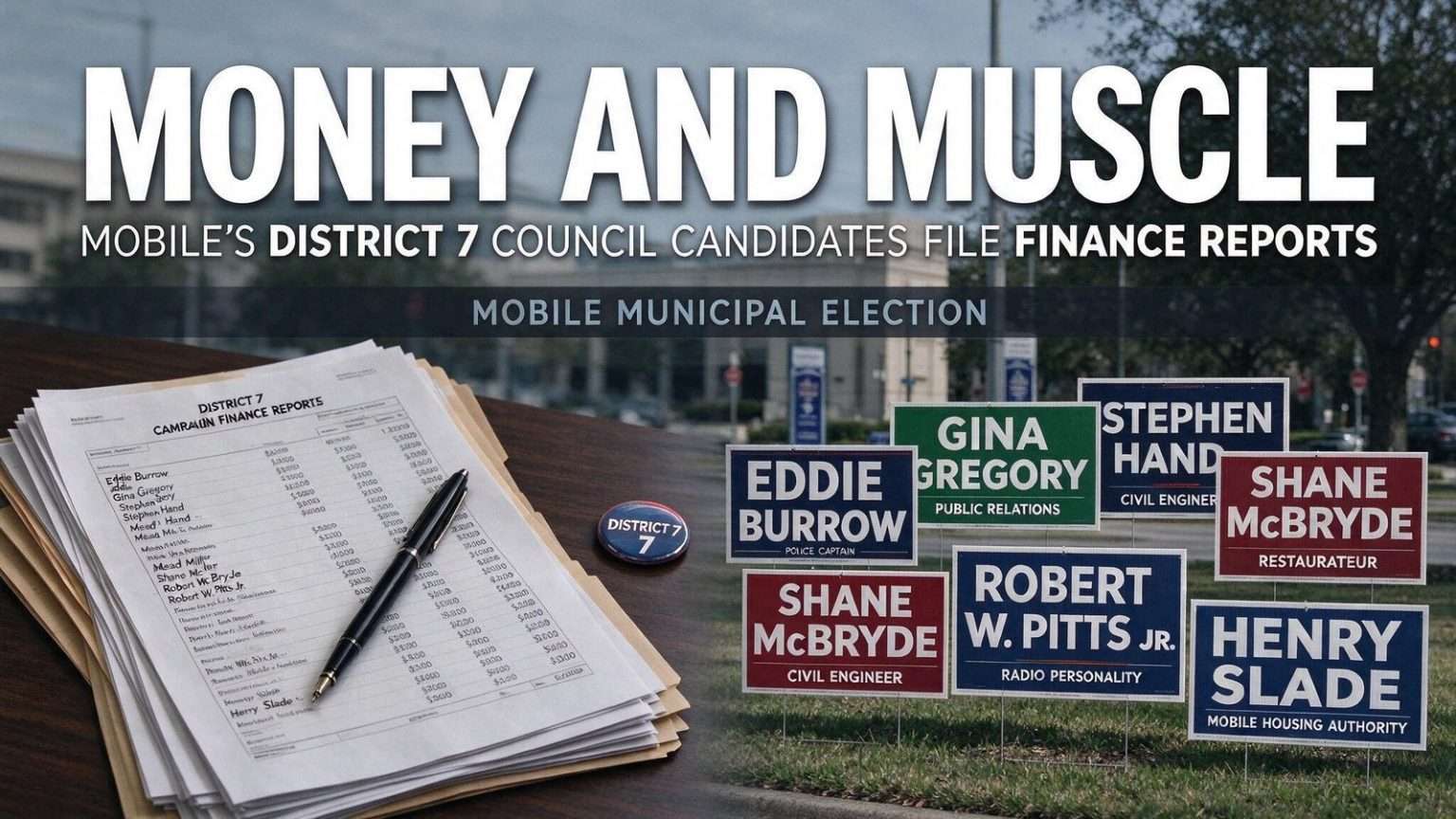
With Mobile’s municipal election only days away, the seven candidates competing for the open District 7 seat on the City Council filed their pre-election campaign finance reports, offering voters a revealing look at who was bankrolling the contest to represent the city’s northwest neighborhoods. The reports arrived, as they always do, as the plainest documents of the campaign — names, dates and dollar amounts standing in for all the door-knocking and yard signs.
The seat came open when Councilman John Peavy launched a campaign for mayor, leaving a wide field to succeed him. Voters were set to decide the race Tuesday, Aug. 23, with a runoff scheduled for Sept. 13 if no candidate captured a majority. In a seven-way race, a runoff was the likeliest outcome on paper, which meant the primary was really about securing a place in the final two — and the money reports showed who had the resources to survive a second round.
Seven names appeared on the District 7 ballot: police Capt. Eddie Burrow, public relations executive Gina Gregory, civil engineer Stephen Hand, restaurateur Mead Miller, radio personality Shane McBryde, Robert W. Pitts Jr. and Mobile Housing Authority employee Henry Slade. The field ranged across the professions that usually populate a council race — law enforcement, business, engineering, media and public service — and no single candidate entered the final week with the race’s fundraising clearly won.
Under state law, candidates were required to disclose their campaign’s financial activity within five to 10 days of the election. The filings itemized contributions above the disclosure threshold and every expenditure of consequence, giving the district a documented account of its own contest in the last days before the voting.
Firefighters and a former congressman line up behind Hand
Few contributions stood out like the one Stephen Hand collected from the Mobile Fire Fighters Association, which gave his campaign $10,000. A five-figure check from the firefighters’ union in a council race announced that a bloc of organized, politically active public employees had chosen a candidate and was prepared to spend on his behalf — a meaningful signal in a district where public-safety workers live on nearly every street.
The 42-year-old civil engineer and father of four also drew a $100 donation from retired U.S. Rep. H.L. “Sonny” Callahan, along with $1,000 from Alabama Realtors and $2,000 from the United City Workers Coalition. The Callahan name carried particular weight in Mobile politics: the former congressman’s endorsement, even at the modest token level of a hundred dollars, marked Hand as acceptable to the city’s moderate establishment.
Hand’s campaign reported raising $17,120 in cash contributions, spending $12,304.05 and closing the period with $4,815.95 on hand. His single largest expenditure was $10,488.52 paid to MH3 Printing — the signature expense of a candidate racing to cover a seven-way district with mailers and printed materials before the voters made up their minds.
The pattern of the report suggested a campaign built on organizational support rather than self-funding: union money, Realtor money, a coalition of city workers, and an establishment elder’s blessing, all converted into printed outreach across the northwest neighborhoods.
Police leadership rallies to Burrow
Eddie Burrow, a 51-year-old captain in charge of the Mobile Police Department’s support services section, leaned on his law-enforcement roots. Police Chief Sam Cochran and former Chief Billy Mingus were among his backers, and Burrow said he would retire from the department if he won the seat. In a council race, the visible support of the department’s sitting chief and his predecessor amounted to an institutional endorsement that money could not buy.
His pledge to retire if elected was more than a formality. State law and department practice discourage police officers from holding elected office while wearing the badge, and the promise let voters weigh his candidacy as a genuine career change rather than a moonlighting arrangement. It also removed the question of how a sitting captain would answer to a council he might one day sit on.
Burrow reported $3,200 in cash contributions plus $500 in itemized in-kind support, much of it from local body shops and auto dealers. He spent $1,507.46 and entered the final days of the campaign with $1,692.54 in the bank. The totals were modest next to Hand’s, but his campaign’s strength was never going to be measured in dollars — it was a network of colleagues, gun-range acquaintances and neighborhood watch veterans whom a police captain can reach without buying a single mailer.
In-kind support from the automotive trades told its own story about the candidate’s base. Body shops and dealerships are the businesses police officers know best, and their donations — signs, printing, services rather than cash — stretched a small budget further than its face value suggested.
City Hall connections boost Gregory
Gina Gregory, a former City Hall spokesperson for outgoing Mayor Mike Dow, benefited from her ties to the city’s political establishment. Dow’s soon-to-retire campaign committee steered $670 to her bid, and the Committee to Re-Elect District 1 Councilman Fred Richardson added $1,000. Donations from other politicians’ committees are a rare and telling currency: they mean an officeholder is spending his own supporters’ money on someone else’s race.
Gregory, by then the public relations director for MDI Media Group, opened the filing period with $6,080.68, raised an additional $15,190 and closed with $6,755.44 on hand after spending $14,515.24 over roughly six weeks. Among the seven campaigns, hers reported the highest total cash raised in the period, an advantage that came less from any single large check than from breadth.
Her donor list ran long, including contributions from Tusco PAC, the Mobile Area Association of Realtors, Regions Financial’s governmental affairs committee and a number of prominent local families. It was the profile of a candidate known quantity to the city’s business and civic leadership — the person the establishment would call if the race went to a runoff and a single alternative had to be chosen.
The committee-to-committee donations also mapped the district’s political relationships. Richardson’s committee investing across district lines signaled interest in who would hold the neighboring seat; a retiring mayor’s committee distributing its remaining funds signaled a City Hall apparatus placing its bets before it dissolved.
Miller digs into his own pocket
Mead Miller, the 58-year-old co-owner of a pair of Picklefish restaurants, financed much of his own campaign, lending it nearly $6,300. He reported $2,150 in cash contributions for the period, expenditures of $8,542.85 and a slim closing balance of $538.45. His spending included payments to sign companies, the local daily newspaper and other local advertising outlets.
Self-funding a council race from a restaurant’s till is its own kind of statement. Miller was asking District 7 to hire a businessman in his own right, and the loan put his money where the pitch was. The closing balance of a few hundred dollars left nothing for a runoff, which meant his strategy — like Burrow’s — had to be organized support rather than an extended air war: restaurant regulars, other business owners, and the voters who already knew the Picklefish name.
The advertising mix also said something about the candidate’s reading of the district. Sign companies first, the daily paper second, local outlets alongside: a campaign buying visibility at the street level, where a seven-candidate field forces every name to compete for recognition on every corner.
A snapshot of a wide-open contest
Taken together, the reports underscored just how competitive the District 7 race had become. Hand’s five-figure firefighter contribution and Gregory’s deep roster of establishment donors set the pace in fundraising, while Burrow counted on the visible support of the city’s police leadership and Miller wagered his own money on the outcome. The remaining candidates — McBryde, Pitts and Slade — rounded out a field that guaranteed District 7 voters no shortage of choices.
That the three least-funded campaigns still mattered was part of the district’s arithmetic. In a seven-way race, a candidate needs only a fraction of the vote to reach a runoff, and a radio personality’s name recognition or a Housing Authority employee’s neighborhood network can produce that fraction without a treasury. The finance reports measured resources, not votes, and every campaign in the field had a theory of how to win with the resources it had.
The open-seat dynamic also explained the intensity. A council seat that comes open once a generation draws the ambitions of a decade, and the reports captured that: a police captain promising to retire into public service, an engineer carrying labor’s banner, a PR executive inheriting the mayor’s network, a restaurateur betting his own cash. District 7, covering the working and middle-class neighborhoods of northwest Mobile, was about to choose which of those identities would represent it on a council that would soon have a new mayor above it.
With the reports filed and the money largely spent, the candidates turned to the final push before Election Day, hoping their investments in signs, mailers and advertising would translate into votes across northwest Mobile. The Aug. 23 primary would settle the question or send at least two of them to Sept. 13 — and the documents filed in the days before gave the district its last full accounting of who was spending what to win its seat.