University of South Alabama Mobile
Twenty-Five Attorneys Seek Mobile Judgeship as a Notable Candidate Enters Council Race
Twenty-five Mobile attorneys applied for a district judgeship, while a City Council hopeful became what he called the first openly autistic candidate in Alabama history.
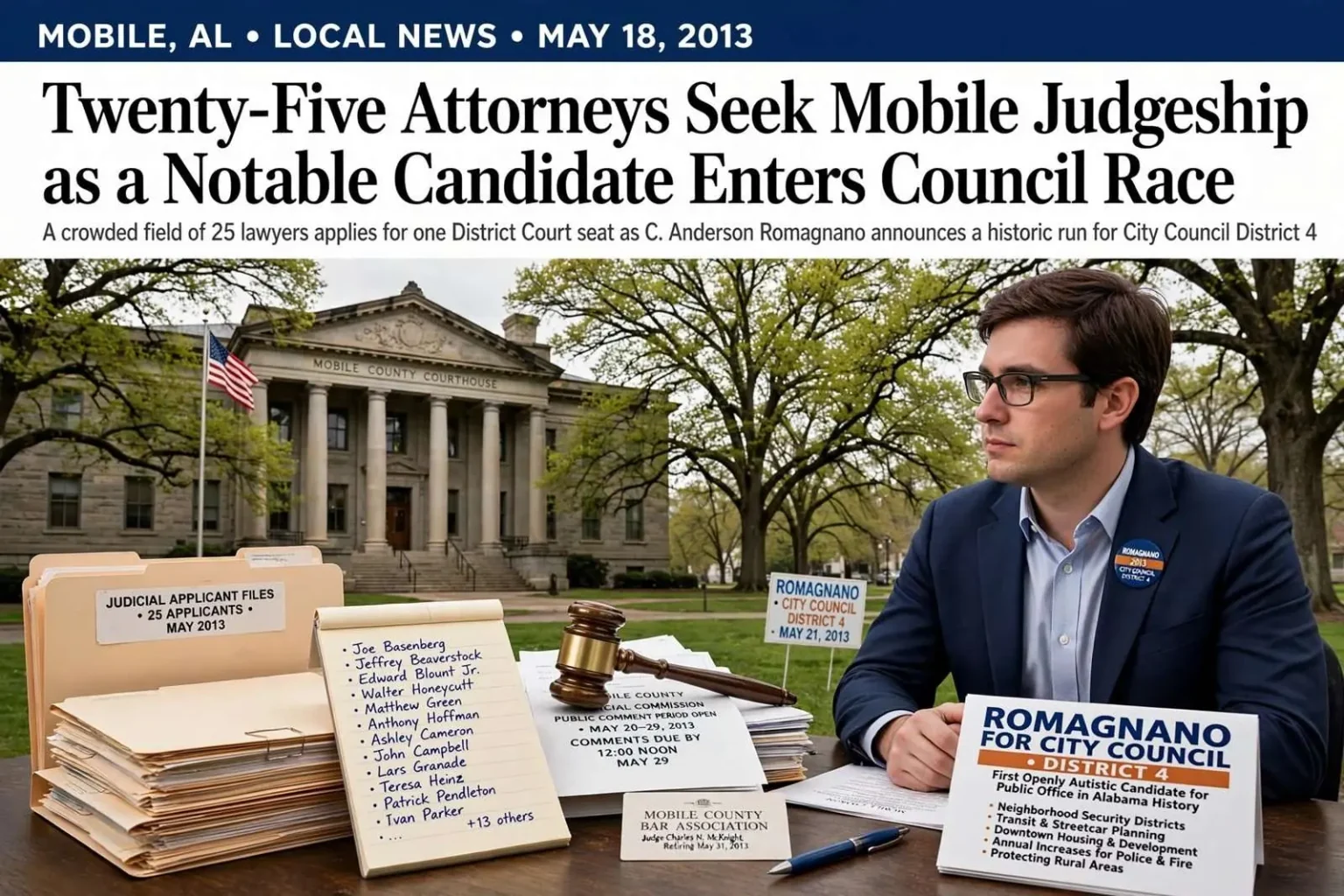
A crowded field of Mobile lawyers lined up in mid-May 2013 to compete for a single seat on the Mobile County District Court, even as the city’s council races produced a candidate who drew attention for reasons all his own. Together, the developments captured a busy stretch in local civic life.
A field of twenty-five
Twenty-five attorneys applied to fill the impending vacancy created by the May 31 retirement of District Judge Charles N. McKnight. The applicants ranged widely across the Mobile bar and included Joe Basenberg, Jeffrey Beaverstock, Edward Blount Jr., Walter Honeycutt, Matthew Green, Anthony Hoffman, Ashley Cameron, John Campbell, Lars Granade, Teresa Heinz, Patrick Pendleton and Ivan Parker, among others. The names of Pendleton and Parker had been omitted from an initial list because of an oversight and were later added.
Even by the standards of a large urban bar, twenty-five applicants for one seat signaled strong interest. District court judgeships rarely open through anything but retirement, and a vacancy caused by a sitting judge’s departure comes with no incumbent to run against — the most accessible route to the bench a Mobile lawyer will ever see. The field’s breadth, from litigators to government lawyers, reflected that reality.
The correction to the initial list, adding Pendleton and Parker, was a small procedural footnote with real consequences. An omission in a judicial selection process can quietly end a candidacy before it begins; catching it preserved the fairness of the process and the applicants’ standing in it. Selection officials treated the fix as routine, but it illustrated how carefully such rolls must be kept.
The Mobile County Judicial Commission, chaired by presiding Circuit Judge Charles Graddick, invited the public to submit confidential comments for or against any applicant through noon on May 29. The commission would interview the candidates and forward three nominees to Gov. Robert Bentley, who would make the final appointment.
The comment window gave the process its public dimension. Attorneys, litigants, courthouse staff and anyone who had seen an applicant’s work firsthand could weigh in without attribution, supplying the commission with the kind of practical information — temperament, diligence, courtroom demeanor — that resumes and interviews rarely reveal. The same screening format had served Mobile’s judicial vacancies for years, and the commission’s chairman pressed again for a swift resolution so the docket would not wait on Montgomery.
A first for an Alabama candidate
In the District 4 City Council race, C. Anderson Romagnano announced his candidacy and described himself as the first openly autistic person in Alabama history to campaign for public office. A graduate of McGill-Toolen High School and Spring Hill College who had attended law school in New Orleans, Romagnano worked in marketing and advertising and had once been employed by the Mobile County License Commission.
Romagnano’s candidacy put District 4 — which takes in much of west and northwest Mobile — at the center of a conversation about representation. Openly autistic candidates remained vanishingly rare in American politics in 2013, let alone in Alabama, and Romagnano addressed his diagnosis directly rather than treating it as a handicap to be hidden. His campaign argued, in effect, that the same attention to detail and system-wide thinking that shaped his approach to policy was part of the same mind.
His platform was ambitious and detailed. It called for neighborhood security districts across the city, a review of Mobile’s recent smoking ban, policies to encourage high-rise and downtown residential development, steps toward a streetcar and eventual light-rail system in the older parts of the city, the long-advocated conversion of Broad Street into a landscaped boulevard, and annual increases in police and fire personnel. He also proposed measures to protect the quasi-rural character of several outlying areas.
The platform’s range — from transit policy to public safety staffing to land-use protection on the city’s edges — ran well past the usual potholes-and-permits fare of a council campaign. Neighborhood security districts, in particular, drew on a model other cities had used to fund extra patrols through voluntary district assessments. The Broad Street boulevard idea had circulated in Mobile planning circles for years, and Romagnano’s embrace of it aligned his campaign with the city’s long-running argument over how to reconnect neighborhoods divided by the roadway.
Whatever the odds against him, the announcement added a genuinely novel voice to a council season already animated by a competitive mayoral race. District 4 voters would see a candidate who had turned a lifetime of navigating a world not built for him into a governing philosophy: pay attention to details, question assumptions and plan in decades rather than election cycles.
Business support and a loss at the port
The mayoral contest, meanwhile, gained a fresh endorsement as the Mobile Commercial Real Estate Exchange Club voted to contribute $2,500 to challenger Sandy Stimpson, who was running against incumbent Mayor Sam Jones in the Aug. 27 municipal elections.
The contribution from the commercial real estate community was more than symbolic. Realtors, brokers and developers track city hall’s decisions on zoning, incentives and infrastructure more closely than almost any other business constituency, and a group endorsement of a challenger against a sitting mayor signaled real unease with the incumbent’s economic direction. Stimpson, an engineer and longtime civic figure, had built his campaign around reforming city government and accelerating job growth — themes that played naturally with the real estate community’s stake in Mobile’s development pipeline.
For Stimpson, the summer stretch between announcement and the Aug. 27 vote was about converting establishment goodwill into grassroots organization. The Exchange Club’s $2,500 check would be one of many markers along that road; the election itself would turn on whether the reform message reached beyond the business community into neighborhoods across all seven council districts.
Baldwin County District Attorney Hallie Dixon, the first prosecutor in her county named the state’s Prosecutor of the Year, was slated to address a Republican breakfast club on the causeway. Dixon’s appearance tied Baldwin County’s political scene into the same busy season. A district attorney drawing statewide recognition in her first years in office was, for the breakfast club’s members, both a draw and a point of local pride — the Eastern Shore’s top prosecutor being celebrated on a stage usually reserved for statewide officeholders.
The period was also marked by loss. Mark Ivey Sheppard, vice president for trade and development at the Alabama State Port Authority, died at his home following a brief illness at age 61.
Recruited to the port in 2005, Sheppard had led trade and carrier development for its intermodal investments through a global recession, capping a maritime career of more than 30 years. A Mobile native and University of South Alabama graduate, he was remembered by port director James K. Lyons as a key member of the team and a good friend.
A port losing a quiet builder
Sheppard’s role at the Port Authority covered some of the most consequential years in its modern history. The intermodal push — linking the port’s container operations to rail and highway networks — was the strategy intended to make Mobile a serious competitor in the Gulf’s container trade, and it unfolded just as the 2008 financial crisis froze global shipping demand. Persuading carriers and cargo owners to commit new services in that climate required exactly the patient, relationship-driven work that trade development directors do out of public view.
The port’s trajectory since — new terminal capacity, growing container volumes and a deepening channel project — rests on the groundwork laid by officials like Sheppard during those lean years. A maritime career of more than three decades, most of it spent before the port’s recent growth spurt, made him part of the generation that kept the institution moving through the lean stretches when the investments looked like gambles.
Lyons’s remembrance — a key member of the team and a good friend — captured the dual character of the loss: institutional and personal. Port work is a small profession layered atop a small city, and a Mobile native who spent his career bringing the world’s cargo to his hometown occupies a place that is not easily refilled by recruitment.
Taken together, the week’s news traced the full range of Mobile’s civic life: a court seat drawing twenty-five applicants, a council race breaking new ground in representation, a mayoral contest drawing industry money, a neighboring county’s prosecutor earning statewide honors, and a port losing one of the quiet builders behind its ambitions. Cities are shaped by such stretches — rarely noticed as they happen, visible only in what follows.
The through-line connecting these stories was ambition of the civic kind. The twenty-five judicial applicants, the first-time council candidate, the challenger courting the real estate community and the port executive recruiting carriers through a recession were all, in their different ways, betting on Mobile’s future. That convergence — court, council, mayor’s office and waterfront all in motion at once — is what a growing city looks like from the inside, even when the individual headlines seem unrelated.
For readers across the bay, Baldwin County’s contribution to the season was equally telling. A district attorney earning the state’s top prosecutorial honor and a breakfast club drawing her to the causeway confirmed what growth statistics had long suggested: the Eastern Shore’s political and legal institutions were maturing into counterparts, and competitors, of Mobile’s own.