
Mobile Eases Mardi Gras Permit Deadlines as Carnival Groups Weigh COVID-19 Cancellations
Mobile is giving Mardi Gras parading organizations more time and flexibility to decide on 2021 plans, easing permit and ball-cancellation deadlines as several mystic societies call off their events amid the COVID-19 pandemic.
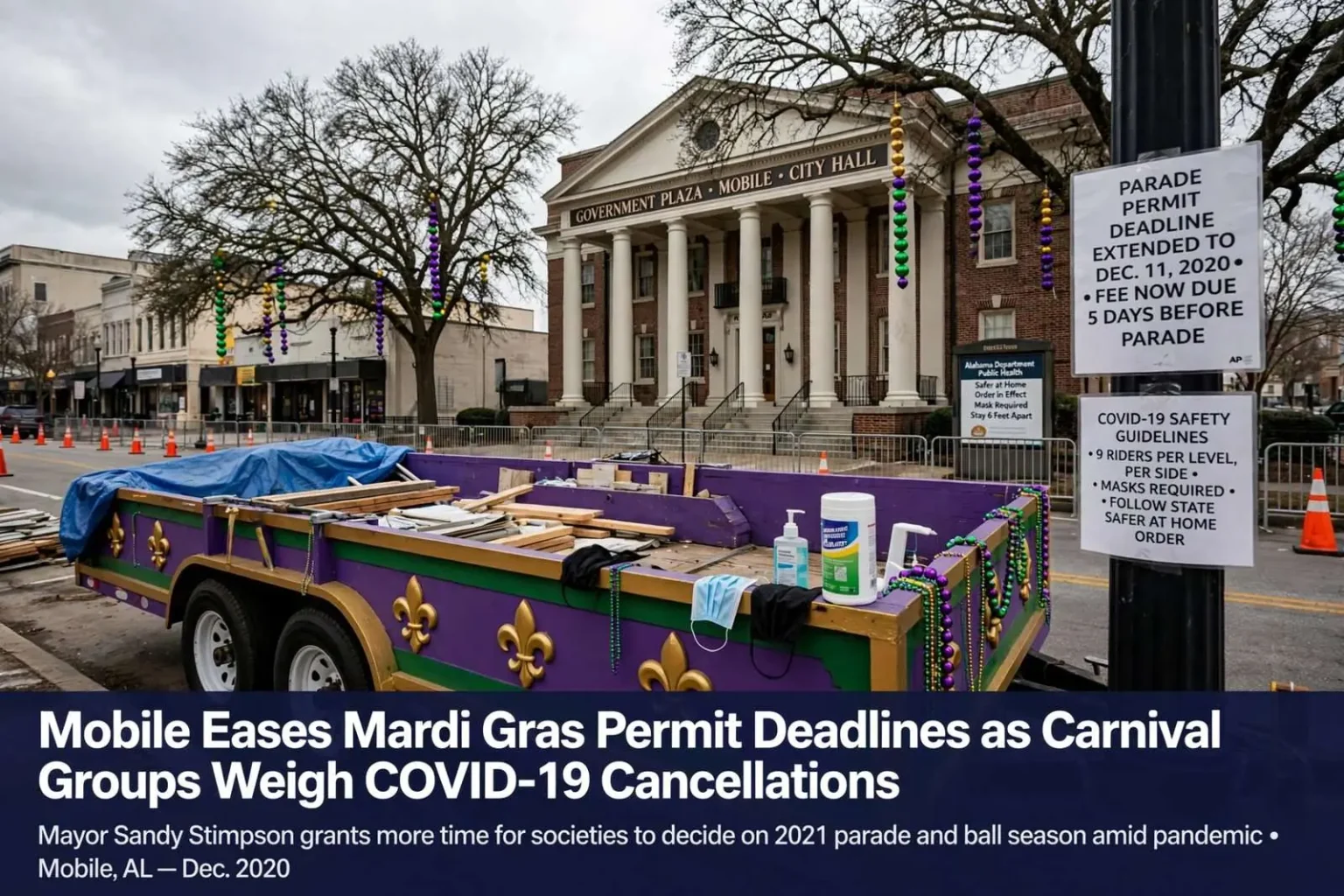
Mobile Mayor Sandy Stimpson is giving Carnival organizations more breathing room to decide whether to hold their 2021 Mardi Gras parades and balls, as the ongoing COVID-19 pandemic continues to prompt mystic societies across the city to scale back or scrap their plans altogether.
The changes were spelled out in a memorandum sent to parading organizations following a virtual meeting the mayor’s office held with society representatives. The letter softens several deadlines that groups would normally have to meet months in advance, giving them more flexibility to wait and see how the public health situation develops before committing time and money to a parade or ball.
The flexibility amounts to a bet by City Hall that patience can save the season. Rather than forcing each society to declare months ahead of time whether it will parade, the city is letting them hold their places on the calendar while the pandemic’s trajectory becomes clearer — a calculation aimed at the dozens of organizations still weighing their options.
Parade permits without the upfront cost
Under the revised guidance, societies now have until Dec. 11 to apply for a parade permit, but they will not have to pay the associated permitting fee until five days before their parade is scheduled to roll.
That change effectively lets organizations lock in a parade route and date without having to pay upfront, months before Carnival season begins in earnest. In a normal year, the permit calendar forces societies to commit their money to a season they cannot yet see; the revised terms let a society preserve its slot and then withdraw, at no cost, if conditions make a parade impossible.
For parading organizations, whose budgets rest on membership dues and whose parades represent the payoff of a full year of float construction and planning, the difference between committing in early fall and committing five days before the first throw is substantial. A society can keep a float project moving without risking its fee on a season that may not happen.
Easier cancellations for the balls
The city is also loosening the rules for ball reservations at venues owned by the city and managed by ASM Global. Under the new policy, groups can cancel those reservations without penalty up to a week before the event.
Any deposit a society has placed with ASM Global for a Mardi Gras venue will be refunded if the group cancels because of concerns about spreading COVID-19. The city manages a roster of civic venues — the Civic Center among them — that anchor the ball season each winter, and the deposit policy had been one of the harder commitments a society had to make months ahead of Carnival.
If a ball is called off, alcoholic beverages already purchased through ASM Global will be paid for by the city and set aside for the organization’s use during the 2022 Mardi Gras season. That provision addresses one of the less visible costs of a canceled ball: the inventory a society has already ordered for its ball night, which would otherwise sit as a sunk expense. Under the city’s terms, the stock carries over to the following season rather than going to waste.
The state order that governs it all
The flexibility comes as Gov. Kay Ivey’s Safer at Home order remains in effect, with an extension pushing it to at least Dec. 11. City officials say it is not yet clear whether the order, or some successor to it, will still be active by the time parades are scheduled to roll during Carnival season.
If the order remains in place, the city’s legal department has determined that floats could carry as many as nine riders per side and per level at the same time.
That interpretation gives parading societies a working answer to the question that most affects their plans: how many maskers a double-decker float can hold while keeping the spacing the state order contemplates. A traditional float’s two levels and two sides can seat dozens of riders; the legal reading means a society can size its rider lists and its float fleet against a specific, predictable limit rather than guessing.
Any additional restrictions beyond the state’s Safer at Home order, or whatever order follows it, would fall to the Mobile County Health Department to decide, according to the guidance.
City officials described the matter as fundamentally a public health issue that rests within the health department’s authority, and said they would continue relaying new information to Carnival organizations so group leaders can make informed decisions. The arrangement keeps the health department — the agency that has tracked the county’s case counts, testing and hospital capacity throughout the pandemic — at the center of any further Carnival rulings, with City Hall acting as the channel of information to the societies.
Who has already called it off
Several mystic societies have already announced they will not parade or hold balls in 2021. Crewe of Columbus has called off both its parade and its ball for the coming season. The Order of Polka Dots has likewise canceled both of its scheduled events. The La Krewe de Bienville parade, traditionally held on Joe Cain Day, has also reportedly been scrapped for 2021.
Each cancellation carries its own weight in the Carnival calendar. The Crewe of Columbus and the Order of Polka Dots are fixtures of the parade lineup, and La Krewe de Bienville’s Joe Cain Day procession caps one of the most storied weekends of the season — the Sunday that honors the eccentric founding figure of Mobile’s Carnival revival, when the streets fill with the red-feathered tribes and the day belongs to the city’s oldest legends.
For the societies that canceled, the decision turned on the arithmetic of commitment: a parade requires months of float work, costume orders, insurance, band contracts and member dues, all spent against a season whose public health conditions cannot be known in advance. A ball requires a venue deposit, catering, a band and an inventory of drinks — commitments the city’s new terms now cushion, but which still represent real money against uncertain attendance.
What the season is worth
Mardi Gras is a major economic and cultural event for Mobile, drawing thousands of visitors downtown each year for parades, balls and related festivities. The string of cancellations reflects the uncertainty facing organizers as they try to balance decades-old Carnival traditions against ongoing public health concerns tied to the pandemic.
Restaurants, hotels and downtown merchants build their winter around the season’s crowds, and each canceled parade removes a night of that business from the calendar. The societies themselves are civic institutions, several tracing their lineages more than a century back, and a lost season for any of them is a lost chapter in an unbroken tradition. That history is precisely why City Hall’s approach has been to coax rather than compel — to make waiting cheap and canceling reversible.
City officials have indicated they hope the eased permitting and cancellation terms will encourage groups that are still undecided to hold off on canceling and instead wait closer to Carnival season to make a final call.
The calculus for the undecided societies will sharpen as Dec. 11 approaches. If the state’s health orders are easing and case trends improve, the societies that held their slots can parade with their fees due only days before rolling. If conditions worsen, they can step back with deposits refunded, inventory banked for 2022, and their places on the calendar waiting for the next Mardi Gras — a season that, unlike this one, no pandemic will have had months to shape.
Why the deadlines matter so much
Mardi Gras in Mobile runs on a schedule set nearly a year in advance. Societies choose themes and begin float construction after the previous season ends; costume and throw orders are placed over the summer; venue bookings for balls are locked in long before the first moon pie lands. The permit process for parades — routes, dates, times, police support and street closures — is one of the last formal checkpoints in that pipeline, and under normal rules it demands payment months before Ash Wednesday.
The 2020 pandemic broke that pipeline. Festivities wound down just as COVID-19 arrived in Alabama, and the societies planning for 2021 spent the summer and fall weighing commitments against a virus whose course nobody could chart. A deadline that once asked for little more than administrative housekeeping suddenly asked each organization to underwrite a public event against an uncertain future — which is what the mayor’s memorandum set out to change.
How the nine-rider rule reads
The legal department’s determination — nine riders per side, per level — translates the state order’s gathering limits into the vocabulary of a float. A standard parading float is essentially a rolling two-story platform, with riders spaced along both sides on each level and a driver below. The reading lets societies calculate their rider rosters exactly: a two-level float under the state order could carry up to 36 maskers, distributed according to the society’s design.
Whether that limit survives to parade season depends on the state order in effect next February. The Safer at Home order has been extended repeatedly, each extension adjusting the gathering rules as the state’s numbers moved. Carnival organizations will be watching each update, because the difference between the current limits and whatever follows determines how many members ride, how many throws are made and, ultimately, whether a parade is worth the expense of rolling.
The city’s role in a season it does not run
Mardi Gras in Mobile is organized by private societies, but the city is its indispensable stagehand: it issues the permits, closes the streets, provides police and sanitation, and owns several of the venues where the balls are held. That is why the easing of deadlines had to come from the mayor’s office and had to involve ASM Global, the management company that operates the city’s venues.
The memorandum did not order anyone to parade or forbid anyone from canceling. It adjusted the terms of the city’s own dealings — fees, deposits, purchased goods — so that the cost of waiting would fall on the city rather than the societies. Officials framed the decision in plain terms: if Mobile’s Carnival season survives the pandemic, it will be because the societies that wanted to roll found a way to wait, and the city made the waiting affordable.
For now, the calendar holds its shape. The societies that remain committed will spend the fall finishing floats against a Dec. 11 permit deadline, the balls still hold their nights in the city’s venues, and downtown keeps its parade routes penciled in — with every penciled line erasable, at no penalty, until a week before it would have mattered.