
Mobile Extends Carnival Fantasy Cruise Contract Through 2019
Mayor Sandy Stimpson signed a one-year extension keeping the Carnival Fantasy homeported at the Port of Mobile through November 2019.
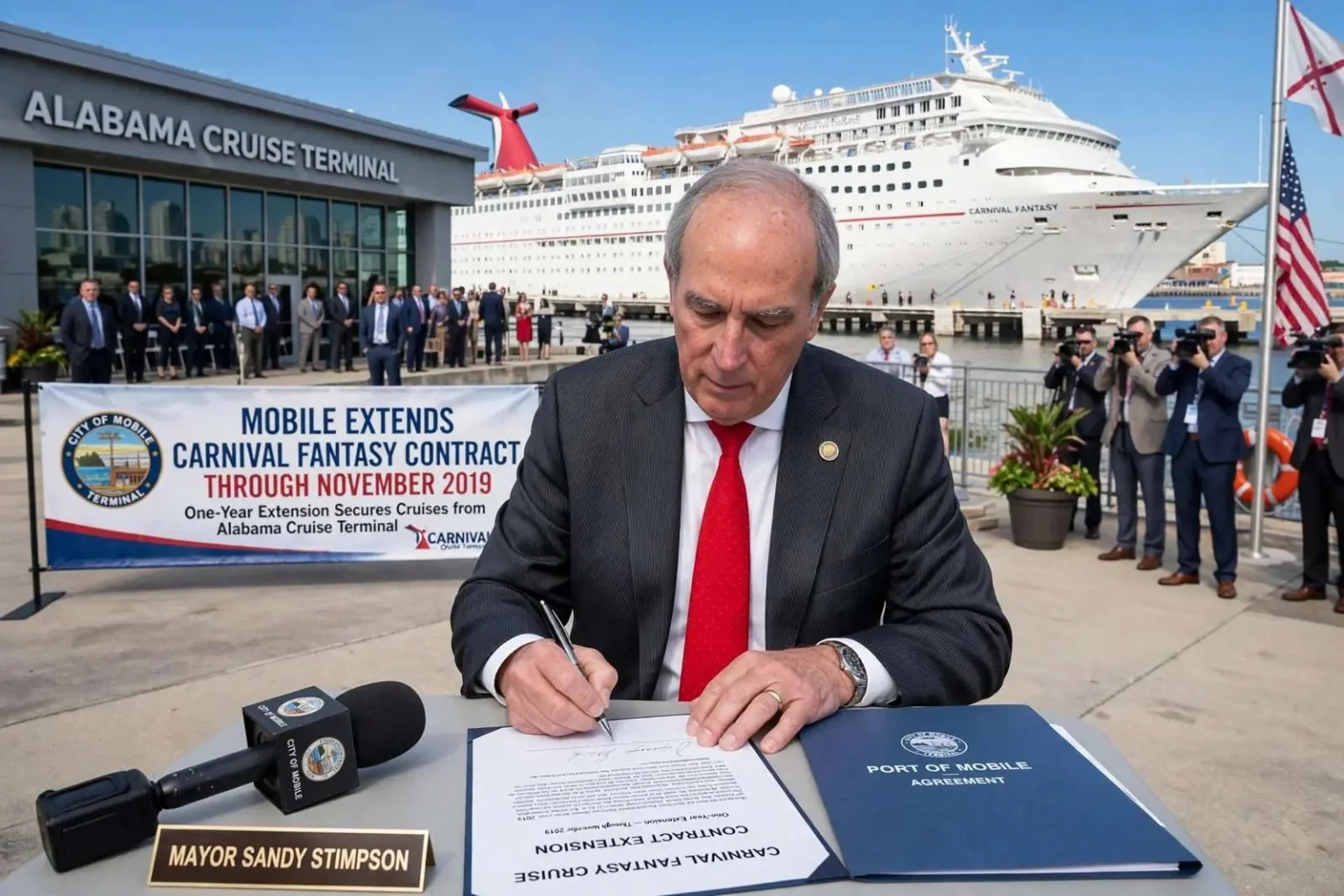
Mayor Sandy Stimpson signed a one-year contract extension Monday that will keep the Carnival Fantasy sailing from the Port of Mobile through November 2019, securing the cruise ship’s presence in the city for another full season of sailings. The agreement follows the city’s 2015 deal that brought Carnival back to Mobile, and the 2017 extension that carried the ship through December 2018. With the latest signing, Carnival exercised the first extension option from that original agreement, a mechanism both sides built into the contract to allow the partnership to continue without renegotiating from scratch.
The Carnival Fantasy has been the lone cruise ship homeported at the Alabama Cruise Terminal since Carnival’s return to Mobile, and it has functioned as a reliable engine of foot traffic for downtown. On a regular schedule of departures, the vessel brings thousands of passengers into the city, many of whom arrive a day early or linger after a cruise, filling hotels, restaurants, and attractions along the waterfront and into the historic districts. Port officials have long described that steady stream of visitors as one of the most consistent economic drivers on Mobile’s riverfront.
A Tourism Engine for Downtown
“We worked hard to recruit the cruise industry back to our city, and we’ve worked even harder to ensure its future,” Stimpson said. “Carnival’s presence has played a major role in our pursuit to establish Mobile as a major tourist destination.”
City leaders have counted the cruise terminal among the anchor investments that reshaped downtown Mobile over the past two decades, alongside the convention center and the revitalization of Dauphin Street. The terminal sits on the Mobile River just south of downtown, and cruise days reliably produce surges of business for parking operators, shuttle services, restaurants, and shops within walking distance or a short drive of the berth. Each sailing also supports dockworkers, line handlers, security staff, and the transportation crews who provision the ship with food, fuel, and supplies before it leaves port.
Mobile’s cruise story has not always been smooth. The city built the Alabama Cruise Terminal in the mid-2000s with high expectations, but Carnival pulled the Fantasy from Mobile in 2011 amid industry repositioning and questions about the terminal’s finances, leaving the facility to sit largely idle and its debt burden to become a recurring point of criticism at City Hall. For years afterward, the prospect of reviving cruising from Mobile was treated as a test of whether the city could make good on a costly public investment.
The 2015 agreement marked the turning point. Negotiated during Stimpson’s first term, the deal brought Carnival back at a lower guaranteed cost to the city than the original arrangement, and ridership responded strongly enough that the line extended its commitment in 2017. The extension signed this week continues that trajectory, and city officials have pointed to the sequence of renewals as evidence that the cruise business in Mobile now stands on its own merits rather than on heavy public subsidy.
What the Extension Means for Travelers
For Gulf Coast residents, the extension means the Fantasy’s familiar schedule of short cruises remains in place through late 2019. From Mobile, the ship has typically offered four- and five-day itineraries to the western Caribbean, with calls at ports such as Cozumel and Progresso in Mexico, giving area families a drive-to departure point that avoids the cost and logistics of flying to larger cruise hubs in Florida. Travel agents across south Alabama and the Florida Panhandle report that the ability to board in Mobile is a deciding factor for first-time cruisers and for older travelers who prefer to keep the trip entirely within driving distance.
The Fantasy itself is a veteran of the Carnival fleet, a Fantasy-class vessel that has been homeported in more than a dozen cities over its career. While it is smaller than the mega-ships now being built for the industry, its size is well matched to Mobile’s terminal and to the market the line serves here, where the appeal is convenience and value rather than onboard spectacle. The ship carries roughly two thousand passengers per sailing, and with a full schedule of departures the annual passenger count through the port runs well into the six figures.
The Broader Port Economy
Cruise activity is only one slice of the maritime economy at the Port of Mobile, which ranks among the busiest deepwater ports on the Gulf of Mexico. The state dock complex handles containerized cargo, breakbulk freight, forest products, and steel, and the adjacent Alabama State Port Authority facilities support thousands of jobs across the region. Tourism officials note, however, that cruising occupies a distinct niche: whereas cargo traffic moves through the port with little public visibility, every cruise departure puts the waterfront on display for a crowd of vacationers, many of them from outside Alabama.
That visibility matters to the city’s broader tourism strategy. Mobile has worked in recent years to build a reputation as a destination in its own right, marketing its Mardi Gras heritage — the city claims the oldest carnival celebration in the United States — its antebellum and Victorian architecture, the USS Alabama Battleship Memorial Park, and a growing calendar of festivals. Cruise passengers who might otherwise drive straight to the terminal are a natural audience for those attractions, and hospitality businesses downtown tailor weekend promotions around scheduled sailings.
Regional economic development groups have also pointed to the cruise terminal as a factor in recruiting decisions, a visible sign that Mobile is a city with functioning amenities and an active waterfront. Hotels near the airport and along Government Boulevard absorb much of the pre-cruise lodging demand, while the parking operations tied to the terminal generate revenue that helps offset the facility’s operating costs.
City officials did not announce further options under the renewed agreement, but both sides described the relationship as stable, and the structure of the 2015 contract leaves room for additional extensions should ridership continue to justify them. For now, the immediate effect of Monday’s signing is certainty: travelers can book Mobile departures more than a year out, and the businesses that depend on cruise traffic can plan around a schedule that runs through November 2019.
Cruise Competition on the Gulf
Mobile’s renewal also lands in a competitive context. New Orleans and Tampa have long operated larger cruise programs with multiple ships and more varied itineraries, and Galveston has grown into one of the busiest homeports in the Gulf thanks to its highway access from Texas’ population centers. Against that competition, Mobile’s pitch has been convenience for residents of south Alabama, Mississippi, and the western Panhandle — a terminal reachable in under an hour for most of the immediate region, with none of the bridge traffic or congestion associated with the bigger ports. Retaining the Fantasy preserves that option; losing it, as the city learned between 2011 and 2015, would leave a vacuum that would be expensive to fill a second time.
The extension also stabilizes employment tied directly to the ship’s presence. Cruise operations require tugboat services, pilots from the state’s bar pilots association, customs and border protection staffing, terminal security, housekeeping, and baggage handling crews, along with the local transportation operators who shuttle passengers between the terminal and hotels. While none of those positions depends on a single vessel alone, the Fantasy’s regular schedule provides a dependable baseline of activity that makes staffing and investment predictable for the businesses involved.
Looking Ahead
Stimpson’s administration has framed the cruise program as part of a larger waterfront strategy that includes continued public investment in the riverfront and Cooper Riverside Park, plus private development downtown that has added residences, hotels, and restaurants within sight of the terminal. Each renewal of the cruise contract, officials say, strengthens the case for that investment by demonstrating sustained demand for a lively waterfront.
For the passengers who have made Mobile a habit — many of them repeat cruisers from Baldwin County, Mississippi, and the Panhandle — the extension simply removes uncertainty. The Fantasy will sail from the Alabama Cruise Terminal through November 2019, keeping a familiar routine intact and keeping thousands of visitors a month arriving in downtown Mobile with time and money to spend.
The sequence of agreements since 2015 has also changed the tone of the debate at City Hall, where the terminal’s early years of debt and vacancy once dominated budget discussions. Council members who once questioned the facility’s future now point to the steady cruise schedule when defending the investment, and the administration has treated each renewal as a benchmark of the turnaround. Should Carnival eventually reposition a newer or larger vessel to Mobile, the operational track record built on the Fantasy’s years of service would form the foundation for that next step. Until then, the city and the line will keep evaluating the option years one at a time, exactly as the contract’s authors intended.


