Fashion Model From Mobile Identified in National Gallery of Art Photograph
Manasie Ree Horn, a Mobile woman photographed during the Black Arts Movement, has been officially identified in the National Gallery of Art's collection after her son recognized her image and submitted documentation.
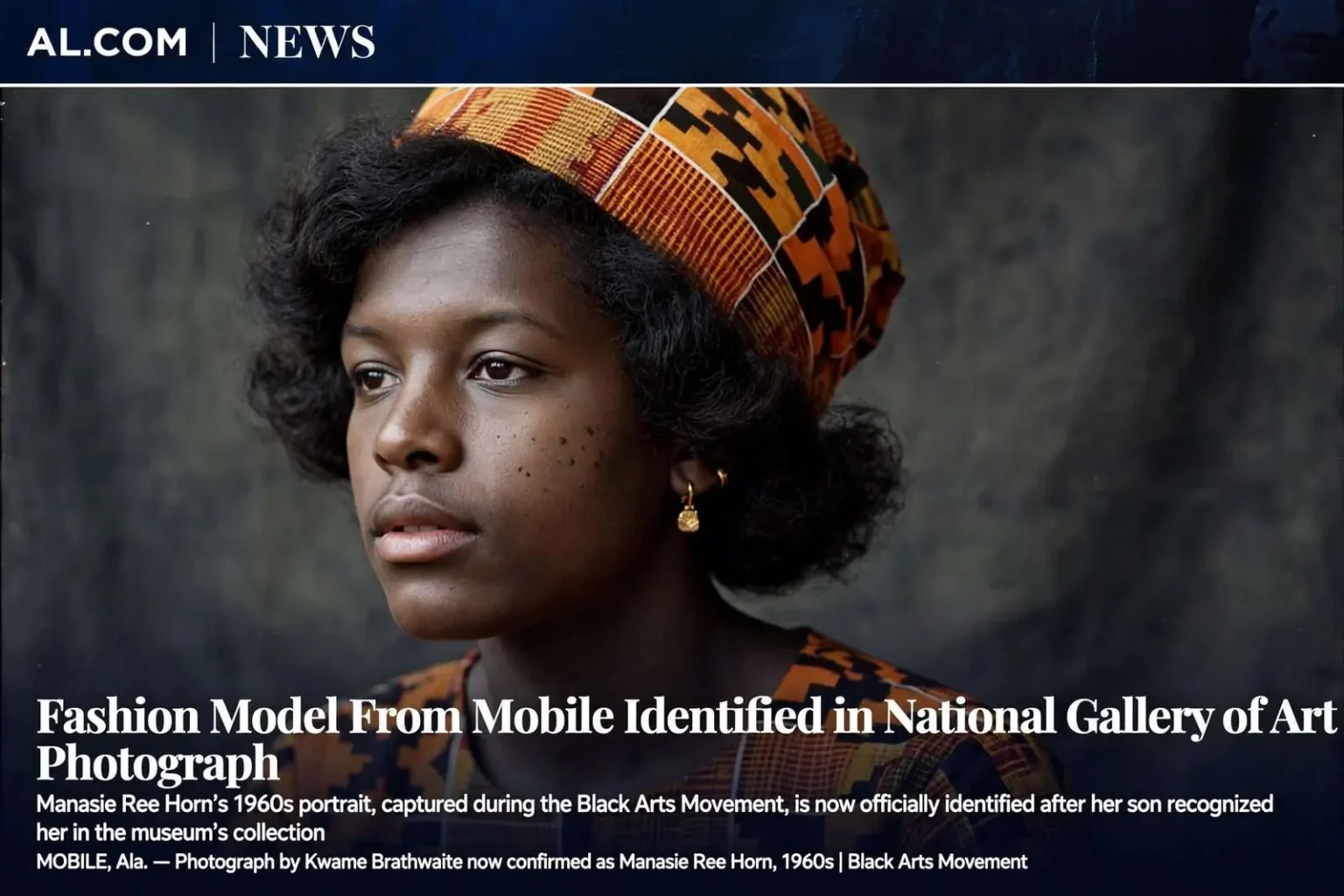
MOBILE, Ala. – A Mobile woman’s image, captured decades ago during the Black Arts Movement, is now officially identified in the National Gallery of Art’s collection – the result of her son recognizing her in a photograph and submitting documentation to the museum.
From Mobile to New York
Manasie Ree Horn grew up in the Roger Williams Homes and graduated from Central High School in 1960. She later studied at what is now Bishop State Community College before leaving Mobile for New York to pursue a career in fashion.
Her son, Zane Horn, said his mother went on to become a professional model in New York – a bold step for a young woman from Mobile.
“I would imagine at the age of 19 or 20, she must have been scared. But it took a lot of courage to go somewhere. Could you imagine seeing the subway for the first time coming from Mobile?” Zane Horn said.
A photograph without a name
Photographer Kwame Brathwaite captured Manasie Ree Horn’s image during the Black Arts Movement. One of those photographs eventually entered the National Gallery of Art’s collection – but for years, the woman pictured was unidentified.
A cousin’s discovery
The identification began with a chance encounter. Zane Horn’s cousin visited the Getty Center in Los Angeles and spotted a familiar face in a Black Arts Movement exhibit. She sent the photograph to family, asking if it was Manasie. Zane Horn immediately recognized his mother.
“I always took care of her stuff. And I just, you know, people say it looks like she’s still here,” he said.
When he saw the photograph, he noticed his mother’s name was missing. He submitted documentation to the museum and the National Gallery of Art, and the portrait is now officially identified as Manasie Ree Horn and part of the Gallery’s collection.
A wall of recognition in Jackson
The exhibit has traveled from Washington, D.C., to Los Angeles and now to Jackson, Mississippi. For Zane Horn, seeing it there was overwhelming.
“We went up to Jackson, Mississippi, to the Jackson Museum of Art, and as we pulled into the city, pulling up to the museum, on every pole leading to it was her picture. That’s when it hit me. And once inside, that’s when I saw the full wall with her picture on it. And I just sat quietly, and you know, I had that little moment,” he said.
Recognition after all these years
Zane Horn said his mother often faced criticism about her body but went on to earn national recognition.
“To see something like this, to get recognition after all these years, when they told her her legs was too skinny, but now she’s in the National Archives forever in Washington D.C. Go figure,” he said.
Manasie Ree Horn died in Mobile on Aug. 4, 2002, at age 61. Her portrait is part of “Photography and the Black Arts Movement, 1955-1985,” on display at the Mississippi Museum of Art in Jackson through Nov. 8.
About the photographer
Kwame Brathwaite was among the movement’s most influential photographers, known for images that challenged narrow standards of beauty and affirmed Black pride. A Harlem-based photographer who died in 2023, Brathwaite is widely credited with helping popularize the phrase “Black Is Beautiful” through his work in the late 1950s and 1960s, including his portraits of the Grandassa Models, a collective of Black women models he and his brother, Elombe Brath, organized to showcase natural hairstyles and African-inspired fashion.