Mobile Filmmaker Drew Hall Brings Sci-Fi Trilogy to the Crescent Theater
Mobile native Drew Hall directs Mudbrick Media's sci-fi trilogy, with Skyhook: The Phoenix Rises screening at the Crescent Theater in December 2012.
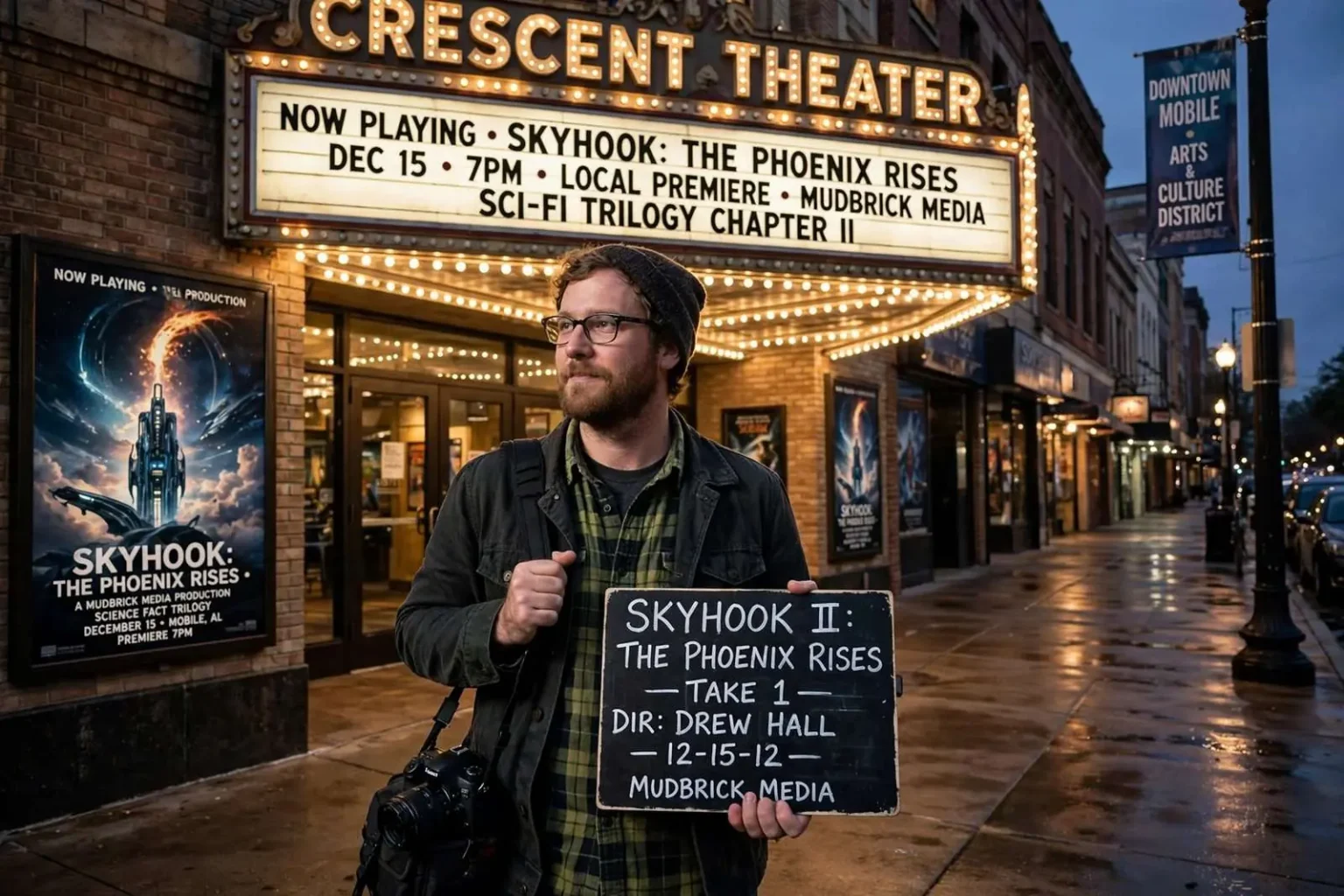
In December 2012, Mobile-based filmmaker Drew Hall was preparing to unveil the second installment of an ambitious science fiction trilogy produced by local production company Mudbrick Media. The film, titled Skyhook: The Phoenix Rises, was set to screen at the Crescent Theater in downtown Mobile on December 15th.
For a city better known for shipbuilding and Mardi Gras than for space elevators and energy weapons, the screening marked a quiet milestone: a homegrown director premiering the second chapter of a locally produced science fiction franchise, in a downtown theater that had become the gathering place for Mobile’s independent film community.
Hall, a Mobile native and University of South Alabama graduate, had taken a winding path to the director’s chair. Growing up in Mobile, he spent his formative years frequenting local video stores and absorbing films ranging from the blockbusters of Steven Spielberg and George Lucas to the gritty cinema of the 1970s.
That double education — the spectacle of the blockbuster tradition and the texture of the 1970s films that inspired it — shaped the sensibility he would bring to his own work. The science fiction he grew up watching taught scale; the grittier cinema taught character.
A pivotal moment came when he entered a short film into an American Film Institute student contest, shooting on a VHS-C camera and editing with two VCRs.
The tools were as humble as filmmaking tools get: a consumer camcorder and two tape decks, shuttling between them to cut. What the exercise proved was instinct — a student could make something with a beginning, middle and end, and want to make more.
From South Alabama to the Director’s Chair
At the University of South Alabama, Hall was among the first students to work with the school’s new Avid digital editing suites. Before that, he learned the craft on reel-to-reel systems, an experience he credited with teaching him the fundamentals of timing and pure editing.
The sequence of technologies he learned in reverse order of history — tape before digital, splicing before timelines — gave him a grounding that pure-digital editors rarely develop. Cutting on physical systems forces a filmmaker to know exactly where every frame lives; the Avid then multiplied how fast that knowledge could be applied.
Professors Dr. Lia Hotchkiss in the English department and Dr. Richard Ward in Communications played instrumental roles in his development, allowing him the freedom to explore filmmaking on his own terms.
That freedom — unusual for a program with fixed curricula — let Hall treat his coursework as raw material for his own projects rather than assignments to complete. The two professors named in his account stand for the kind of faculty support that turns a regional university into a filmmaker’s first studio.
After graduating, Hall moved to Missouri, where he served as vice president of production at an advertising agency. There, he wrote and directed a branded web series that reignited his passion for filmmaking.
Advertising is where many directors learn to work fast, cheap and decisive — to solve a visual problem in days rather than months. The branded web series gave Hall the writer-director experience commercial work rarely allows, and it sent him back toward narrative filmmaking with a producer’s discipline intact.
When that chapter closed, Hall and his wife Sara returned to South Alabama, settling on Dauphin Island. He took a job making commercials in Gulf Shores, where he connected with filmmaker Dusty Bias, whose independent feature Prairie Love proved that compelling films could be made anywhere.
Bias’ example mattered for what it demonstrated rather than what it earned: a serious feature could be made far from any industry center, by people already living where they wanted to live. For a filmmaker deciding between a coast-adjacent life and a Hollywood-adjacent one, that proof changed the calculation.
The Mudbrick Media Connection
Hall’s big break came through a phone call. Todd Hall (no relation) reached out on behalf of Mudbrick Media executive producer Denny Wilkins, who was looking to produce a feature film. Cinematographer Scott Lumpkin had recommended Drew as a potential director of photography.
The chain of introductions — a cinematographer’s recommendation, a name that matched his own, a call from an executive producer — is how regional film careers actually begin: not at agent offices, but through the working relationships of people already shooting something nearby.
After shooting Mudbrick’s first feature, Counter-Clockwise, Wilkins offered Hall the chance to direct Skyhook, the first film in what would become the company’s “science FACTion” trilogy.
Moving from cinematographer to director between projects was the decisive promotion of Hall’s career — a producer who had seen his work up close deciding the vision behind the camera should be the one running the set.
Hall described Mudbrick Media as a talent development center and creative playground for filmmakers. The company operated on a model reminiscent of the old studio system, providing resources and paying its crew while allowing creative freedom — as long as filmmakers could defend their artistic choices.
The old-studio comparison is precise. The classic studios functioned by keeping people working — writers, directors, crews — under one roof with steady pay and a pipeline of projects, so that craft accumulated from film to film. Mudbrick’s version traded the contract system for a philosophical one: resources and payroll in exchange for accountability to the work itself.
The Sci-Fact Trilogy
Written by Wilkins, the trilogy follows a team of brilliant scientists whose adventures carry a unifying theme: that scientists can be heroes too.
The premise inverts a genre habit. Science fiction has long cast its scientists as cautionary figures — the makers of monsters, the creators of machines that get out of hand. Wilkins’ trilogy puts them in the action-hero role instead: the experts whose knowledge is the plot’s engine, not its warning.
In Skyhook, the team is tasked with building the world’s first space elevator, only to face sabotage from a mercenary who plants an agent among them.
The space elevator is the trilogy’s founding ambition — the engineering project that would change how humanity reaches orbit — and the mercenary’s infiltration gives the first film its thriller spine: an enemy inside the team, working against a project that cannot be built twice.
The sequel, The Phoenix Rises, finds the team recruited by a secretive Department of Defense program to develop countermeasures against an energy weapon, while dealing with threats from their past.
The second film moves the team from civilian science to the defense establishment, and from building to defending — countermeasures against a weapon, while the personal history each scientist carries begins to catch up. It was the film Mobile audiences were set to see at the Crescent in mid-December.
The trilogy was set to conclude with Sons of Liberty, in which the team would tackle dirty bomb detection while investigating a serial killer.
The finale’s pairing — a terror-prevention mission and a murder hunt in the same story — suggested the third film would fold the trilogy’s science-hero theme into its darkest stakes yet, with the team working at the intersection of physics and crime.
Rock and Roll Meets Filmmaking
One of the more unusual aspects of the Mudbrick productions was the involvement of Page Hamilton, frontman of the influential rock band Helmet. Hall and Hamilton had met at a Helmet concert in Mobile, and Hamilton’s music had been a formative influence on Hall since he first heard the band’s Meantime album as a teenager.
Helmet’s sound — heavy, precise, rhythm-driven — had been the soundtrack of Hall’s adolescence, and the fact that its composer ended up scoring his films closed a circle that began in a Mobile video store and a concert venue. The meeting in Mobile turned a fan into a collaborator.
Hamilton, along with his composition partner Patrick Kirst, a music professor at USC, composed the score for Skyhook and was working on music for The Phoenix Rises.
The pairing gave the trilogy a score from two distinct worlds: Hamilton’s alternative-metal instincts and Kirst’s conservatory training. For a low-budget science fiction production, that level of original scoring was itself a statement about the seriousness of the project.
Building Alabama’s Film Industry
Hall was a vocal advocate for growing the film industry in Alabama. He praised the Alabama Film Office, led by Tommy Fell, as well as local film commission representatives Eva Golson and Diane Hall for their support of productions in the region.
The offices he named were the state’s connective tissue for production: the state film office coordinating incentives and permitting, and the local commissions — Golson’s in Mobile and Diane Hall’s in the region — doing the on-the-ground work of matching crews to locations and productions to communities.
He pointed to locations across the state — Sloss Furnaces in Birmingham, limestone quarries in Huntsville, and historic sites in Montgomery — as evidence that Alabama could serve as a diverse backlot for filmmakers.
The list mapped the state’s range in three points: a National Historic Landmark of iron industry that looks like nothing else in America, industrial quarries that read as lunar or extraterrestrial, and a capital city’s historic architecture that plays any period. A director scouting Alabama could find, within a day’s drive, sets most states would have to build.
The biggest challenge, Hall noted, was building a deep local crew base. While many aspiring filmmakers gravitated toward directing and cinematography, productions needed skilled workers in dozens of other roles, from production designers and script supervisors to grips and gaffers.
That gap defined the difference between a state with filmmakers and a state with a film industry. Every production arriving in a region hires an iceberg of trades beneath its creative leads — art departments, electrics, camera support, continuity — and the depth of that labor pool is what producers price before they choose a location.
A stronger crew base, he argued, would give producers the confidence to bring more work to Alabama, following the model that had turned neighboring Louisiana into a production hub.
Louisiana’s rise offered the template: incentives drew the first productions, working crews formed around them, and the crews themselves became the state’s best argument for the next round of work. Hall’s argument for Alabama ran the same direction — that the trilogy Mudbrick was building in Mobile, and the premiere at the Crescent, were the early chapters of exactly that accumulation: a state learning, production by production, to keep its own film economy at home.