When Springsteen Played Twice in Mobile: A Radio Man Remembers the City’s Loudest Decade
A former WABB-FM program director recalled 1973 to 1978 as the golden age of Mobile radio and live music, when Skynyrd played Fort Whiting and Springsteen sold out two nights running.
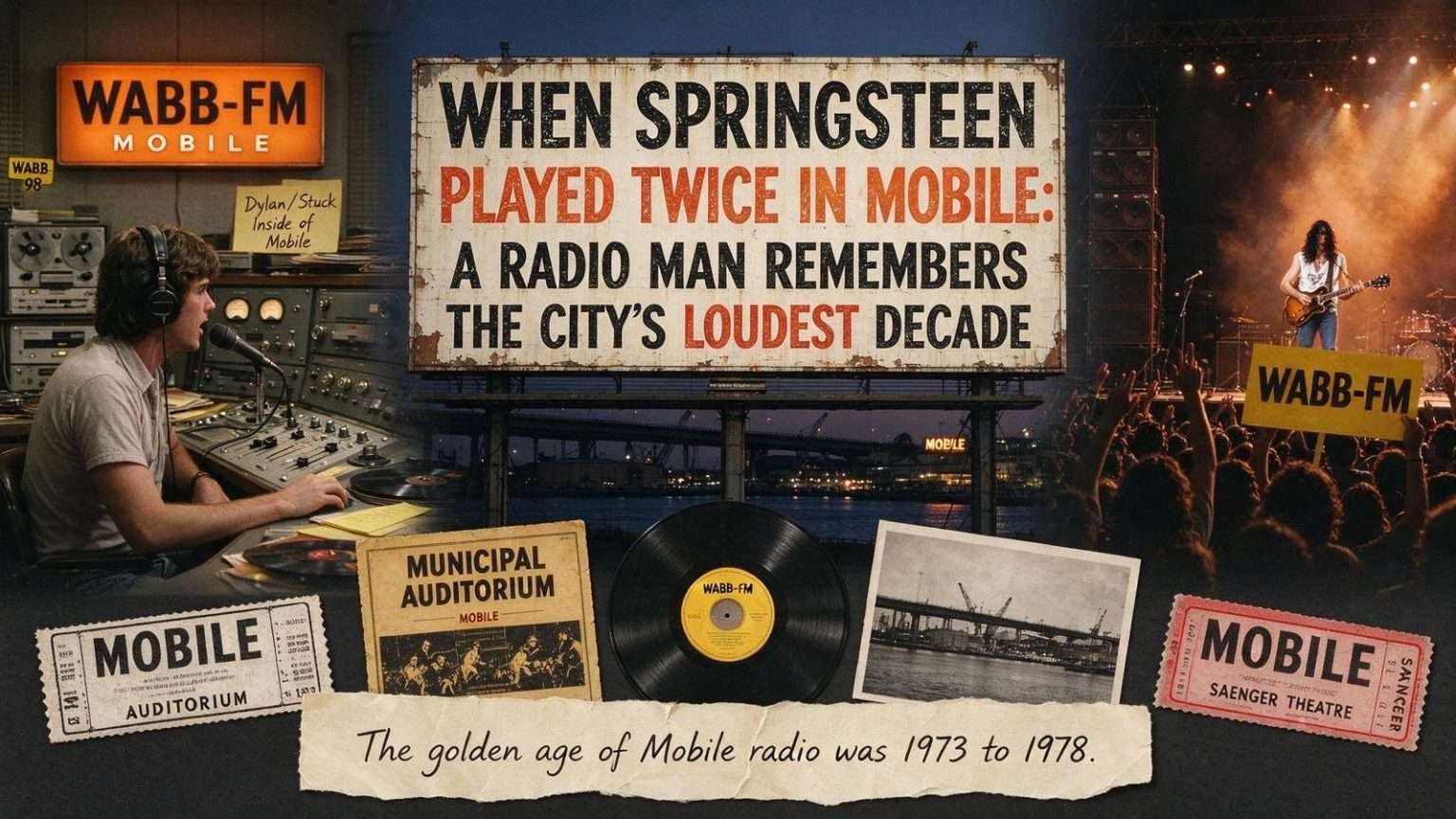
Asked in March 2005 to name Mobile’s golden age, Lee Stamp — a Mobile attorney who had spent the 1970s as program director of WABB-FM — picked a narrow window and made a large claim for it.
“The Golden Age of Mobile radio was from 1973 to 1978,” he wrote. “At least it was for me. While someone might argue that point, it would be hard to argue against the proposition this same period was the golden age of live music in Mobile.”
He had a case. In that five-year stretch, a freewheeling FM station signed on with a mission to play everything its consultants’ format charts said not to, and a downtown auditorium booked the biggest touring acts in America into a city most tours skipped. The combination — a station that sold the shows and a hall that held them — produced a run of concerts that South Alabama had never seen before and has not fully seen since.
Stuck in Mobile
Stamp arrived in 1972 to run the FM station, which one delay after another kept off the air. The concert scene he found was, by his description, uncomplicated: a band needed a color in its name and could not play more than three chords. Deep Purple. Black Oak Arkansas. Pink Floyd — though he allowed he was kidding about Pink Floyd.
On Feb. 5, 1973, at the age of 22, he launched WABB-FM with Bob Dylan’s “Stuck Inside of Mobile with the Memphis Blues Again.” It was, in retrospect, an unimprovable choice — a Dylan deep cut that named the city in its title and gave a brand-new free-form station its first statement of purpose.
“I’m not sure what our listeners expected on that Thursday night,” he wrote, “but eventually we were able to convince a pretty significant group of people we liked rock and roll, and blues and soul, country rock and rockabilly, acid rock and space rock, glimmer and glam, southern rock and southern folk, pop and punk, and other music that defied characterization. And, most importantly, we were able to weave it together so it made sense.”
That mission statement put WABB-FM against the grain of American radio in 1973. AM Top 40 ruled the market, and FM was still the quiet band teenagers tuned past. A station that jumped from John Lee Hooker to southern folk to glam in the same hour was making a bet that Mobile had listeners nobody had counted — young people, soldiers, students — who wanted the whole musical world instead of a playlist.
The jocks
Stamp was a fan of his own station and listened when he was not working.
The lineup shifted constantly, but the all-star roster, in his memory, was formidable: Maja Piff on middays; Lee Moore, the best afternoon-drive jock; Paul Fuller at night; and, in a category of her own, Leslie Fram, who started as a part-timer and rose to become program director.
The best radio he ever heard, he said, was accidental. For a stretch, Fuller began coming in early, and he and Moore would run an unscheduled two-man show from 5 to 6:30 p.m. — two professionals riffing through the drive-time hour with no format clock and no plan, the kind of broadcast that could never survive a modern program director’s schedule and, in Stamp’s memory, never needed to.
The room, the ticket, the show
The only small room in town was Thirstee’s, near the university, where John Prine, Keith Sykes, Ian Matthews and Marshall Chapman made the best ticket in Mobile. A singer-songwriter room wedged near the college crowd, Thirstee’s offered what the big halls could not: a close table, an acoustic set, and the sense that the artist on the small stage might stick around after the last song.
Everything larger played the city’s big venues. The Mobile Municipal Auditorium was the workhorse — a vast exposition hall downtown where touring rock acts could stage full productions and sell thousands of tickets. The Fort Whiting Armory handled mid-size shows, Ladd Stadium hosted the outdoor spectacles, and the Saenger Theatre, the 1920s movie palace on Joachim Street, offered the intimate house that suited solo artists and smaller ensembles. Between the four rooms, Mobile could accommodate nearly any act a promoter wanted to route through the Gulf Coast.
And acts wanted to route through, because the station made it worth their while. WABB-FM’s promotion of a show — on-air spots, giveaway tickets, the jocks’ chatter all week — was, in a market without competing rock FM, the difference between a half-full hall and a sellout. Promoters noticed, and the touring itinerary that once skipped Mobile in favor of New Orleans and Pensacola began including the city as a regular stop.
Two nights with Springsteen
The run’s peak came with Bruce Springsteen, who played Mobile twice in that window as his reputation exploded from club act to national phenomenon. In the mid-1970s, Springsteen’s live show was the hottest ticket in American rock, and a city of Mobile’s size rarely appeared on itineraries at all — twice was an extravagance no other act of his stature matched in that era.
And Bonnie Raitt delivered a tutorial in live performance for which she would not receive proper credit for another decade. Her Mobile appearances came in the years before her commercial breakthrough, when she was a slide-guitar prodigy touring behind albums that critics loved and radio ignored — the kind of booking that marked the station’s taste and the city’s willingness to buy it.
Elvis and Sinatra also came through. They did not need his help selling tickets.
The other names in the era’s ledger — the Allman Brothers at the height of southern rock, Lynyrd Skynyrd as the genre’s standard-bearers, Willie Nelson between outlaw-country triumphs, Frank Zappa on one of his relentless national tours, John Lee Hooker carrying the blues through town — read today like a festival lineup scattered across five years. For a city then dismissed as a one-night stop at best, it was an accumulation no one had predicted.
Why it ended
“Those were the good old days,” Stamp wrote. After a scandal at the auditorium, the concert business in Mobile dried up. Many people blamed the scandal alone; he believed other factors were at work.
His diagnosis was unsentimental. The bottom line is the bottom line. If promoters make money, they come back. And it helps, he added, to have a radio station that sells tickets.
The two forces he named — venue trouble and promotion loss — worked together. A scandal at the Municipal Auditorium unsettled the business arrangements that made the hall usable, and as the 1970s closed, the station that had made Mobile a reliable stop was itself changing, as free-form FM gave way across the country to tighter formats and corporate programming. A promoter deciding where to route a national tour counted both: an uncertain hall and an uncertain promotional partner were enough to send the itinerary back to New Orleans and Pensacola, cities that had never stopped being on the map.
The timing matched a national shift. The mid-1970s was the last era when a mid-size city could count on the major tours passing through, because the economics of touring had not yet consolidated around arena circuits and national promotion firms. By the 1980s, the biggest acts played a fixed list of arenas, and cities without an arena — Mobile among them — watched the itineraries route around them. The golden age ended not because the audience disappeared but because the business changed around it.
What the window left behind
The five-year run left marks that lasted. A generation of Mobilians who came of age between 1973 and 1978 saw, in their own hometown, acts that other cities their size never got; the memories of those shows became the local standard against which every later concert season was measured. The Saenger Theatre, the auditorium, Ladd Stadium and Fort Whiting all carried stories from that stretch into the city’s collective memory, and the station’s alumni — Piff, Moore, Fuller, Fram — carried Mobile radio careers into markets far beyond the Gulf Coast.
Fram’s ascent in particular foreshadowed what came after. A part-timer who rose to program director at 22-something, she went on to a national career in Atlanta radio that made her one of the most prominent programmers in the country — the most successful export of the era Stamp described. Her trajectory is the proof of his claim that the station’s staff was an all-star roster: the format radio of the 1980s hired exactly the kind of broad-taste, high-energy programmers that free-form Mobile had been developing all along.
Stamp himself left radio for law, but the era remained his reference point. When he wrote his remembrance in 2005, he was reconstructing a Mobile that no longer existed — a city with a rock FM monopoly, an auditorium in its prime, and promoters willing to route Springsteen through the Gulf Coast twice. The letter stands as both nostalgia and testimony: the five years from 1973 to 1978 were, by the count of the man who lived them, the loudest and best music Mobile ever heard.
The lesson he drew for the city’s present was plain. Concerts follow certainty — a dependable hall, a dependable promoter, a station that can fill a room — and Mobile had all three once. Rebuilding them, he suggested, was the only route back to the golden age; the acts would come if the arithmetic worked, because it always had.