Mobile’s 100 Best-Paid City Employees, Disclosed in the Middle of a Budget Fight
Documents produced during the city's deficit crisis show 100 employees earning between $63,127 and $161,333. The public works director tops the list, ahead of the police and fire chiefs.
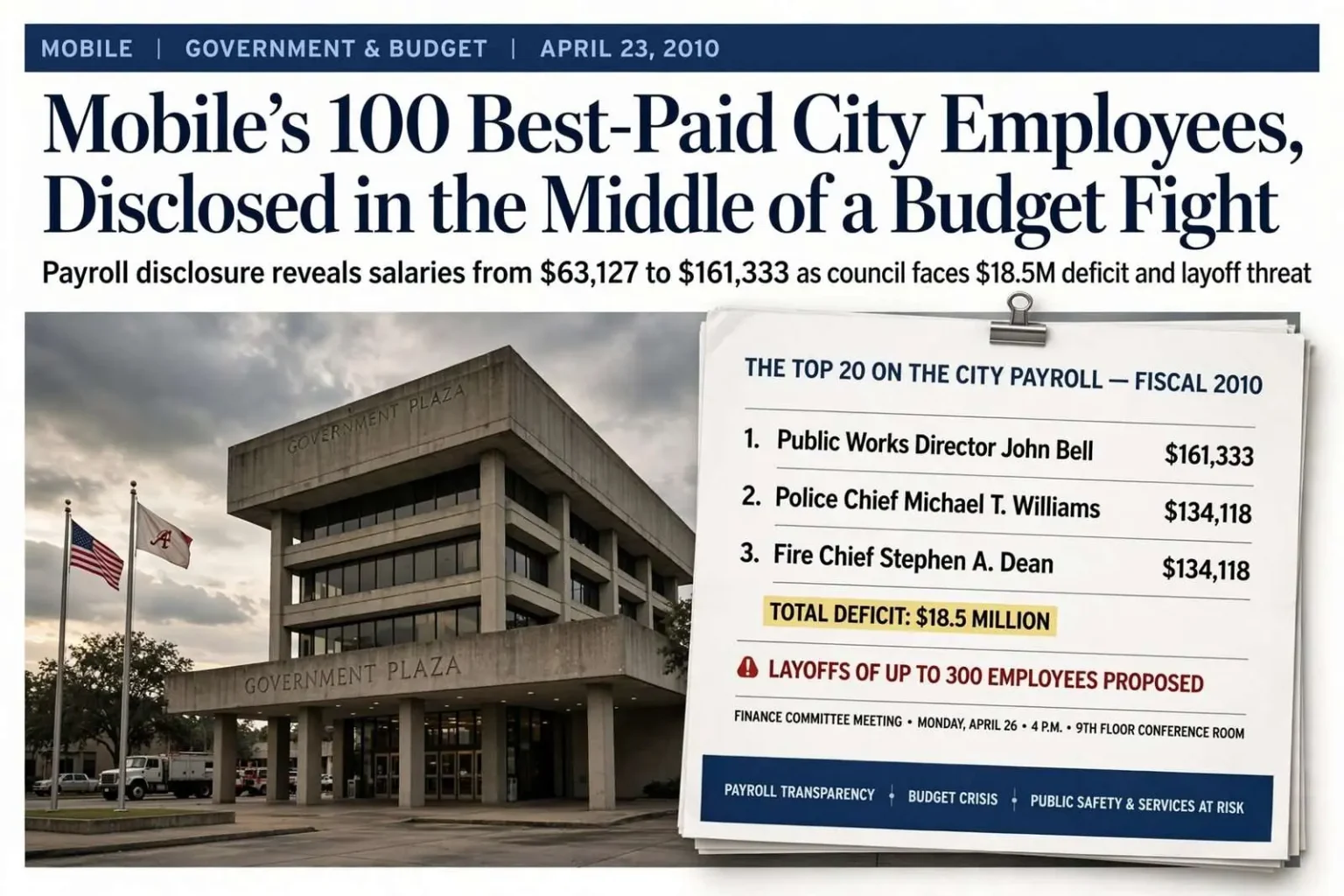
The city of Mobile has 100 employees whose annual pay ranges from $63,127 to $161,333, according to documents developed in connection with the city’s effort to close a projected $18.5 million deficit in its fiscal 2010 budget. The disclosure landed at an awkward moment for city hall. City workers had narrowly escaped a proposed 10-percent across-the-board pay cut, and only days earlier the Mobile City Council had rejected a one-percent sales tax increase, leaving layoffs of as many as 300 employees on the table as the administration hunted for savings. Salary figures, in that climate, were read very carefully by everyone.
Payroll transparency of this kind is unusual in any mid-sized Southern city, and it mattered here for reasons that went well beyond curiosity. When a government is deciding whether to cut services, raise taxes or reduce its workforce, the compensation of the people who run the government becomes part of the public debate. The documents circulated among council members, budget analysts and reporters alike, and the names at the top of the list were familiar to anyone who follows Mobile’s municipal government.
The Top Twenty on the City Payroll
At the very top of the list sits Public Works Director John Bell, whose annual salary of $161,333 made him the city’s best-paid employee. He was followed by the two most visible public safety officials in city government: Police Chief Michael T. Williams and Fire Chief Stephen A. Dean, each drawing $134,118 a year. The symmetry of the two chiefs’ pay reflected the city’s practice of keeping its top uniformed salaries in line with one another.
Just behind them came Assistant City Attorney Flo Kessler at $116,896, a figure that reflected her seniority within the city’s legal department. Chief Deputy Police Chief Lester Hargrove earned $114,369, and Executive Director of Finance Barbara Malkove, the official charged with steering the city through the deficit, earned $113,942. Traffic Engineering Director Bill Metzger was next at $111,395, followed by City Engineer Nick Amberger at $108,678.
The upper ten rounded out with Assistant Fire Chief William Pappas at $106,027 and Mayor Sam Jones’ chief of staff, Al Stokes, at $102,211. Stokes’ position placed the mayor’s office squarely within the ranks of the city’s top earners, a reminder that the people defending the budget plan were also among those whose compensation was being scrutinized.
A cluster of departments tied for the next band of pay. Information Technology Director Sue Farni, Real Estate and Asset Management Director Bill Demouy, and Deputy Police Chief James Barber each earned $100,918, just over the six-figure threshold that tends to attract attention in a budget crunch. These were the officials responsible for the city’s computer systems, its property holdings and a large share of the police department’s day-to-day command structure.
The final eight names in the top twenty were grouped tightly together at $96,056 and below. Deputy Police Chief Joe Kennedy earned $96,056, as did three deputy fire chiefs: Mark Hansberry, Fred D. Sims and Paul R. Smith. Director of Urban Development Laura J. Clarke matched that figure as well, underscoring how closely the city benchmarked salaries across departments of comparable responsibility. Chief Municipal Judge Holmes Whiddon earned $94,494, and City Attorney Larry Wettermark closed out the list at $92,601.
Read as a whole, the top twenty skews heavily toward public safety and public works, the two areas where a city’s obligations are most visible and most labor-intensive. Police and fire command staff accounted for ten of the twenty names. The remainder came from engineering, finance, legal, technology and administrative functions — the professional bureaucracy that keeps a city of Mobile’s size operating from day to day.
The Caveat on the City Attorney’s Figure
The city attorney’s figure requires a caveat that any careful reader of the list should note. Larry Wettermark’s $92,601 likely represents a retainer rather than the full cost of the city’s legal representation, with additional legal work by Wettermark and his firm billed at an hourly rate on top of it. The actual cost to the city of securing legal advice — in litigation, contract negotiation, land use matters and the daily stream of questions that flow through a municipal law department — is therefore higher than the number on the list suggests.
Retainer arrangements of this kind are common among Alabama municipalities of Mobile’s size. Rather than staffing a large in-house legal office, a city pays a private firm a base amount for continuous availability and then pays separately for heavy demands on the firm’s time. The arrangement can be economical, but it makes true legal costs harder to read from a salary table, which is precisely why the caveat matters in a budget discussion.
What the Numbers Leave Out
Salary, in any case, is not the whole of compensation. Some city employees also receive benefits including favorable health insurance terms, take-home vehicles, food allowances and participation in the state’s Deferred Retirement Option Program, known as DROP. Those benefits are harder to price and rarely appear in the tables that circulate during a budget fight. They are, however, real money, and they are part of what a city buys when it hires a department head.
DROP deserves particular attention in an Alabama context. The program, administered through the Retirement Systems of Alabama, allows employees who reach retirement eligibility to declare a retirement date and then keep working for a set period, collecting retirement benefits into an account while their salary continues. For the city, the arrangement can retain experienced leadership for a few extra years, but it also carries costs that do not show up as salary. For employees, it can substantially increase the total value of a career spent in public service.
Health insurance is the other large invisible line. A family coverage plan worth well over $10,000 a year at the time functioned as a meaningful supplement to any salary on the list, and take-home vehicles — standard for public safety commanders and public works leadership — represented both compensation and a cost the city bore directly. When officials and residents compared the payroll to private-sector pay, these additions mattered.
The Context Behind the List
One hundred employees earning $63,000 or more is not, in itself, evidence of anything improper. Mobile is a city of roughly 200,000 people with a municipal workforce of about 2,550, and it employs engineers, lawyers, chiefs and directors who could plausibly earn more in the private sector. A city engineer certified in Alabama competes with private firms in Mobile and Baldwin counties for talent; a finance director with municipal bond experience is equally marketable. The comparison that matters is not to a household budget but to what other cities of similar size pay for similar work.
That said, lists like this one circulate for a reason. When a mayor proposes cutting every employee’s pay by 10 percent and a council contemplates laying off as many as 300 people, the question of what the top of the payroll looks like is one the public is entitled to ask. The arithmetic is inescapable: the difference between top salaries and median municipal wages becomes a fairness question the moment layoffs and pay cuts enter the conversation. Residents asked to accept closed services or higher fees wanted to know who was bearing the burden and who was not.
The deficit itself framed everything. An $18.5 million shortfall in a budget of Mobile’s size could not be closed by trimming supplies or deferring equipment purchases. It inevitably pushed the debate toward the city’s largest expenses, and payroll is the largest expense a city has. Every percentage point of salary savings represents millions of dollars, which is why the pay cut proposal, the rejected sales tax increase and the layoff scenario were all live at once.
Where the Budget Fight Stood
The fiscal 2010 debate unfolded against the backdrop of the worst national recession in decades, which had depressed the sales tax and property tax receipts on which Alabama municipalities depend. Mobile, like cities across the Gulf Coast, had watched revenue fall short of projections while demand for services held steady. The council’s rejection of the one-percent sales tax increase reflected a recognized political reality in a state where general sales taxes already rank among the highest in the nation relative to income.
With the tax option off the table, the administration’s remaining levers were painful ones. A 10-percent across-the-board pay cut, narrowly avoided, would have spread the burden across all 2,550 employees. Layoffs of up to 300 workers would have concentrated it on the newest and often lowest-paid staff, while shrinking the ranks of police officers, firefighters and the public works crews residents deal with directly. Neither path was costless, and neither was politically easy.
The Finance Committee of the Mobile City Council was scheduled to meet Monday, April 26, at 4 p.m. in the ninth-floor conference room at Government Plaza, where the deficit remained the only item that mattered. What the committee decided — and how the salary disclosure shaped the room — would help determine whether Mobile closed its gap with cuts to pay, cuts to people, or some combination that spread the pain across both. In a city where compensation had suddenly become public property, every vote carried a payroll number attached to it.