Mobile Honors Broadcasting Legend Mel Showers With Honorary Street Names
Mobile installed Honorary Mel Showers Drive and Avenue signs outside the Studios at 555 Broadcast Drive, honoring the 50-year WKRG anchor.
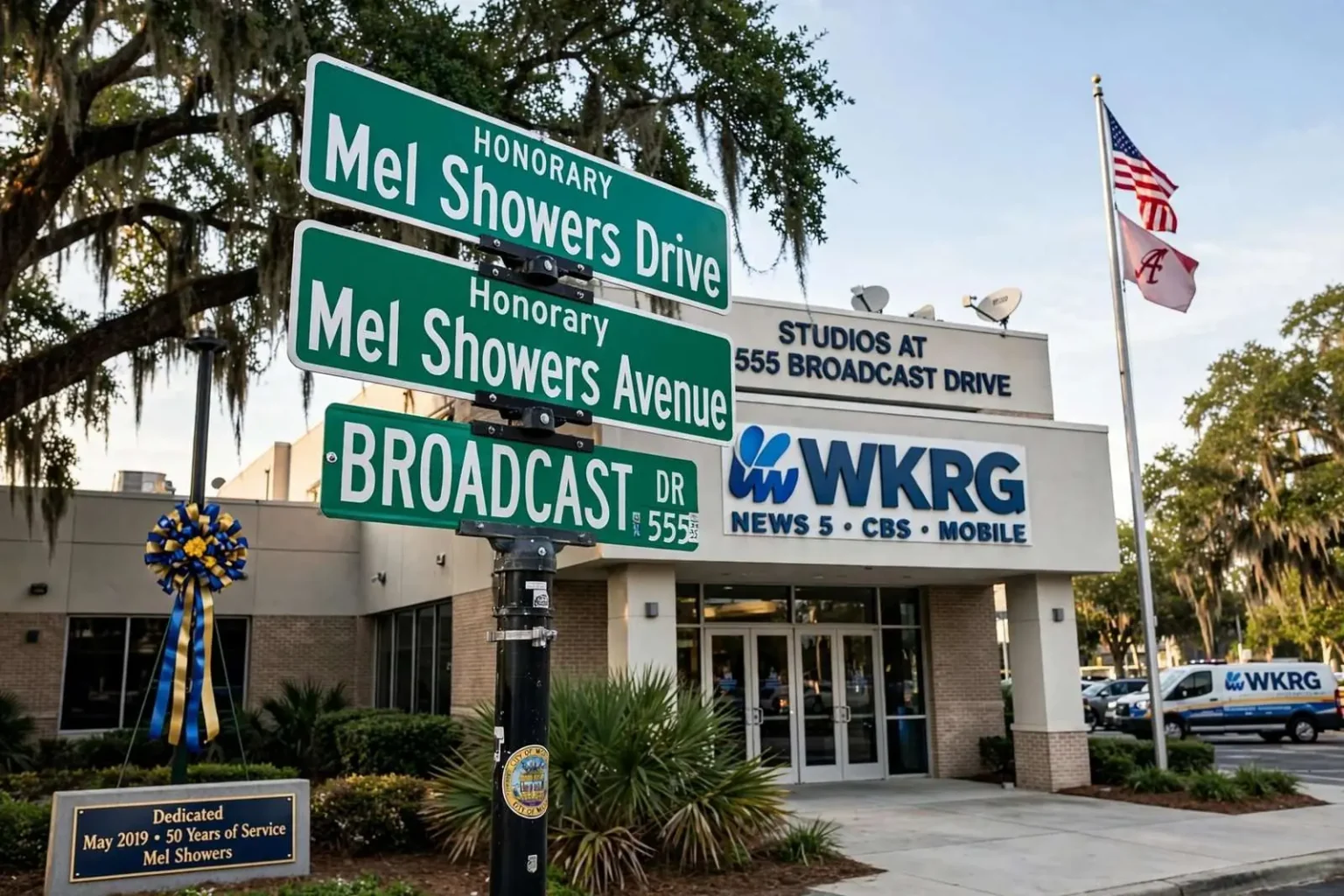
The City of Mobile has installed new street signs designating “Honorary Mel Showers Drive” and “Honorary Mel Showers Avenue” outside the Studios at 555 Broadcast Drive, paying tribute to the longtime WKRG anchor who retired from his regular duties in May 2019 after a 50-year career on Gulf Coast television. The signs, placed along the approaches to the broadcast studios, ensure that viewers who watched Showers for decades will pass his name on their way to the building where much of that history was made.
Showers, a staple of Mobile evening news for half a century, is moving into a semi-retirement role and will still anchor occasional broadcasts. The honor comes the same week an exhibit celebrating his career opened at the History Museum of Mobile, giving the city two public commemorations of a broadcaster whose voice and presence became part of daily life across the central Gulf Coast.
A Half-Century on the Air
A 50-year career at a single station is a rarity anywhere in American television, and it made Showers one of the longest-serving local news anchors in the region. Over those five decades, he guided viewers through some of the most consequential moments in Mobile’s recent history — hurricanes and their long recoveries, floods, political transitions, economic shifts, and the everyday stories of a growing city. Generations of Mobile-area families came to know the rhythm of his broadcasts, with children who watched him with their parents eventually tuning in with children of their own.
Local news anchors who last that long become more than journalists; they become fixtures of civic life. Showers’ longevity gave his reporting a continuity that few in the industry can match. When storms threatened the coast, viewers turned to him not just for information but for reassurance, a role that Gulf Coast broadcasters have historically played during hurricane seasons that regularly test the region. When he announced his retirement from regular duties in May 2019, the response from viewers reflected that decades-long relationship.
The Honorary Street Names
Honorary street naming is one of the most visible forms of civic recognition a city can bestow. Rather than renaming an actual street — a step that requires changing addresses and navigating postal and emergency-service complications — cities install ceremonial signs alongside the official ones, marking a stretch of roadway in honor of a person’s contribution. Mobile has used the practice to honor civil rights leaders, athletes, musicians, and public servants, adding these signs to neighborhoods and corridors across the city.
The location of the new signs is deliberate. The Studios at 555 Broadcast Drive sit on a campus that has housed the station’s operations, and placing “Honorary Mel Showers Drive” and “Honorary Mel Showers Avenue” at its approaches ties the tribute to the place where Showers spent his career. Every anchor, producer, photographer, and guest who arrives at the building will now pass the name of the man who defined its newsroom for 50 years — a daily reminder of the standard he set and the audience he served.
WKRG and Mobile’s Broadcasting Story
The station Showers served for so long is itself a piece of Gulf Coast history. WKRG went on the air in the 1950s as part of the media holdings of the Kennamer family, whose newspaper and broadcasting interests helped shape how Mobile County residents received news through the second half of the 20th century. Broadcast Drive, where the studios sit, is a fitting address for an industry that clustered its facilities there, and the station’s tower and newsroom have been landmarks for area viewers ever since.
Local broadcasting in markets like Mobile has always demanded versatility. Anchors in mid-sized Gulf Coast markets do more than read scripts; they host community events, chair charity drives, front severe weather coverage that can stretch for hours, and interview everyone from mayors to little league champions. Showers’ half-century in that seat means he interviewed or crossed paths with an enormous share of the people who shaped the city during that era, and his institutional memory became one of the station’s most valuable assets.
That history is part of what the new exhibit at the History Museum of Mobile captures. Museum exhibits on local broadcasting are relatively rare, and the timing of the exhibit’s opening alongside the street sign dedication reflects how closely the two honors were coordinated. Visitors to the museum can see the arc of a career that paralleled the transformation of television itself — from the era of film cameras and typewriters to digital production and around-the-clock news cycles.
Semi-Retirement and What Comes Next
Showers’ move into semi-retirement, rather than a full departure, will be welcome news to the viewers who made his broadcasts part of their evenings. In his new arrangement, he will still anchor occasional broadcasts, keeping a presence on the air while stepping back from the daily grind of the newsroom. The announcement in May 2019 that he would leave his regular duties closed one of the longest tenures in Gulf Coast broadcasting, and the city’s decision to follow it with both a street dedication and a museum exhibit shows how fully that tenure registered with the public. For the station, retaining even a part-time connection to a legend of its brand is a link between eras; for viewers, it means the familiar voice will still surface from time to time, anchoring special coverage or major stories.
The transition also marks a changing of the guard in Mobile television news. The anchors and reporters now carrying the station’s regular newscasts learned their craft in an industry Showers helped define locally, and several have spoken over the years about the example his tenure set for consistency, community connection, and professionalism. A 50-year run does not just build an audience; it trains the people who will eventually inherit the desk.
Between the honorary signs on Broadcast Drive, the museum exhibit, and his continued occasional appearances on the air, Mobile has made its appreciation of Showers unmistakably public. Few cities honor their local broadcasters this thoroughly, and fewer broadcasters earn it. For a man whose work was seen by five decades of Gulf Coast families, the signs outside the studio are a fitting marker: the city he informed for so long has now put his name on the road home.
Why Local Anchors Matter to a City
Sociologists and media historians who study mid-sized American cities often note the special role that longtime local anchors play in a community’s identity. In smaller markets, the anchor is not a distant celebrity but a neighbor — seen at church, at restaurants, at high school football games — and that visibility builds a trust that national broadcasts cannot replicate. During emergencies, that trust becomes functional: residents act on what an anchor they have known for decades tells them, whether that means evacuating ahead of a hurricane or sheltering through a tornado warning.
Mobile’s hurricane history makes that trust especially consequential. From Hurricane Frederic in 1979 through Ivan, Katrina, and the storms that followed, generations of area residents have spent long hours in front of local television waiting for updates on tracks, evacuations, and damage. Anchors who stayed on the air through those long events — as Showers did across so many seasons — became part of how the city remembers its worst weather and its recoveries.
The city’s decision to honor a broadcaster with dual street signs also speaks to how Mobile values its own cultural history. The city that claims the oldest Mardi Gras celebration in the country, a deep musical heritage, and a cast of literary and civil rights landmarks has long marked its geography with tributes to the people who shaped it. Adding a news anchor to that roster reflects a straightforward judgment: telling the city’s story, night after night, for 50 years is itself a civic contribution worth memorializing.
For viewers who want to see the commemorations themselves, the honorary signs stand outside the Studios at 555 Broadcast Drive, where they will remain as a permanent marker, and the exhibit celebrating Showers’ career is open at the History Museum of Mobile. Together they offer two ways to appreciate a career that unfolded in the city’s living rooms — one on the road to the studio, and one in the institution that keeps the city’s story for the generations who never saw those broadcasts live.
For the History Museum of Mobile, the exhibit opened the same week gave residents and visitors a chance to see the artifacts and milestones of that career up close — the memorabilia, the photographs, and the stories of five decades behind the desk. The museum, located in the old City Hall complex downtown, regularly hosts exhibits on the people and institutions that shaped the city, and a broadcasting career as long as Showers’ offered plenty of material to draw from.
Together, the street signs and the exhibit amount to a civic thank-you delivered twice over — once on the pavement outside the studio where he worked, and once in the museum that preserves the city’s memory. For a broadcaster whose face was in Mobile’s living rooms for 50 years, it is recognition that reaches both the daily route and the historical record, and it will remain there long after his occasional broadcasts have aired.