Mobile Literary Festival Set for March 16 at Ben May Main Library
Gulf Coast authors including Carolyn Haines headline the free 2019 Mobile Literary Festival, March 16 at the Ben May Main Library in downtown Mobile.
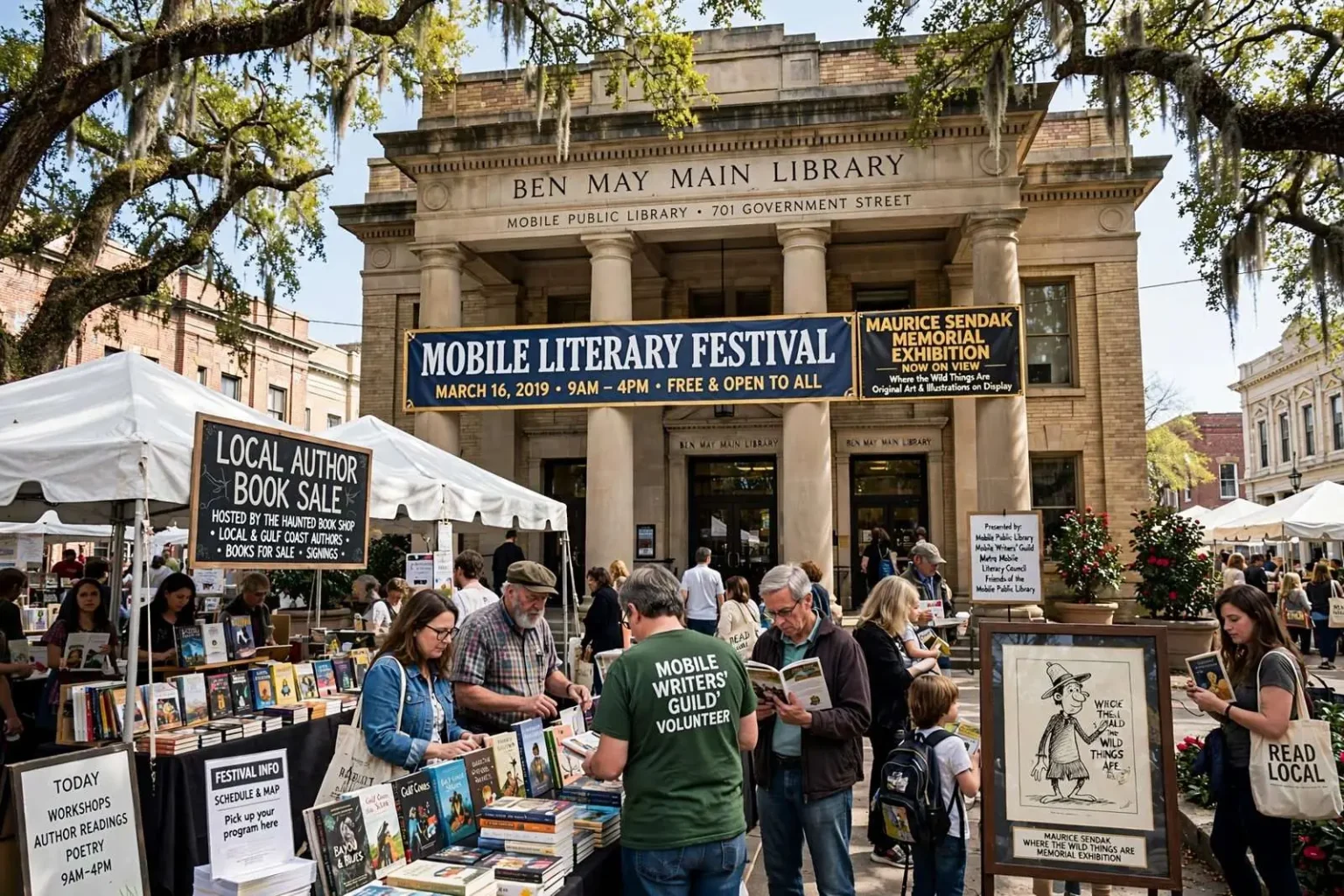
Mobile’s literary community takes center stage on March 16, 2019, when the Mobile Literary Festival returns to the Ben May Main Library at 701 Government Street downtown, running 9 a.m. to 4 p.m.
This year’s lineup features a long roster of Gulf Coast authors and poets, including Carolyn Haines, Rob Holbert, Linda Busby Parker, Adam Prince, former television journalist Bill Riales and poet Sue Brannan Walker, among many others. Attendees can browse a local author book sale, sharpen their own craft in workshops led by award-winning writers, and catch fresh voices at readings throughout the day.
The Writers on the Bill
The headliner names carry genuine weight in Alabama letters. Carolyn Haines, who lives and writes in the Mobile area, is best known for the Sarah Booth Delaney mystery series set in the Mississippi Delta, a string of novels that has earned her a devoted national readership and multiple career honors, along with a career-spanning body of literary fiction. Sue Brannan Walker, a former poet laureate of Alabama, has spent decades as one of the state’s foremost literary citizens — poet, editor, and professor whose work has shaped generations of Gulf Coast writers. Linda Busby Parker brings award-winning fiction and a career in writing and teaching; Adam Prince contributes acclaimed short fiction; Rob Holbert, co-founder of the region’s alternative press, represents the Gulf Coast’s journalism and publishing community; and Bill Riales, a familiar face from decades of Mobile television news, represents the storytellers who covered the region’s daily history on air.
That mix — novelists, poets, journalists, memoirists — is the festival’s signature. Rather than a single-genre conference, the Mobile Literary Festival has always treated writing as one broad craft, and its panels put fiction writers beside journalists and poets beside broadcasters, on the theory that audiences read across lines and so do the people who write for them.
A Day at the Main Library
The Ben May Main Library, the flagship of the Mobile Public Library system, occupies a landmark building on Government Street in the heart of downtown’s historic district. Its public spaces, meeting rooms, and auditorium provide the festival’s infrastructure, and its stacks remind every visitor what the day celebrates. The 2019 festival added a singular attraction: the Maurice Sendak Memorial Exhibition on display inside the historic main library — a touring exhibition of work by the creator of “Where the Wild Things Are,” giving attendees a rare chance to see the art of one of children’s literature’s towering figures alongside a full day of regional literary programming.
Who Makes the Festival Happen
The free festival is presented by the Mobile Public Library, Mobile Writers’ Guild, The Haunted Book Shop, Metro Mobile Literacy Council and Friends of the Mobile Public Library, and is open to everyone. The partnership is a portrait of how Mobile’s literary ecosystem actually works. The library system provides the venue and the public mission; the Writers’ Guild supplies the working writers and the workshop leaders; the Metro Mobile Literacy Council brings the region’s literacy and education network; and the Friends of the Mobile Public Library underwrite the costs that keep admission free.
The Haunted Book Shop deserves special mention. One of Mobile’s most beloved independent bookstores, it has anchored the local book trade for decades from its spot in the city’s historic district, and its role in the festival — running the book sale, connecting authors with readers — extends a mission the store performs year-round. Independent bookstores in cities the size of Mobile do more than sell books; they host the signings, stock the local authors, and make a festival like this one possible at all.
Workshops, Sales, and Readings
The festival’s structure gives attendees three distinct experiences in one day. The workshops, led by the visiting writers, offer hands-on craft instruction — the kind of teaching that draws aspiring novelists, poets, and memoirists from across the Gulf Coast for a day of concentrated learning. The book sale puts local and regional authors’ work in front of buyers directly, with authors on hand to sign; for self-published and small-press writers especially, it is one of the year’s best opportunities to reach readers face to face. And the readings spread throughout the day give the audience the festival’s most direct pleasure: hearing writers read their own work aloud, often before the same listeners crowd the signing table afterward.
The schedule of activity times and locations was available from the festival organizers, and attendees were advised to plan their day in advance — with multiple simultaneous offerings, choices matter, and the day rewards those who arrive at 9 a.m. with the program in hand.
Mobile’s Literary Tradition
Mobile’s claim on literary culture runs deep. The city that produced Eugene Walter — the expatriate man of letters whose “The Untidy Pilgrim’s Handbook” helped redefine Southern writing — has always sustained a literary scene disproportionate to its size, from the literary journals published here to the novelists who set their fiction on the Gulf Coast. The city’s libraries, bookstores, and writing organizations have kept that tradition alive through decades of change, and the annual festival is its public showcase: one Saturday each spring when the community of readers and writers Mobile quietly supports becomes visible downtown.
The Sendak Exhibition’s Visit
The Maurice Sendak Memorial Exhibition deserves its own place in the day’s plan. Sendak, who died in 2012, transformed children’s literature with “Where the Wild Things Are” and a shelf of other classics whose illustrations rank among the most recognizable art of the twentieth century. Traveling memorial exhibitions of his work bring original art, sketches, and process material to venues across the country, and its placement inside the Ben May Main Library made the festival a two-generation event — parents and grandparents who grew up on Sendak’s books walking the exhibition with children discovering them for the first time.
For the festival’s organizers, the exhibition also served the literacy mission at the heart of the partnership. Children’s literacy begins with the pleasure of books, and few artists have conveyed that pleasure more powerfully than Sendak. An audience that came downtown for a mystery novelist or a poetry workshop could leave having also stood in front of the wild things — a reminder that the reading life starts early and never really ends.
Why Free Matters
Free admission is not an accident of the festival’s design; it is its policy foundation. The organizations behind the event — library, guild, literacy council, bookstore, and Friends group — share a conviction that access to writers and writing instruction should not depend on a conference fee. A day of workshops from award-winning authors carries real value, and keeping the doors open to everyone means students, retirees, working writers, and the simply curious all walk the same Government Street hallways on the same Saturday.
The Metro Mobile Literacy Council’s role underscores the point. The organization works year-round on literacy across the region, and its presence at a festival celebrating books is a reminder of the stakes: every reader at the festival was once a new one, and the community that builds festivals also builds the programs that put the first book in a child’s hands.
Plan Your Day
The practical details framed the experience: doors at 9 a.m., a full slate of panels, workshops, and readings through 4 p.m., the book sale running all day, and the Sendak exhibition open to festival attendees inside the library. Visitors new to downtown Mobile could add the surrounding historic district to their day — the library’s Government Street location places it within walking distance of the city’s most significant architecture, museums, and parks.
A full schedule of activity times and locations was available from the festival organizers, and for a one-day event of this density, preparation paid. The Mobile Literary Festival has earned its place in the city’s cultural calendar by doing the simple things well: gathering the region’s writers in one building, putting their books within reach, and admitting everyone who wants to spend a Saturday among them. On March 16, 2019, Ben May Main Library hosted all of it — and with a Maurice Sendak exhibition upstairs, the day connected Mobile’s literary present to the widest possible idea of what books do for a community, from the wild things to the workshop table.
The Ben May Main Library as a Civic Landmark
The venue itself carries the festival’s history. The Ben May Main Library, named for the Mobile businessman and philanthropist whose family foundation made the modern building possible, has anchored the Mobile Public Library system since it opened on Government Street in the mid-1980s, and its predecessor libraries served the city from downtown for more than a century before that. The building’s public rooms host community meetings, author events, and civic life year-round; for one Saturday each spring, the literary festival fills them end to end.
Government Street itself is one of Mobile’s great corridors — laid out in the city’s early grid, lined with historic churches, mansions, and institutional buildings, and running from the downtown core into Midtown. A festival day there doubles as a tour of the city’s architectural heritage, and the library sits among the corridor’s most heavily used public buildings.
Carolyn Haines and the Gulf Coast Mystery Tradition
Among the headliners, Haines’ presence reflects the region’s outsized contribution to a specific genre. The Gulf South has become one of American mystery writing’s most fertile territories, and Haines — an Alabama native and longtime Mobilian-area writer — stands among its most successful practitioners. Her Sarah Booth Delaney novels, launched in 1999 with “Them Bones,” built a series that continues to this day, alongside her literary fiction and her work mentoring new writers through the USA Writing program, where she taught at the University of South Alabama. Her festival appearances draw the kind of crowd that comes with questions — about plotting, about series writing, about how a writer stays married to the same character for decades.
Sue Brannan Walker’s presence carries similar weight in poetry. A former Alabama poet laureate, professor emerita, and editor whose career spans dozens of books and decades of service to the state’s literary institutions, Walker represents the Gulf Coast’s academic and poetic backbone — the writer-scholar whose influence runs through the region’s classrooms and journals as much as its bookstores.
The Book Sale as a Local Economy
The local author book sale that runs through the festival day is more than a convenience. For regional writers, direct sales events are the economic floor of a writing life in a mid-sized market: no touring publicity budget, no chain-store placement, just a table, a stack of books, and readers who came downtown to meet them. Festivals like Mobile’s consolidate that market into a single high-traffic day, and the authors who do well there do well enough to keep writing.
The sale also gives readers something no algorithm can: the chance to talk with the person who wrote the book in their hands. Mobile’s literary community has always run on those conversations — in the aisles of The Haunted Book Shop, at library signings, at festival tables — and the March 16 festival put a year’s worth of them into a single Saturday, from 9 a.m. to 4 p.m., at 701 Government Street, for anyone willing to come.