Mobile man arrested after allegedly breaking into ex-girlfriend’s home, police say
A 35-year-old Mobile man was arrested after allegedly breaking into his ex-girlfriend's home and taking her property, police said.
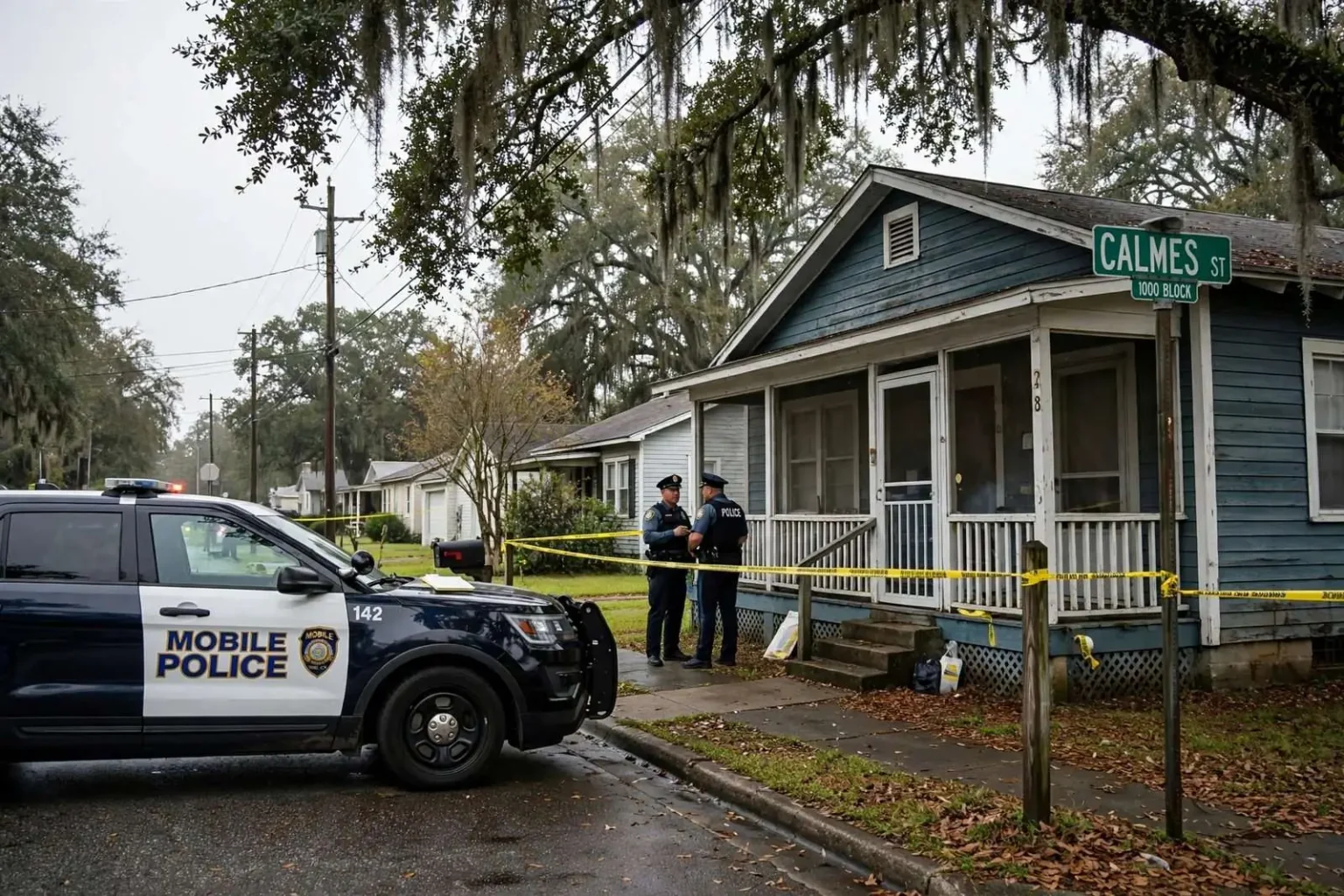
MOBILE, Ala. — A man was arrested after he allegedly entered his ex-girlfriend’s residence, took her property and left before Mobile police arrived, according to authorities. Officers responded to a reported domestic dispute involving a burglary Tuesday just after 7 a.m. in the 1000 block of Calmes Street, a residential street in Mobile’s broader downtown-adjacent neighborhoods, where the morning call set off an investigation that ended in an arrest the same day.
On scene, they learned the victim’s ex-boyfriend had allegedly entered her home without permission, taken her belongings and fled, Mobile police said. The alleged entry of an ex-partner into a residence without consent, regardless of any prior relationship, constitutes burglary under Alabama law, and the removal of property converts the incident from a trespass into a theft as well. Officers located Levernon Wallace, 35, and arrested him. He is charged with second-degree domestic violence for burglary, and his bond is pending, according to police.
The case falls under Alabama’s domestic violence statutes, which treat offenses committed between people in a past or present household or romantic relationship as a distinct category with its own charge structure and consequences. Second-degree domestic violence burglary covers entering or remaining unlawfully in a dwelling with intent to commit a crime, when the victim falls within the statute’s relationship definitions. The classification matters: domestic violence charges in Alabama carry penalties and processing rules that differ from the equivalent non-domestic offenses.
How the morning unfolded
The timeline described by police is a compact one. The victim reported the incident shortly after 7 a.m., telling officers that her ex-boyfriend had come into her home uninvited, taken items belonging to her and departed before police could arrive. Responding officers documented the scene, took the victim’s account and gathered the information needed to identify the suspect. Mobile police located Wallace later and made the arrest, closing the gap between report and apprehension within the same day.
That speed reflects both the nature of the alleged offense and the realities of police work in domestic cases. Unlike a stranger burglary, in which the intruder may be unknown, domestic-related entries usually involve a suspect whose identity is known to the victim, which shortens the investigative path dramatically. Officers collect the victim’s statement, any physical evidence of entry, descriptions of the missing property and any witnesses, and the known relationship between the parties points directly to the person to be located and interviewed.
Alabama’s domestic violence framework
Alabama rewrote its domestic violence laws in the late 1990s, creating specific felony and misdemeanor degrees for offenses committed within covered relationships. The structure was designed to acknowledge a reality that victim advocates had documented for years: violence and property crimes between intimate partners follow patterns different from stranger crime, and the justice system’s response needed to account for ongoing contact, retaliation risks and the victim’s continued exposure. Second-degree domestic violence covers burglary in a domestic context, alongside degrees covering assault, strangulation and other offenses.
The relationship element is central. The statutes apply between current and former spouses, people who have lived together, people who share a child and people in or formerly in a dating or romantic relationship, among other covered connections. A person who breaks into a stranger’s home is charged with ordinary burglary; a person who enters an ex-partner’s home without permission faces the domestic violence version of the same conduct, with the relationship alleged as part of the charge. Prosecutors treat that designation seriously, because research and case experience show that unauthorized entries by former partners are a recognized warning sign of escalating danger.
What happens after an arrest
Wallace’s bond was pending at the time of the report, meaning a judicial officer had not yet set the amount and conditions of pretrial release. In Alabama, bond in a domestic violence case typically comes with conditions beyond payment — no-contact orders protecting the accused’s victim, stay-away provisions covering the victim’s residence and workplace, and sometimes monitoring requirements. Those conditions are enforced through the criminal case, and violations generate new charges independently of the underlying offense.
The case now moves through the court system: an initial appearance, review of the evidence by the district attorney’s office, and proceedings in Mobile County’s courts. The charge is an allegation at this stage, and the presumption of innocence applies until guilt is established in court or by plea. Prosecutors handling domestic violence cases typically coordinate with victim advocates, who help victims understand protective orders, court dates and safety planning as the case proceeds.
For residents of the Calmes Street neighborhood and communities across Mobile, the case illustrates how the system responds when a former partner crosses the line into a residence uninvited. Police encourage anyone in immediate danger from a current or former partner to call 911, and victims of domestic violence can reach resources including the national Domestic Violence Hotline and local advocates through Mobile’s service organizations. The investigation and prosecution of the Tuesday-morning case now rest with Mobile police detectives and the Mobile County District Attorney’s Office, and the court will determine the outcome of the allegations.
The neighborhood and the response
The 1000 block of Calmes Street sits in the older residential fabric near downtown Mobile, an area of modest homes and longtime residents a short drive from the central business district. Morning calls there route to the precinct officers who patrol the area daily, and a 7 a.m. dispatch places the response at the height of the morning routine — residents leaving for work, school traffic building on the connecting streets. Officers arriving on a domestic-related call follow protocols specific to such incidents: separating the parties, assessing for injuries, collecting statements and checking for any existing protective orders that might bear on the situation.
The arrest the same day illustrates the priority Mobile police place on domestic-related offenses. Department policy and state law both push these cases toward swift action, in part because the research record on domestic violence identifies the period immediately after a separation as the most dangerous for victims. An ex-partner who enters a home without permission and takes property has already crossed legal lines that predict escalation, and officers are trained to treat the unauthorized entry itself as serious rather than as a private dispute over belongings.
Victim advocates make the same point in practical terms. A person leaving a relationship is advised to plan for safety: changing locks, informing neighbors and family, documenting prior incidents and obtaining protective orders where the pattern warrants. When an ex-partner does enter a home, the legal response — an arrest, a no-contact condition of bond, a criminal charge — creates formal distance that the victim can enforce through the courts rather than relying on informal promises.
Property taken in domestic cases
The alleged removal of the victim’s belongings adds a recovery dimension to the case that prosecutors and courts handle alongside the criminal charge. Property taken in a burglary can be recovered as evidence and returned, and Alabama law provides mechanisms for victims to reclaim their belongings once the prosecution no longer needs them. In practice, domestic cases often involve disputed ownership — items purchased jointly, gifts, household goods — and courts sort through those claims as part of the proceedings when the parties contest them.
For the victim, the loss of property in such an incident is rarely about the objects themselves. The taking is an assertion of control, a demonstration that the former partner can reach into her home and her life at will. That is why the criminal law treats the conduct as burglary rather than merely a theft dispute: the unlawful entry into a dwelling is the core of the offense, and the statute’s domestic designation recognizes the relationship between the parties as an aggravating element rather than a mitigating one.
The court process ahead
Once bond is set, the case will proceed through the standard sequence for a felony charge in Mobile County. Wallace will make an initial appearance before a district judge, where the charge is formally presented and bond conditions — including any no-contact order protecting the victim — take effect. The district attorney’s office then reviews the evidence gathered by Mobile police: the victim’s statement, any surveillance or witness accounts, evidence of the entry and the inventory of missing property. Grand jury action or a preliminary hearing determines whether the case proceeds to circuit court for trial.
Second-degree domestic violence burglary is a felony under Alabama law, carrying a potential sentence that runs to years in prison if a conviction is obtained. Sentencing in domestic cases can include protective order extensions, counseling requirements and other conditions intended to reduce reoffending. The outcome in any individual case depends on the evidence, the defendant’s record and the decisions of prosecutors, judges and juries — and the charge against Wallace remains an allegation, with the state bearing the burden of proving every element beyond a reasonable doubt.
Police noted that the investigation was handled by officers who responded within minutes of the Tuesday-morning call, located the suspect and completed the arrest the same day. For the victim, the charge is the beginning of a legal process designed to provide both accountability and protection; for the neighborhood, it is an example of the domestic violence framework at work — a system Alabama built specifically because the people most likely to enter a home unlawfully are, in far too many cases, people the resident once trusted.