
Mobile man pleads guilty in 2012 murder of South Alabama student
Tevin Wells pleaded guilty to felony murder in the 2012 robbery-slaying of University of South Alabama student Andrew Saxon near campus.
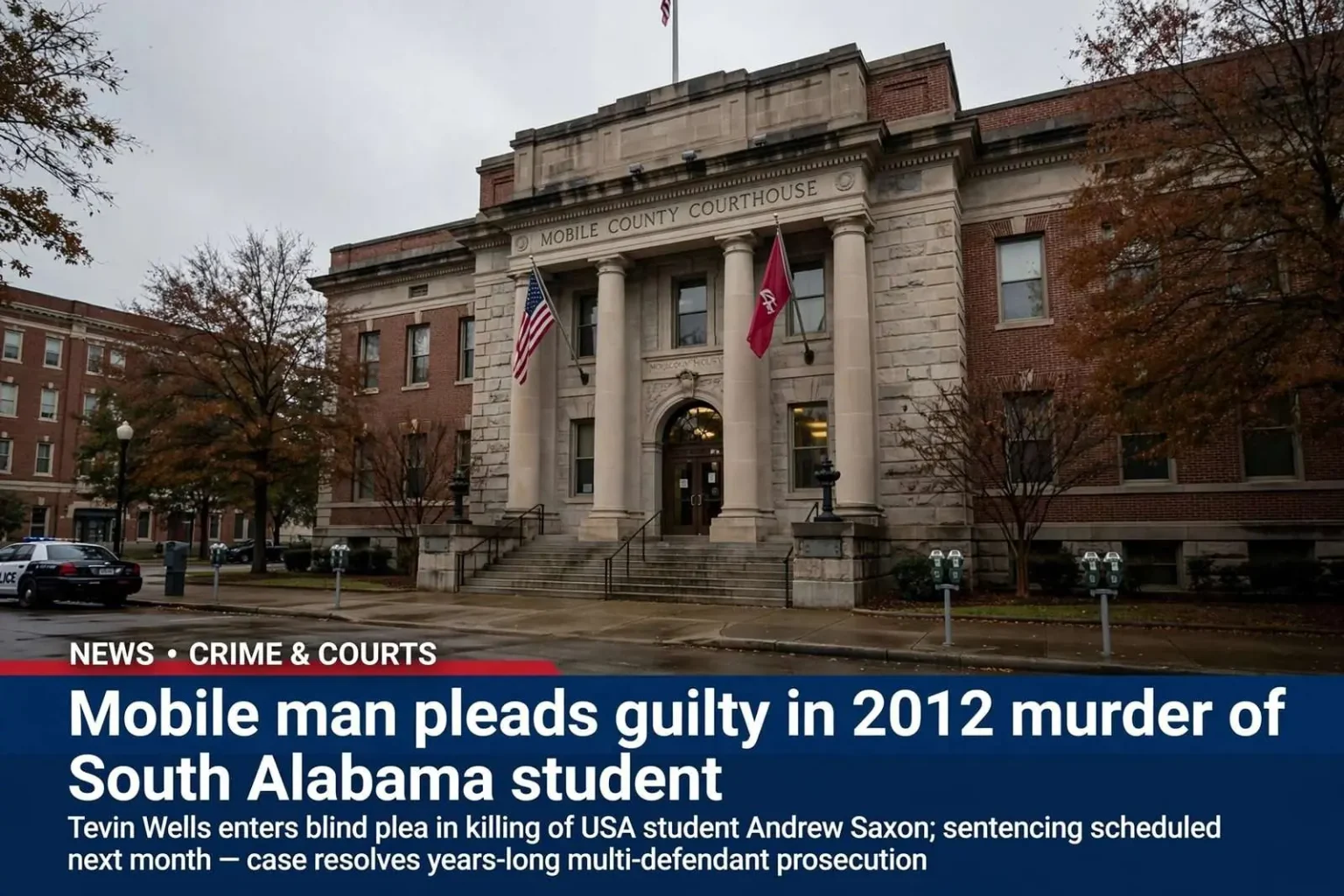
A Mobile man has pleaded guilty in the 2012 killing of a University of South Alabama student, according to the Mobile County District Attorney’s Office, resolving one of the remaining prosecutions in a case that has moved through the courts for years. Tevin Wells entered a blind plea to felony murder in the death of Andrew Saxon, who was shot and killed at his home near the USA campus in what investigators described as a robbery that yielded only video games. Wells is one of three people charged in the case, and a judge is scheduled to sentence him next month.
The plea brought a measure of resolution to a case that has shadowed Mobile’s campus-area neighborhoods since the night of the killing. Prosecutors said Quinten Godfrey, identified as the triggerman, pleaded guilty in 2016 and was sentenced to life in prison, while Christopher Case was also charged in the case. Wells’s guilty plea leaves the sentencing decision entirely in the hands of the judge — the defining feature of a blind plea — rather than the product of a negotiated agreement between defense and prosecution.
What a blind plea means
A blind plea is among the highest-stakes moves in criminal law. In a conventional plea agreement, a defendant and prosecutors negotiate a specific sentence or sentencing range in exchange for the guilty plea, and the judge normally honors the deal. In a blind plea, by contrast, the defendant pleads guilty with no agreement at all: the prosecution makes no promises, and the judge is free to impose any sentence the law allows, from the minimum to the maximum. Defendants choose this path for reasons that vary — sometimes the evidence is overwhelming, sometimes co-defendants have already been convicted, and sometimes the calculation is that the judge’s sentence will be no worse than what a trial and verdict might produce, without the risk of a harsher outcome after a jury’s conviction.
For Wells, the blind plea to felony murder put his future entirely before the sentencing judge, with the sentencing hearing scheduled for the following month. At such hearings, prosecutors present the facts of the offense and the victim’s impact; the defense presents mitigation — the defendant’s background, age and circumstances; and victims’ families often speak. In a case of this kind, with a young man shot to death in his own home over property as trivial as video games, the sentencing argument was always likely to weigh heavily toward the prosecution’s side of the scale.
Felony murder itself is a doctrine with a particular logic. Under Alabama law, a killing committed during the course of certain dangerous felonies — robbery among them — is murder, regardless of who fired the shot and regardless of whether the killing was intended. The doctrine holds all participants in the underlying felony accountable for a death that occurs in its commission, which is why all three defendants in the Saxon case faced murder charges even though only one, prosecutors said, pulled the trigger.
The case’s facts
Andrew Saxon was a University of South Alabama student living near the campus when he was shot and killed in his home during a robbery in 2012. The detail that came to define the case in public accounts was the incongruity of the loss: investigators said the only items taken in the robbery were video games. A student’s life ended, prosecutors and police concluded, in a break-in whose proceeds would have been worth little at a resale counter — a fact that has made the case a recurring reference point in local discussion of the senselessness of armed home invasions.
The campus-area neighborhoods around the University of South Alabama blend student rentals with long-established residential streets, and crimes against students in that corridor draw particular attention from the university community and city police alike. The 2012 killing stood out even in a city that has wrestled with elevated violent-crime rates for years: the victim was young, the setting was his own home, and the motive was a handful of gaming consoles and games.
The investigation ultimately produced charges against three defendants: Tevin Wells, Quinten Godfrey and Christopher Case. Prosecutors identified Godfrey as the triggerman — the person who fired the shot that killed Saxon — and he pleaded guilty in 2016, receiving a sentence of life in prison. Case was also charged in the case, with his prosecution proceeding on its own track. Wells’s 2016-era plea — entered years after the killing, after years of pretrial proceedings — followed the slow clock that multi-defendant murder cases run on in the Mobile County court system.
The Mobile County court process
The Mobile County District Attorney’s Office, which announced the plea, prosecutes the felony caseload of one of Alabama’s largest judicial circuits. Murder cases in the circuit move through grand jury indictment, arraignment, years of pretrial hearings — competency evaluations, suppression motions, co-defendant severances — before reaching plea or trial. Multi-defendant cases multiply the complexity: each defendant gets separate counsel, separate motions and often separate resolutions, which is why a 2012 killing could still be producing guilty pleas and sentencings years later.
Godfrey’s 2016 conviction by plea — life in prison for the man identified as the triggerman — set the baseline for the case’s outcomes. Against that standard, Wells’s blind plea to felony murder placed him before the same judge with the same potential exposure: felony murder in Alabama carries a sentence of imprisonment for life, with the precise term determined at sentencing. The decision to plead blind rather than negotiate suggested either that no agreement could be reached or that the defense preferred to take its chances with the court’s discretion rather than accept the state’s terms.
The sentencing hearing scheduled for the following month would complete Wells’s portion of the process. Alabama sentencing in murder cases allows victims’ family members to address the court, and the hearing gives the judge the full record: the facts of the home invasion, the trivial value of what was taken, the loss of a university student, and the outcomes already imposed on the co-defendants. Judges in such hearings weigh consistency with co-defendants’ sentences, the defendant’s role and record, and the arguments of both sides.
Christopher Case’s case remained its own proceeding, to be resolved on its own evidence and timeline. In the architecture of a multi-defendant prosecution, each resolution shapes the next — co-defendant convictions provide testimony and precedent, and each plea narrows the factual disputes remaining for the court. By the time Wells entered his plea, the case’s central facts were long established: a robbery, a shooting, a death, and three men charged.
What the case leaves behind
For the University of South Alabama community, the years-long arc of the prosecution has been a reminder of how a single night can alter many lives — the student killed at home, the family that spent years following court hearings, the young defendants who traded their futures for a few used video games. Cases like Saxon’s are cited by campus police and city officers in safety outreach to students: locks on doors, awareness of who is at the door, and the reality that home invasions in student neighborhoods are rarely random in their opportunity, even when the victims are strangers to the offenders.
For Mobile, the case joined the long local conversation about violent crime and its consequences. The city’s homicide rate has made violence prevention a standing concern of city government, neighborhood associations and law enforcement, and the felony-murder prosecutions arising from the Saxon case demonstrated one end of that system’s response: the certainty and severity of outcomes when a robbery ends in death. The felony-murder rule ensures that no participant in a deadly home invasion can reduce his exposure by claiming he did not fire the shot — a principle the case’s outcomes, from Godfrey’s life sentence to Wells’s plea, made concrete.
The blind plea also illustrated the pragmatism of the courts. After years of litigation, with a co-defendant already sentenced to life and the evidence established, the plea spared Saxon’s family the ordeal of another trial while preserving the judge’s full discretion at sentencing. The sentencing set for the following month would determine whether that discretion produced a term consistent with the life sentence already imposed on the case’s triggerman.
What remains in the public record is the account confirmed by the Mobile County District Attorney’s Office: Andrew Saxon, a University of South Alabama student, was shot and killed in 2012 at his home near campus in a robbery that took only video games; Quinten Godfrey, identified as the triggerman, pleaded guilty in 2016 and is serving life in prison; Christopher Case was also charged; and Tevin Wells has now pleaded guilty by blind plea to felony murder, his sentence to be set by a judge at a hearing next month. The years between the crime and the pleas measure the slow, deliberate pace of capital-case-adjacent justice in Mobile County — and the permanence, for everyone involved, of what one night’s robbery cost.


