Mobile Mardi Gras Crowds Top 200,000 Again as Parade Season Builds Toward Fat Tuesday
Mobile Police estimate more than 200,000 people attended Mardi Gras parades during the second week of Carnival, pushing the season total past 340,000 as the city heads into its final stretch before Fat Tuesday.
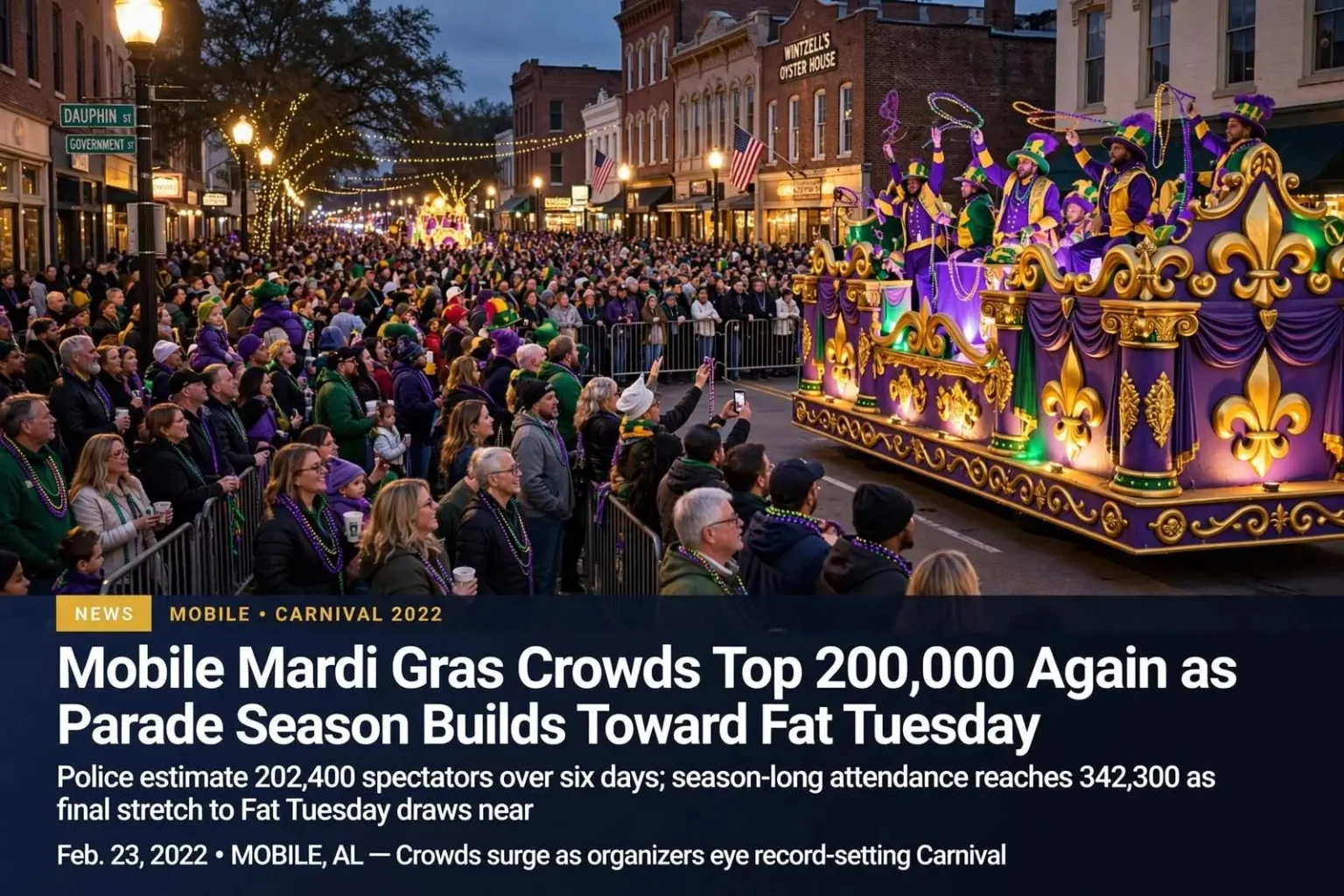
Mobile’s Mardi Gras season kept growing last week, with police estimating that more than 200,000 people turned out along downtown parade routes between Thursday, Feb. 17, and Tuesday, Feb. 22 — an even bigger showing than the crowds that kicked off Carnival the weekend before.
The Mobile Police Department put the six-day total at 202,400 spectators, pushing the season-long attendance estimate to 342,300 with the biggest parades of the year still ahead. Organizers say the pace points toward a record-setting Carnival.
“We’ll have well over a million in attendance this year,” Mobile Carnival Association Executive Director Judi Gulledge said. “Crowds have been great thus far. We’ve had good weather. I think the community has been looking forward to getting back out after a year’s hiatus.”
No parades are scheduled for Wednesday, Feb. 23, giving the city a brief pause before six consecutive days of celebration that build to Fat Tuesday. Gulledge said downtown hotels are already fully booked for the stretch, and that restaurants and other Carnival-dependent businesses across Mobile are gearing up for their busiest days of the season.
She also praised the city’s expanded parking options along the parade routes, saying the additional capacity has already eased congestion and made it easier to manage the larger crowds. Gulledge encouraged parade-goers to watch for the orange no-parking signs posted along routes and to check the city’s Mardi Gras webpage for maps, schedules and parking guidance before heading downtown.
A Season Building Toward Its Peak
The crowds come as no surprise to anyone who follows Carnival in the Port City. Mobile lays claim to the oldest Mardi Gras celebration in the United States, one that began with French Catholic settlers in the early 1700s and took organized form in 1831 with the Cowbellion de Rakin Society, whose successors formed the Mobile Carnival Association to plan and coordinate the city’s parades. More than two centuries later, the season remains woven into the civic calendar of a city that treats Carnival not as a single day but as weeks of balls, parades and neighborhood gatherings along the Gulf Coast.
Mobile’s mystic societies — private organizations that build floats, stage balls and ride the parade routes — roll night after night through February, with the earliest parades drawing neighborhood crowds and the final week pulling spectators from across the region and beyond. The rhythm is familiar to locals: crowds start modest, swell on weekends, and reach their peak in the six days between the final weekend and Fat Tuesday, when the season’s largest and oldest organizations traditionally roll through downtown.
That pattern carries real economic weight. Downtown restaurants, bars, hotels, costume shops and float-building operations all depend on the season, and a year’s hiatus left many of them eager for the return of full parade schedules. With rooms booked solid downtown through Fat Tuesday, the final stretch functions as the busiest stretch of the year for a wide swath of Mobile’s hospitality economy, from waitstaff and hotel clerks to the seamstresses and float riders whose preparation began months earlier.
City officials and parade organizers spent the early season working out logistics that a larger-than-usual crowds demanded. Additional parking capacity near the routes, clearly marked no-parking zones and an online hub for maps and schedules have become the main tools for keeping tens of thousands of pedestrians, floats and tow trucks from colliding on narrow downtown streets each night.
Night by Night Through the Busiest Week Yet
Police crowd estimates and incident reports for each night of the past week show how the celebration built steadily toward the weekend before tapering off Monday and Tuesday.
The week opened Thursday, Feb. 17, with roughly 9,200 people turning out for the Order of Polka Dots parade despite forecasts of severe weather. The storm system ultimately had little impact on downtown Mobile. Officers fielded 10 complaints, issued 20 parking citations and towed 22 vehicles that night.
Attendance jumped to about 44,500 for the Order of Inca parade on Friday, Feb. 18. Police responded to 14 complaints and one report of a lost child, issued 55 parking citations and towed 11 vehicles.
Saturday brought the largest crowds of the week. An estimated 62,500 people lined the routes for the afternoon parades of the Mobile Mystics, Mobile Mystical Revelers and Mobile Mystical Friends, with police logging 13 complaints, 14 parking citations and 30 tows. That evening, another 36,400 turned out for the Maids of Mirth, Order of Butterfly Maidens and Krewe of Marry Mates parades. Officers responded to 18 complaints, charged two adults with misdemeanors, issued 49 parking citations and towed 14 vehicles during the Saturday night rolls.
On Sunday night, the Neptune’s Daughters and Order of Isis parades drew about 14,000 spectators. Police reported 11 complaints, two misdemeanor arrests, 24 parking citations and 29 vehicles towed.
Crowds thinned somewhat to start the workweek. Monday night’s Order of Venus and Order of Many Faces parade drew an estimated 9,100 people. Officers responded to seven complaints, including one report of a lost child, and arrested two adults on misdemeanor charges. Nine parking citations were issued and nine vehicles were towed.
By Tuesday, Feb. 22, the Order of LaShe’s parade brought the crowd count back up to about 26,700. Police fielded nine complaints, issued 11 parking citations and towed nine vehicles.
The incident numbers track closely with the size of each crowd. The busiest night of the week, Saturday afternoon’s tripleheader, produced the most tows, while the smaller early-week parades generated only a handful of complaints and citations apiece. The two lost-child reports, one on Friday and one on Monday, underscore the particular challenge of policing an event where families with small children mix with dense crowds after dark, and officers handled both without any indication of more serious trouble.
For the Mobile Police Department, the season is a sustained exercise in crowd management rather than enforcement. Officers working the routes concentrate on traffic flow, pedestrian safety and the parking enforcement that keeps evacuation lanes and float staging areas clear, and the citation and tow counts from the past week reflect that focus. Department officials have not reported any significant incidents during the season to date, and the misdemeanor arrests logged on Saturday, Sunday and Monday were each isolated matters amid crowds numbering in the tens of thousands.
Reading the Numbers
The attendance figures themselves are estimates, compiled by police officers assigned to each parade based on the density of spectators along the route and the length of the viewing areas. Exact counts are impossible at an outdoor event spread across miles of downtown streets, but the method produces the season-long totals the city and the Mobile Carnival Association rely on to gauge the celebration’s scale, and those totals have climbed steadily since parades returned after the year off.
The 202,400 spectators counted between Feb. 17 and Feb. 22 nearly matched in six days what many earlier seasons drew across their opening weeks, and the 342,300 season total will grow substantially with each of the remaining parades. If the pace holds, the million-attendance figure Gulledge projects would stand among the largest in the city’s modern Carnival history, a benchmark that reflects both the city’s pent-up enthusiasm and the sheer number of parade nights packed into the final two weeks of the schedule.
Weather has been a quiet ally. The severe forecasts that shadowed the Order of Polka Dots’ Thursday night parade never materialized downtown, and the mild, dry Gulf Coast evenings since then have kept routes packed from Government Street to the riverfront. Late-winter weather in south Alabama is rarely guaranteed — cold snaps and thunderstorms are common in February — but so far the season has enjoyed the kind of conditions that bring out multigenerational crowds, complete with folding chairs, coolers and the ladders that line the route hours before the first float rolls.
The Final Stretch
With the mid-week break now behind Mobile, attention turns to the final stretch of Carnival, when the season’s largest parading organizations traditionally roll and downtown crowds swell to their peak ahead of Fat Tuesday.
The six consecutive parade days that lead to Mardi Gras are the densest of the season, often with multiple parades rolling on the same day and nighttime processions drawing the year’s biggest crowds. Downtown streets close for staging in the afternoon, and the viewing areas fill hours in advance, a dynamic that city officials and organizers have been preparing for since the schedule was set.
For visitors heading downtown in the coming days, the guidance from organizers is consistent: arrive early, note the orange no-parking signs that mark temporary restrictions along the route, and use the city’s Mardi Gras webpage for parade maps, the nightly schedule and parking guidance. Officials say the expanded parking inventory near the routes has already made a visible difference in congestion during the first weeks, and that keeping the marked zones clear allows floats, bands and emergency vehicles to move as designed.
Hotels report full occupancy through Fat Tuesday, and downtown establishments are staffing up for what is typically their heaviest run of the year. Businesses across the city — from bakeries supplying king cakes to cleaners pressing costumes and tuxedos for the season’s final balls — describe the last week of Carnival as the payoff for a season that began with the first parade of the year and now builds night by night toward its culmination.
The crowds of the past week suggest the city’s bet on a full return has paid off. More than 200,000 people came downtown in six days, the incident reports stayed manageable, and the biggest parades of the year are still to come. When the last float rolls on Fat Tuesday night, organizers expect the season-long attendance figure to pass the million mark — a fitting milestone for a celebration Mobile has kept alive for more than three centuries.