Rescheduled Mobile Mardi Gras Parade Affected 2018 Visitors and Businesses
A weather-driven 2018 rescheduling of the Mystics of Time parade affected visitors and downtown Mobile businesses, according to WKRG.
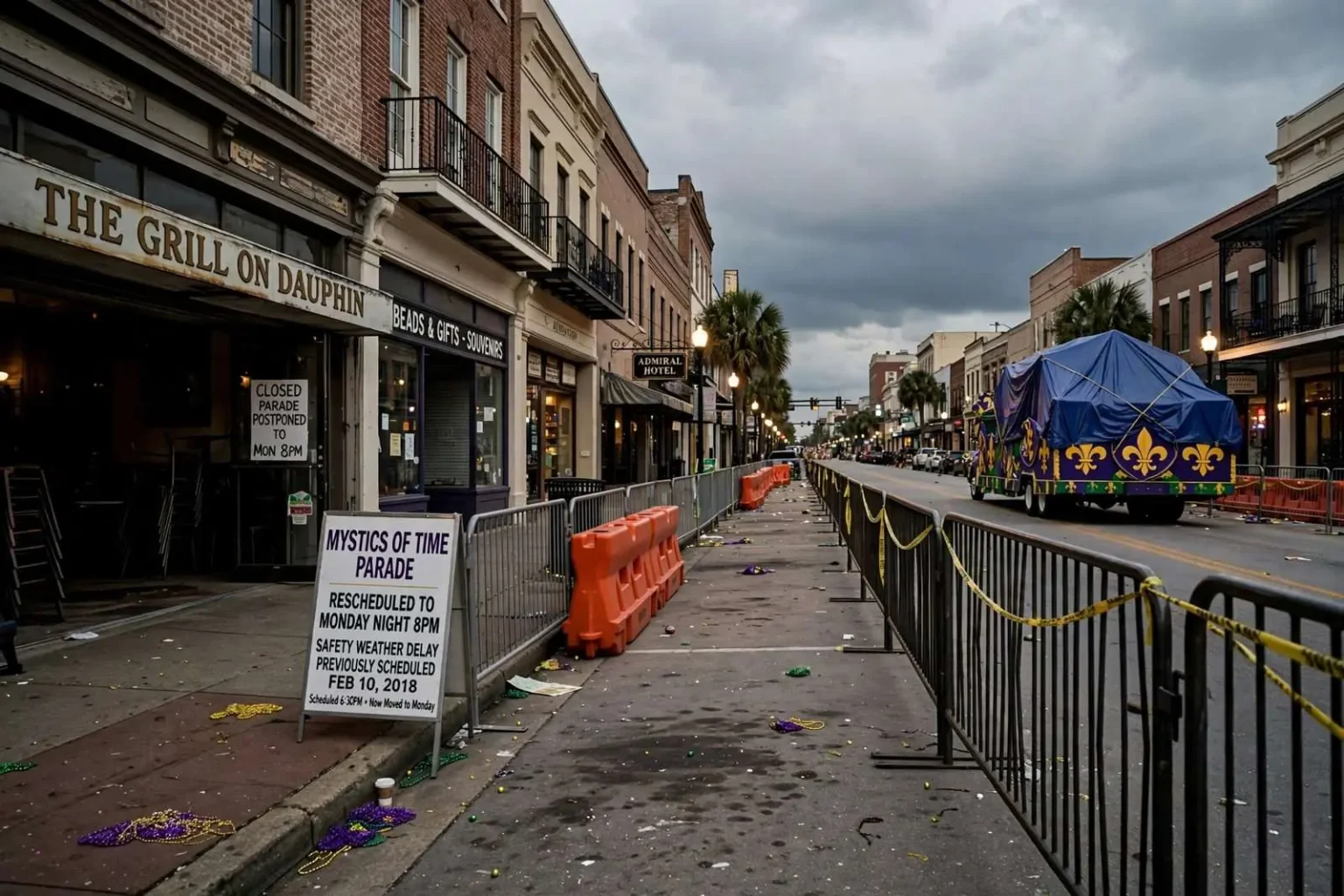
MOBILE, Ala. — Originally reported February 10, 2018. A weather-driven decision to reschedule the Mystics of Time Mardi Gras parade affected visitors and downtown Mobile businesses in February 2018, according to a local news report. The parade was moved to Monday night after the forecast raised concerns, disappointing people who had traveled to Mobile for the celebration because rain did not arrive downtown at the scheduled parade time. The report explored the local economic impact of a schedule change during Mardi Gras.
The decision placed organizers in the classic Mardi Gras bind. Parade schedules are set months in advance, printed in guides, published across the Gulf Coast and built into the travel plans of thousands of visitors. When a forecast threatens storms along a parade route, organizers must weigh the safety of float riders, marching bands and crowds against the certain disruption of moving an event that tens of thousands of people have planned their weekends around. In February 2018, the Mystics of Time chose caution, shifting the parade to Monday night — and then the threatened rain never materialized downtown, leaving visitors who had stayed through the original date to watch empty streets where a parade was supposed to roll.
The economics of a moved parade
The local economic impact of such a change is easy to underestimate. Mardi Gras weekends in Mobile function as a second peak season for downtown businesses, comparable in some stretches to the summer beach trade that coastal towns enjoy. Restaurants stock extra inventory and schedule additional staff for parade nights; hotels price and book rooms months ahead; parking decks and lots plan for overflow; bars and shops along Dauphin Street and the parade corridors schedule their year around the Carnival calendar. A parade that moves by a day scrambles all of it at once.
Visitors who had traveled to Mobile for the scheduled Saturday parade found themselves with a night of unplanned time downtown, and the report noted their disappointment — a real cost to the visitor experience even when the reschedule is the right safety call. Some travelers extend their stays when a parade moves, adding an unexpected hotel night but also an unplanned restaurant meal and a second morning of shopping. Others cannot stay, and their spending simply disappears from that weekend’s ledger. Businesses, meanwhile, staffed for a crowd on a night when the crowd was elsewhere, then scrambled to serve the rescheduled parade on a weeknight when inventory and staffing had been planned for a different demand curve.
Why weather calls are so hard
Gulf Coast weather in February is notoriously difficult to call. Mobile sits at the northern edge of the Gulf’s moisture, where warm, unstable air can collide with passing cold fronts and produce severe thunderstorms with little spatial precision — forecasters may know a line of storms is coming but not whether it reaches downtown at 6:30 p.m. or 9 p.m., or passes 30 miles to the north. The 2018 episode captured that uncertainty exactly: the forecast justified concern, organizers moved the parade, and the rain did not arrive downtown at the scheduled time. Hindsight made the call look unnecessary; at decision time, putting thousands of spectators and float riders in the path of a possible severe storm was a risk organizers were unwilling to take.
Mystics of Time is one of Mobile’s established night parades, rolling through the downtown corridor with illuminated floats during the heart of the Carnival season. Its slot on the calendar draws a substantial crowd of locals and out-of-towners, and its float-building society, like all of Mobile’s mystic societies, spends the year preparing for a single night. Moving that night is a decision no society takes lightly, because the parade is the product of months of work by volunteers, band directors, dance teams and city crews who coordinate routes, barricades and police details.
The visitor experience
For the people the reschedule affected most directly — the visitors — the weekend illustrated both the pull and the fragility of Mardi Gras tourism. Travelers who plan a Mobile Carnival weekend around a specific parade often build hotel reservations, dinner bookings and drives home around a published start time. A move to Monday night meant that some guests either rebooked rooms or simply missed the parade they came for. Local hotels reported the strain that schedule changes put on front desks, and downtown restaurants saw tables empty on the original parade night as visitors who would have dined before or after the parade adjusted or departed.
The report’s exploration of the economic impact placed the episode in a larger context: Mobile’s Carnival season is an economic engine whose value depends on reliability. Parades roll on schedules published a year in advance, and the whole apparatus of tourism — bookings, staffing, inventory, family traditions — depends on that predictability. When weather forces a change, the cost is spread across everyone who planned around the original date, and the benefit is measured only in the risk that never materialized.
A historical record
The 2018 reschedule stands as a case study in the tradeoffs that Gulf Coast event organizers face every season. Safety has to come first, and the decision to move the Mystics of Time parade reflected that priority. But the local news report documented the other side of the ledger — the visitors left disappointed by a rain that never came, and the downtown businesses that absorbed the whiplash of a parade-night demand curve shifted by 24 hours. This article records a 2018 event and is not a current parade schedule or business forecast.
Mobile’s Carnival calendar and its dependents
The Mystics of Time reschedule rippled through a season that Mobile plans as a whole. The city’s Carnival calendar stacks dozens of parades across roughly two weeks of peak activity, organized by mystic societies that range from the oldest and largest to newer organizations, each with its own route, date and ball. The city coordinates the schedule with police, fire, public works and downtown stakeholders so that routes can be barricaded, cleaned and reopened in sequence. Every parade date on that calendar is a commitment not just to revelers but to a chain of dependent operations — bands contracted months ahead, school groups scheduled, vendors booked and downtown employees shifted onto event-night staffing.
That structure is why a single moved parade carries costs beyond one night. When the Mystics of Time shifted from Saturday to Monday in 2018, every downstream commitment had to flex: float transport, band rehearsals and call times, school chaperone schedules, city permit adjustments and the informal economy of parade-night parking that neighbors along the route operate each season. Downtown restaurants recalculated inventory for two nights instead of one, and bars faced the odd calculus of a crowd that had already begun to disperse before the rescheduled parade rolled.
The human side is just as significant. Mardi Gras in Mobile is a multigenerational practice, and families coordinate their Carnival attendance the way other families coordinate holidays — around school calendars, work schedules and traditional gatherings. A parade moved by a day changes who can attend at all. Children who would have come downtown with grandparents on a Saturday cannot on a school night; visitors with Monday flights or work obligations miss the rescheduled event entirely. The disappointment the report captured among travelers reflected that arithmetic.
How organizers make the weather call
The decision framework behind the 2018 move is one that Mobile’s parade organizations have refined over years of Gulf Coast Februarys. Organizers monitor forecasts in the days before a parade and consult with city officials and, when severe weather threatens, with the National Weather Service’s Mobile office, which covers southwest Alabama. The specific hazards that force a call include lightning near the route, high winds that would stress float structures and topple barricades, and heavy rain that creates unsafe crowd and roadway conditions. Float riders on elevated decks and marching bands carrying metal instruments face disproportionate exposure when lightning threatens.
The options available are limited: delay a parade’s start by hours, move it to the following night, or in the extreme case cancel. Each choice carries its own costs. A delay works only if the weather window is clear. Moving to the next night requires the route, police details and bands to be available — no small thing during the congested peak of the season — and it collides with the school-and-work realities of the audience. The 2018 Mystics of Time decision to move to Monday reflected that calculus: the forecast raised genuine concerns, Monday night was available, and the society chose to protect its riders and its crowd.
The unappreciated upside of a quiet night
What the aftermath demonstrated — rain that never arrived downtown at the scheduled time — is the nature of preventive decisions: their success is invisible. Had the parade rolled and severe weather hit downtown, the story would have been about injuries and damage; because it moved and the storm missed, the story was about disappointment and lost revenue. Organizers accept that trade every time they make a weather call, and the 2018 episode gave Mobilians a clear look at how it feels from both sides.
For downtown businesses, the episode also reinforced lessons about flexibility during Carnival. The most resilient operators treat parade-week demand as inherently variable — cross-staffing between weekends and weeknights, keeping inventory flexible, and communicating schedule changes to customers quickly. The city’s own communications, along with local media and the societies’ social channels, are the channels through which a reschedule reaches the audience, and the faster that word travels, the more of a visitor’s weekend can be salvaged around the new time.
Mobile’s Mardi Gras has weathered two centuries of Gulf Coast springs, and individual parades have moved or been rained out many times across that history. The 2018 Mystics of Time reschedule is a recent chapter in that long story: a society’s safety call, a forecast that did not fully materialize, and a weekend that reminded everyone involved — organizers, visitors and downtown merchants alike — how much of the Carnival economy rests on a schedule printed months in advance. This article records a 2018 event and is not a current parade schedule or business forecast.