
Mobile Metro Jail Warden Reacts to Lauderdale County Escape: ‘You’re Only as Strong as Your Weakest Link’
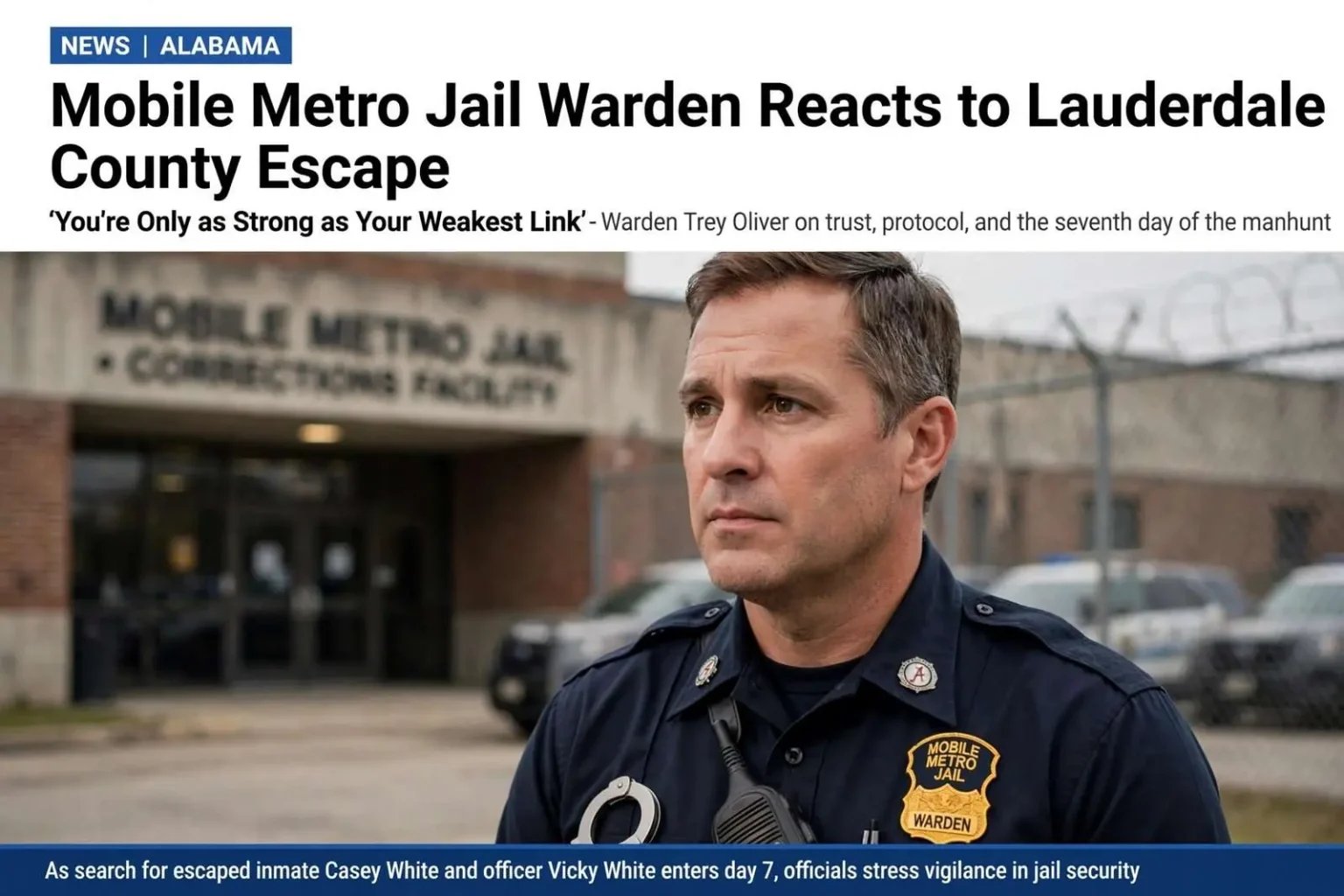
Mobile Metro Jail warden Trey Oliver discusses jail security protocols as the manhunt for Vicky White and Casey White entered day seven.
As the search for escaped inmate Casey White and Lauderdale County Corrections Officer Vicky White stretched into its seventh day, investigators were publicly urging the officer to turn herself in.
Authorities believe Vicky White, no relation to the inmate, developed a relationship with Casey White and facilitated his escape from the Lauderdale County Jail in Florence, a small city in Alabama’s Shoals region that had never seen anything like the manhunt now spreading across state lines.
Officials say the suspected relationship traces back to 2020, when Casey White was brought to Lauderdale County to be arraigned on a murder charge. Since the pair vanished, the investigation has surfaced allegations that he received special treatment behind bars — extra food and visits from Vicky White during her off hours.
For jail administrators across Alabama, the case has become an instant case study in how a trusted employee can undo every safeguard a facility has built.
How Investigators Say It Started
Officials say the suspected relationship traces back to 2020, when Casey White was brought to Lauderdale County to be arraigned on a murder charge. White, a fugitive from Alabama law with a violent history, was housed at the Florence facility during proceedings connected to that charge — and, according to investigators, that is when the contact began that would culminate in the escape two years later.
Since the pair vanished, the investigation has surfaced allegations that he received special treatment behind bars — extra food and visits from Vicky White during her off hours. In a jail, those privileges are currency. Extra food and unsupervised contact are the kinds of favors inmates trade information for, and investigators say the pattern they have pieced together shows a relationship that deepened over time while appearing, to the rest of the facility, like ordinary employee diligence.
Vicky White held a senior position in the corrections operation, with the access and authority that come with it. That standing, authorities say, is what allowed the escape to happen: the person arranging the inmate’s movement that day was the person arranging the escape. The, by-now familiar outlines of the case — a trusted veteran officer, a capital murder defendant, and a patrol car that never made its destination — have been recounted in detail as the search has widened across the region.
By the seventh day of the search, law enforcement had circulated descriptions of the pair and the vehicle believed involved, and officials were making direct public appeals for the officer to surrender — a message aimed at ending the ordeal before it turned more dangerous than it already was.
A Mobile Perspective on Jail Protocols
Trey Oliver, who runs Mobile Metro Jail, said he knows the Lauderdale County sheriff personally and was stunned by the news. “It’s a top-notch facility but you know, you’re only as strong as your weakest link,” Oliver said. “It’s just a shame because she sacrificed such a good career… I hope she turns up alive because certainly things could really be bad.”
Oliver’s assessment carries the weight of someone who runs one of Alabama’s largest county detention operations. Mobile Metro Jail houses hundreds of inmates spanning every stage of the criminal process — pretrial detainees, sentenced inmates, and federal and state holds — in a downtown Mobile facility where the daily movement of people in and out of courtrooms creates exactly the kind of logistical complexity that the Lauderdale County escape exploited.
Oliver emphasized that Mobile Metro Jail operates under strict protocols designed to prevent anything similar: any suspected relationship between a corrections officer and an inmate triggers an immediate investigation, and steps are taken to ensure the two have no contact. The policy reflects a hard truth of jail administration — inappropriate relationships rarely announce themselves, so the standard must be suspicion followed by action, not certainty.
The layers are deliberate. Inmate movements are planned by multiple staff members rather than a single officer, transport assignments are checked against staffing rosters, and supervisors are expected to notice when a particular officer’s interactions with a particular inmate stand out. Cameras and controlled movements provide an audit trail after the fact, but administrators say the front line is the culture: a staff where officers report concerns about colleagues without hesitation.
The Weakest Link
The phrase Oliver used — only as strong as your weakest link — is the axiom every jail administrator knows. Facilities are engineered around the assumption that staff follow procedure; perimeter security, cell locks, transport protocols, and headcounts all depend on it. A single employee willing to subvert those systems renders the engineering moot, because the person opening the doors is on the inside of every defense.
That is what distinguishes the Lauderdale County case from an ordinary escape. Inmates tunneling through walls or overpowering officers are the scenarios security is built to defeat. An escape enabled by the assistant director of corrections — a veteran employee with keys, schedules, and credibility — defeats it by consent. Administrators across the state have spent the week since the escape reviewing their own transport policies and asking a question that has no comfortable answer: how do you design a system to be secure against the people you trust most?
Part of the answer, Oliver suggested, is vigilance over the small things. The alleged extra food and off-hours visits in the Lauderdale case were, individually, the kinds of liberties that can pass unnoticed or unremarked. Compounded over two years, they became the architecture of an escape. In Mobile, the rule is that no liberty is small — a suspected relationship triggers investigation immediately, before patterns harden into schemes.
The Manhunt’s Reach
By the time the search reached its seventh day, it had become one of the widest law enforcement operations in the region’s recent memory. Alerts went out across state lines, tips poured in from the public, and agencies from the U.S. Marshals Service down to local departments worked the case. The Marshals Service, which tracks fugitives nationwide, took a leading role, and the reward money posted for information grew as the days passed without a sighting.
For communities along the escape’s possible routes, the search was a tense backdrop to daily life. Casey White was considered extremely dangerous — a man facing a capital murder charge with a history of violence — and the public warnings reflected that. Residents were urged not to approach either figure but to report sightings immediately.
The case also put an unflattering spotlight on the procedures at the Lauderdale County facility, where the escape had unfolded in daylight through a public building. Investigators walking backward through the events found a trail of anomalies — a transport that was never requested by the courts, an inmate left alone with a single officer against policy, and a patrol car abandoned at a shopping center where a second vehicle waited.
Each revelation sharpened the questions administrators like Oliver were asking in their own facilities. The escape had not been a failure of hardware but of human judgment layered upon human judgment — and, allegedly, upon a hidden relationship no one had caught in two years of proximity.
What Jails Can and Cannot Prevent
Security professionals distinguish between physical security and human security, and the Lauderdale case has become a seminar in the second. Physical measures — cameras, fences, locks, motion sensors — deter and document. But no camera catches a relationship that exists only in off-hours conversations, extra meals, and favors that leave no record. Human security is built from screening, supervision, rotation of assignments, and a staff culture that surfaces concerns early.
Jail administrators also point to the difficulty of the corrections environment itself. Pay is modest, turnover is chronic, and officers spend their shifts in close quarters with people trained to exploit them. Inmate manipulation of staff follows recognizable patterns — sympathy first, small favors, then escalation — and facilities train officers to recognize the stages. The system works when officers report it in themselves or their colleagues; it fails when the person manipulating is trusted enough that no one imagines manipulation at all.
That is why Mobile Metro Jail’s zero-tolerance trigger — any suspected relationship prompts an immediate investigation and enforced separation — is the policy administrators cite most readily. It accepts false alarms as the cost of catching real ones.
The View From Florence
In Lauderdale County, the fallout was immediate and personal. The sheriff who had built a reputation over decades of law enforcement service watched his facility become a national story, and the officer at the center of it was a respected veteran whose career had, until that morning, contained no hint of the betrayal investigators now described. Colleagues who had worked beside her for years struggled to square the person they knew with the person the evidence suggested.
The public appeals for her to surrender — repeated daily by investigators — carried a note of urgency that grew with each unanswered day. Authorities said openly that they hoped she would be found alive, and that the longer the pair remained at large, the more volatile the situation became. For the victim’s family in the capital murder case, the escape reopened wounds that the criminal process had barely begun to address, and prosecutors vowed that the delay would not derail the case against White.
In the Shoals region, where the jail sits blocks from the courthouse, the escape dominated conversation in a way few local stories do. Florence is a city of modest size where the jail is a known institution, and the notion that its own assistant corrections director had walked a murder defendant out the door was, for many residents, harder to absorb than the manhunt itself.
Whatever the search’s outcome, the case has already changed practice in county jails well beyond Lauderdale County. Administrators like Oliver in Mobile are reviewing transport assignments, tightening the rules on one-officer movements, and reminding staff that the system’s strength depends on its least tempted employee — the weakest link, watched over by everyone else.


