Mobile Moves Toward ShotSpotter Gunshot Detection System With Mid-2022 Launch Target
Mobile's City Council weighs a $640,000 three-year ShotSpotter contract that could bring automated gunshot detection to the city by mid-2022.
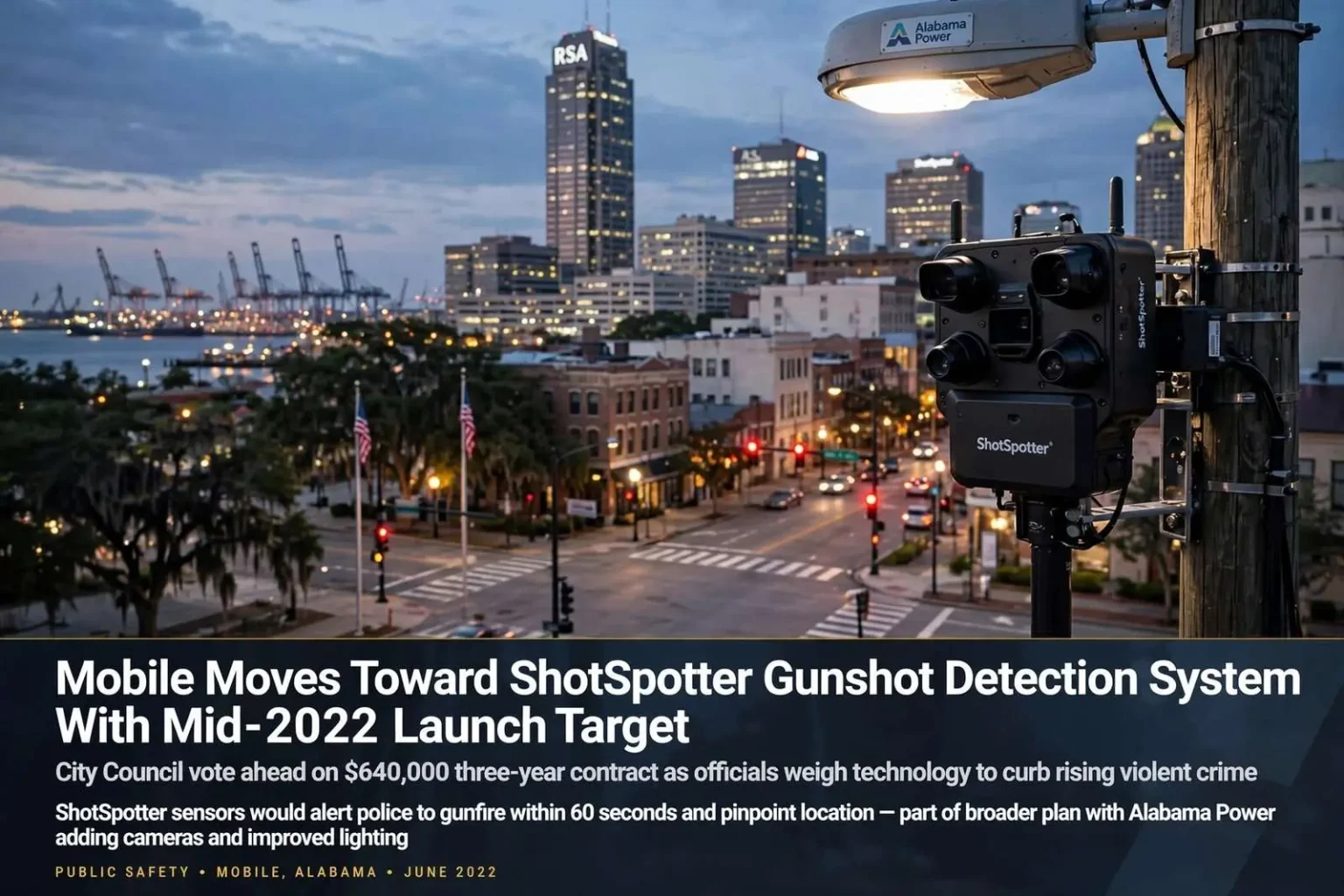
Mobile is one City Council vote away from joining the growing list of cities using automated gunshot detection, with a proposed three-year contract worth roughly $640,000 with ShotSpotter headed for its first council consideration. The push follows a year of rising violent crime in the city. Public Safety Director Lawrence Battiste said the system would give officers a new tool for responding to gunfire.
The proposal arrives as Mobile confronts violence rates that climbed during a period when cities across the country saw similar increases, straining police departments already stretched thin. City officials have assembled a layered response that mixes enforcement, prevention, and technology, and the ShotSpotter contract represents the most expensive and most debated piece of that strategy. The first council consideration begins a process that includes committee review, public discussion, and a final vote in the weeks ahead.
How the Technology Works
ShotSpotter relies on a network of microphones and sensors placed around covered areas. The devices listen continuously for the acoustic signature of gunfire — distinct from fireworks, car backfires, and other street noise — and use the tiny differences in the time a sound reaches each sensor to triangulate its origin. When multiple sensors confirm a shot, the system classifies it, calculates the location, and pushes an alert to dispatch and to officers’ phones, often with a location precise enough to direct responders to a specific address or parking spot.
Under the terms of the proposed agreement, the company says its technology can pinpoint a shooting location within about 82 feet and alert police to a reported gunshot within a minute roughly 90 percent of the time — often before anyone calls 911. “We have a saying that when it comes to shootings time is tissue, meaning that the faster you can get the victim to medical care the better outcomes,” said Phil Dailly of ShotSpotter. The company’s argument is that in most urban shootings, no one calls police at all: victims and witnesses flee, and officers learn of the incident only when a victim arrives at a hospital, if then. Automated detection closes that gap, directing paramedics to wounded victims who might otherwise wait undiscovered and preserving evidence at scenes that would otherwise go cold.
Battiste emphasized the system would not stand alone. The city plans to implement it alongside Alabama Power, which will add cameras and improved lighting in covered areas. “I don’t believe … it would be an effective tool by itself, but the ability to integrate it with all of the other things that we have in place, I believe it will be an effective tool here in the City of Mobile,” he said. The pairing with Alabama Power’s infrastructure improvements reflects a broader strategy: brighter, camera-covered corridors change the calculus for shooters, and detection technology ensures that gunfire that does occur generates an immediate, targeted response rather than an anonymous one.
Scrutiny From Elsewhere
ShotSpotter operates in more than 120 cities, including Birmingham and Montgomery. Its track record has drawn criticism elsewhere: an August 2021 report by Chicago’s Inspector General found that alerts “rarely produce documented evidence of a gun-related crime.” The inspector general’s analysis of Chicago — the system’s largest deployment — found that shot detections rarely led to evidence of a gun-related offense, feeding a national debate over whether the technology reduces gun violence or merely redirects police attention.
The company disputes that characterization, noting that traditional 911 calls during the same period produced reports or evidence at a similar rate — 16 percent versus 17 percent for ShotSpotter alerts — and citing independent audits putting its accuracy at 97 percent. ShotSpotter’s position is that holding alerts to a different standard than 911 calls distorts the comparison: most 911 calls about gunfire also produce no evidence, yet no one argues that answering 911 is wasted policing. The company has also pointed to cities where it says detection has shortened medical response times and increased recovery of shell casings and firearms.
For Mobile’s council members, those competing assessments frame the decision. Supporters point to the technology’s speed advantage and to peer cities in Alabama that have already adopted it, while skeptics question whether $640,000 over three years is better spent on intervention workers, youth programs, or additional officers. The contract’s structure — a fixed term with defined coverage areas — gives the council a natural review point at renewal if the early results do not justify the cost.
What the Contract Would Mean for Mobile
The three-year, roughly $640,000 agreement covers deployment in the areas of the city where gun violence has been most concentrated, with sensor placement kept confidential. If the contract wins approval in the following weeks, city officials hope the system will be operational by June or July 2022. The locations of sensors will not be made public. That confidentiality is deliberate: publicized sensor maps would allow shooters to shift activity to uncovered blocks, undermining coverage and giving criminals a map of where gunfire goes unheard.
The timeline gives the city a mid-summer launch, deploying during the season when gunfire historically peaks in Mobile — long evenings, holidays, and outdoor gatherings that see shooting incidents rise year after year. Deployment involves site surveys, sensor installation, acoustic calibration of the coverage area, and training for dispatchers and patrol officers on how to respond to alerts, which is why cities typically budget several weeks between contract signature and full operation.
How officers respond to an alert matters as much as the detection itself. Departments using the system generally pair alerts with a protocol: responding units treat the location as active, canvass for victims and witnesses, and document the scene for ballistic evidence. The intelligence accumulates over time — clusters of detections feed into the department’s picture of where and when gun violence concentrates, informing where patrol coverage, lighting, and community outreach go next. That data layer is part of what Battiste means when he describes integration with the city’s other tools rather than a standalone fix.
The Broader Anti-Violence Strategy
The ShotSpotter contract sits within a wider agenda Mobile’s leadership has assembled as violent crime climbed. The city has leaned on focused deterrence work with community partners, expanded youth programming, and partnerships with federal prosecutors to target repeat violent offenders. Battiste, a former Mobile police chief who returned to city hall in the public safety director role, has framed technology as one leg of a stool that also includes prevention and community trust — and has been candid that no single tool, however sophisticated, reverses violence on its own.
Alabama Power’s role in the plan is an example of that integration. The utility’s commitment to add cameras and improved lighting in covered areas attacks the environmental conditions that make shootings easier — dark corridors, unmonitored lots — and does so through infrastructure the city itself would otherwise have to fund. Comparable public-private arrangements in other cities have shown that lighting improvements alone measurably reduce gun violence in targeted areas, which is why officials paired the two investments rather than choosing between them.
The national debate over gunshot detection will follow the system to Mobile, and the council’s decision sets up a natural experiment for the Gulf Coast. Birmingham and Montgomery have operated the technology in neighborhoods with persistent gun violence, giving Alabama examples of both its promise and its limitations. What happens in Mobile over the contract’s three years — whether response times fall, whether evidence recovery improves, whether residents in covered areas report feeling safer — will shape not only a renewal vote in three years but also the decisions of other Gulf Coast cities watching how the technology performs here.
Battiste said he expects violent crime to decline over the long run once the technology is in place. That expectation now rests with the City Council, which must weigh a company’s accuracy claims against an inspector general’s skepticism, a six-figure contract against competing public safety needs, and the urgency of a violent year against the patience a new system requires. One vote stands between Mobile and a place among the more than 120 American cities listening for gunfire — and the first alert, if the contract passes, could sound sometime this summer.
The Decision Before the Council
The contract’s path through City Council will follow Mobile’s standard process: a first reading and referral to committee, where members can question police administrators and company representatives, followed by a vote of the full council. Procurement of this size typically draws questions about coverage boundaries, response protocols, data access, and exit provisions, and officials have indicated the administration is prepared to share the deployment plan with members before a final vote. Public comment periods also give residents — including those who would live inside the covered area — a direct voice in the decision.
Cost context matters for the debate. Spread over three years, the roughly $640,000 price is a modest slice of the city’s public safety budget, comparable to the cost of a small number of additional officers over the same period. Supporters argue the system multiplies the value of every existing officer by eliminating the most unreliable part of the gunshot response chain — the 911 call that never comes. Critics counter that the money could fund a year of summer youth employment or community intervention work, programs with their own evidence behind them. The council must weigh not only whether the technology works, but whether it is the right marginal dollar in a budget full of competing claims.
Privacy and civil-liberties questions have trailed gunshot detection in other cities as well, centering on where sensors are placed and whether alerts concentrate police activity in already over-patrolled neighborhoods. Mobile’s officials have responded by stressing that the microphones detect gunfire acoustics rather than record conversations, and that coverage decisions are driven by shooting data rather than by neighborhood demographics. How convincingly the administration answers those concerns during council review may matter as much to the final vote as the accuracy statistics.
How Mobile Compares With Its Neighbor Cities
Birmingham deployed ShotSpotter in high-violence corridors and has credited it with faster discovery of shooting scenes, while Montgomery has used the technology as part of its own violence-reduction push. The presence of two Alabama reference points shortens Mobile’s learning curve: the city can examine how its peers configured coverage, how officers there were trained to respond to alerts, and what operational surprises emerged in the first year. Police administrators in peer departments have generally reported that the system performs best when alert responses are disciplined — units arriving quickly, canvassing thoroughly, and collecting casings that feed ballistic databases.
That evidence chain is one of the system’s quieter benefits. Shell casings recovered at detected scenes are entered into national ballistics networks, where they can be matched to other shootings and to specific firearms. A single recovered casing can tie a gun to multiple crimes across jurisdictional lines, which is why detectives treat detection-driven evidence collection as an investigative investment rather than a mere response statistic. For a city working serial shooting cases, that accumulation matters over the life of the contract.
The next few weeks will decide whether Mobile becomes the third major Alabama city running the technology. If the council approves, the summer deployment window gives the system its trial by fire immediately — peak gunfire season — and the first months of alert data will begin shaping the public verdict long before the contract’s three-year term ends. City officials say they are ready to be judged on the results: fewer undetected shootings, faster medical response, more evidence recovered, and, in Battiste’s expectation, a long-run decline in the violence that prompted the purchase.