Mobile Native Armand DeKeyser Confirmed to National Humanities Council
The U.S. Senate confirmed Mobile native Armand DeKeyser, who leads the Alabama Humanities Foundation, to the National Council on the Humanities.
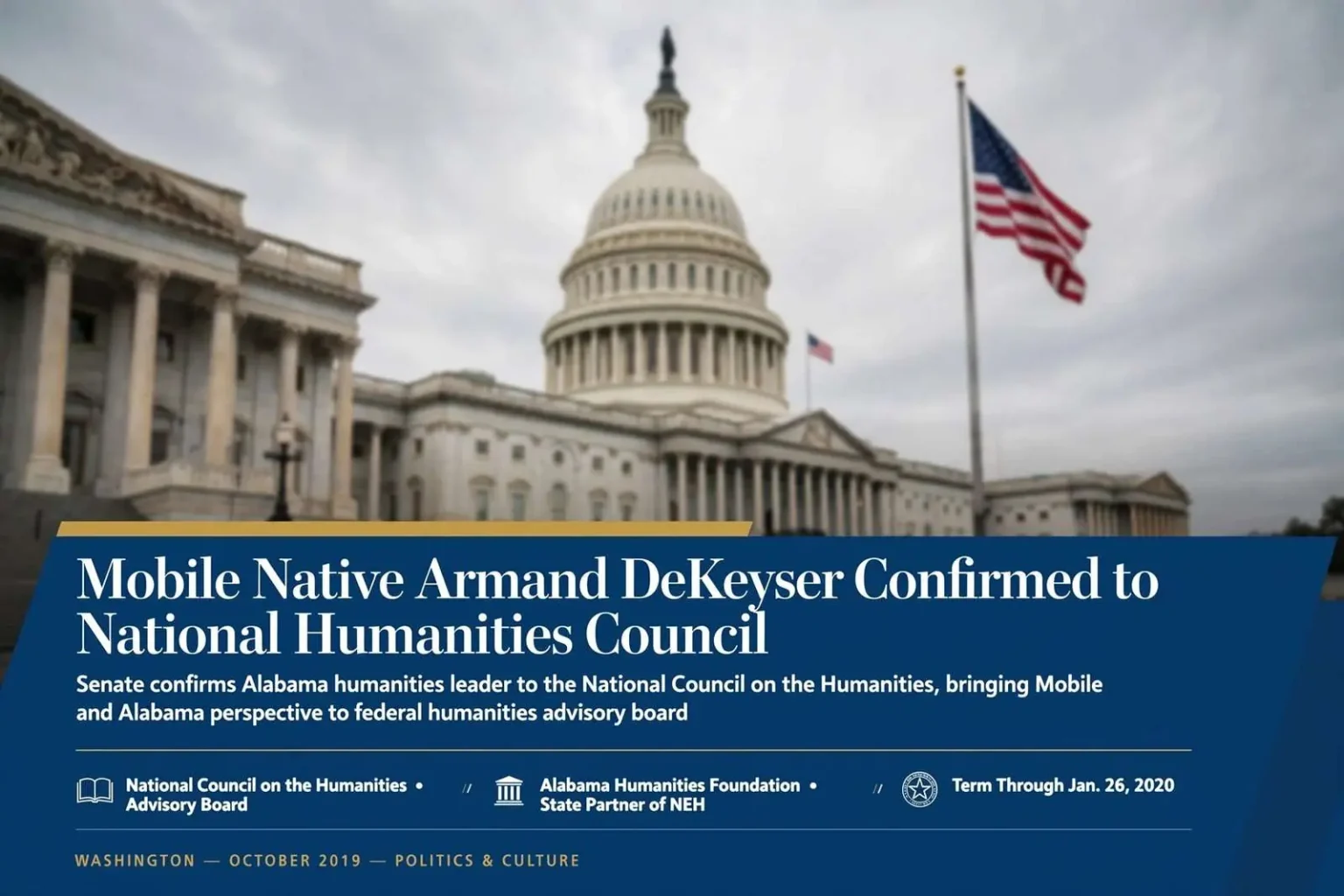
The U.S. Senate has confirmed President Donald Trump’s appointment of Armand DeKeyser, executive director of the Alabama Humanities Foundation, to the National Council on the Humanities. The confirmation places a Mobile native on the advisory board that helps steer federal humanities funding nationwide, a post that will carry his home state’s perspective into the room where grant applications and policy recommendations are weighed.
DeKeyser was one of 16 humanities scholars and advocates from across the country named to the 26-member advisory board. National Endowment for the Humanities Chairman Jon Parrish Peede welcomed the new members, noting they bring expertise in cultural leadership, government, philanthropy and fields ranging from archaeology and literature to history and political science. The breadth of the panel is by design: the council is intended to represent the range of disciplines the endowment funds, from museum exhibitions and documentary films to scholarly research and public programming in small towns.
What the Council Does
The council meets three times a year to review grant applications and advise the chairman on humanities policy. Its role is advisory rather than administrative — the chairman holds final authority over awards — but the council’s evaluations shape which projects reach the public and how the endowment sets priorities across a portfolio that touches every state. Members review applications spanning scholarship, preservation, public humanities programming and education, and their recommendations carry substantial weight in a competitive grant process.
DeKeyser will serve an unexpired term ending Jan. 26, 2020. The partial term is the standard route onto the council, whose members are nominated by the president and confirmed by the Senate for staggered terms so that the board turns over gradually. His confirmation filled one of the board’s vacant seats with a nominee whose career spans government service, business and — most recently — leadership of Alabama’s state humanities council.
“I am humbled by this appointment,” DeKeyser said. “To represent our state and the humanities on such a distinguished board is truly an honor and a privilege.” His remarks framed the post as a charge to carry Alabama’s interests into the federal process, from the perspective of a state whose humanities programming runs through rural museums, historical societies, libraries and classrooms.
A Mobile Native With Deep Roots
DeKeyser is a native of Mobile and a graduate of Auburn University. After years working in Washington, D.C. — most notably as chief of staff to U.S. Sen. Jeff Sessions — he returned to Alabama. He has led the Alabama Humanities Foundation since 2012, guiding the organization through a period when public humanities programming has had to reach audiences across a large, diverse state with a small staff and a budget built largely on federal and philanthropic support.
The Birmingham-based organization, the state partner of the National Endowment for the Humanities, supports programs that promote learning and an appreciation of Alabama’s people, communities and cultures. Its work distributes federal grant dollars to local institutions and runs its own programming — reading initiatives, teacher enrichment, speaker series and community history projects — designed to carry scholarship and cultural conversation beyond the state’s universities. The state-partner relationship is what makes the National Council seat a natural extension of DeKeyser’s day job: the councils that advise the endowment draw heavily on the people who run its state affiliates.
A Career Built in Government and the Military
Before leading the foundation, DeKeyser spent more than three decades in government and private business and served 28 years as an active and reserve Army officer. The combination is unusual on an advisory board stocked with scholars, and it reflects the endowment’s practice of seating members who understand both the academic disciplines it funds and the machinery of government that sustains it.
His Washington years as chief of staff to Sessions gave him a working knowledge of how federal agencies are overseen and how nominations move through the Senate — knowledge that becomes directly relevant now that he sits on the receiving end of that process. The military service adds another dimension: an officer’s experience with organization, planning and execution that humanities boards rarely list among their members’ credentials.
Why the Appointment Matters for Alabama
For Alabama’s cultural institutions, the confirmation means the state has an advocate inside the process that allocates federal humanities funding. Grants from the National Endowment for the Humanities support museums, archives, historic sites and public programs across the state, and the priorities the endowment sets — in consultation with its council — determine how easily local institutions can compete for that support. A council member who has spent years distributing humanities grants within Alabama arrives with a practical sense of what small organizations can accomplish and what they need to apply successfully.
The appointment also underscores the pipeline between state humanities councils and the federal endowment. State affiliates like the Alabama Humanities Foundation operate at the intersection of federal money and local need, and their leaders develop exactly the judgment the National Council is asked to exercise: weighing scholarly merit against public benefit, and balancing prestigious national projects against the small grants that sustain cultural life in communities of a few thousand people.
The Endowment’s Reach in the State
NEH funding touches Alabama in ways residents rarely see attributed. Documentary films about the state’s history, preservation work at historic sites, teacher institutes on Alabama subjects and community reading programs all trace back to endowment grants, often administered through the state partner. The council’s review process is where those proposals first face scrutiny, and the perspectives of members from states like Alabama help ensure the evaluation accounts for institutions far from the major research universities.
DeKeyser’s term runs through Jan. 26, 2020, a window that covers multiple grant cycles and the council’s regular meetings in Washington. During that period he will review applications from across the country while continuing to lead the Alabama Humanities Foundation from Birmingham — a dual role that gives the state both a seat at the federal table and, through its state council, a leader whose vantage point now extends nationwide.
From Mobile to the National Stage
DeKeyser’s path from Mobile to the National Council on the Humanities traces the routes that Alabama’s public servants have long traveled: Auburn, Washington, military service, then back home to lead a state institution. His confirmation by the Senate — the same body he served as a Senate staffer — returned him to federal service in a role that, while advisory, sits at the top of the nation’s humanities funding structure.
For the foundation he leads, the appointment brings visibility and connection: the state partner of the NEH now has its executive director advising the endowment itself. For Alabama, it means that when 26 people meet three times a year to weigh the nation’s humanities grants, one of them comes from the Gulf Coast — a Mobile native who told the endowment’s chairman, and the public, that representing his state on the board was an honor and a privilege he intended to earn.
The Chairman and the Board He Welcomed
Chairman Jon Parrish Peede, himself a Virginian with deep roots in state humanities work before coming to the endowment, has emphasized the council’s role as a bridge between Washington and the state affiliates. The 16 new members he welcomed joined a board whose deliberations set the tone for how federal humanities dollars are judged — whether a documentary project, a museum exhibition, a community archive or a scholarly edition advances the endowment’s mission of serving the public as well as the academy. Peede’s welcome highlighted the members’ expertise in cultural leadership, government, philanthropy, archaeology, literature, history and political science, a description that fits DeKeyser’s government-and-nonprofit career as neatly as it fits the scholars around him.
The council’s structure reflects a deliberate balance. Its 26 seats are filled by presidential nomination and Senate confirmation, with staggered terms that keep institutional memory in the room while fresh perspectives rotate through. Advisory bodies of this kind rarely make headlines, but their judgments shape the cultural programming that reaches the public — the films, exhibitions, books and community projects that begin as grant applications in front of exactly this sort of panel.
The Alabama Humanities Foundation Under DeKeyser
Since taking the foundation’s helm in 2012, DeKeyser has led the organization in its role as Alabama’s statewide humanities advocate. The foundation’s work connects the federal endowment to Alabama institutions: grantmaking that funds local history and cultural projects, programs that bring scholars and communities together and partnerships with libraries, museums, schools and historical organizations across the state. Its Birmingham headquarters places it at the center of a network that reaches every corner of Alabama, from the Gulf Coast to the Tennessee Valley.
The state council model that the foundation operates under is itself a federal creation — the state affiliates exist to carry the endowment’s mission into each state with local judgment about local needs. DeKeyser’s move from that role to the National Council follows the pipeline in both directions at once: a state leader gaining a federal platform, and Alabama gaining a voice in how the partnership is governed. His term, running to Jan. 26, 2020, gives the state several years of representation on the board before the seat turns over again.
A Record of Public Service
The arc of DeKeyser’s career — Mobile upbringing, Auburn education, Army service as both an active and reserve officer, decades in government and business, and a decade leading the state’s humanities organization — gives him the sort of composite background the council’s founders had in mind. Humanities policy sits at the junction of culture, education and public administration, and the board’s mix of scholars and practitioners exists to judge proposals from both angles: the intellectual merit of the work and the practical capacity of the institutions that would carry it out.
His confirmation closes the loop on a nomination process that moved from the White House through Senate review, the same machinery he once managed from the chief of staff’s desk. It returns a Mobile native to federal service, places Alabama’s humanities community at the national table and adds to the National Council on the Humanities a member whose own statement of purpose — representing his state on a distinguished board — doubles as a description of the career that got him there.