
Mobile Native Dr. Christopher Park Keeps Winning the City’s Most Grinning-Inducing Honor: Best Boob Doc
Mobile native Dr. Christopher Park wins another Best Boob Doc title, built on breast reconstruction work from his Dauphin Street practice.
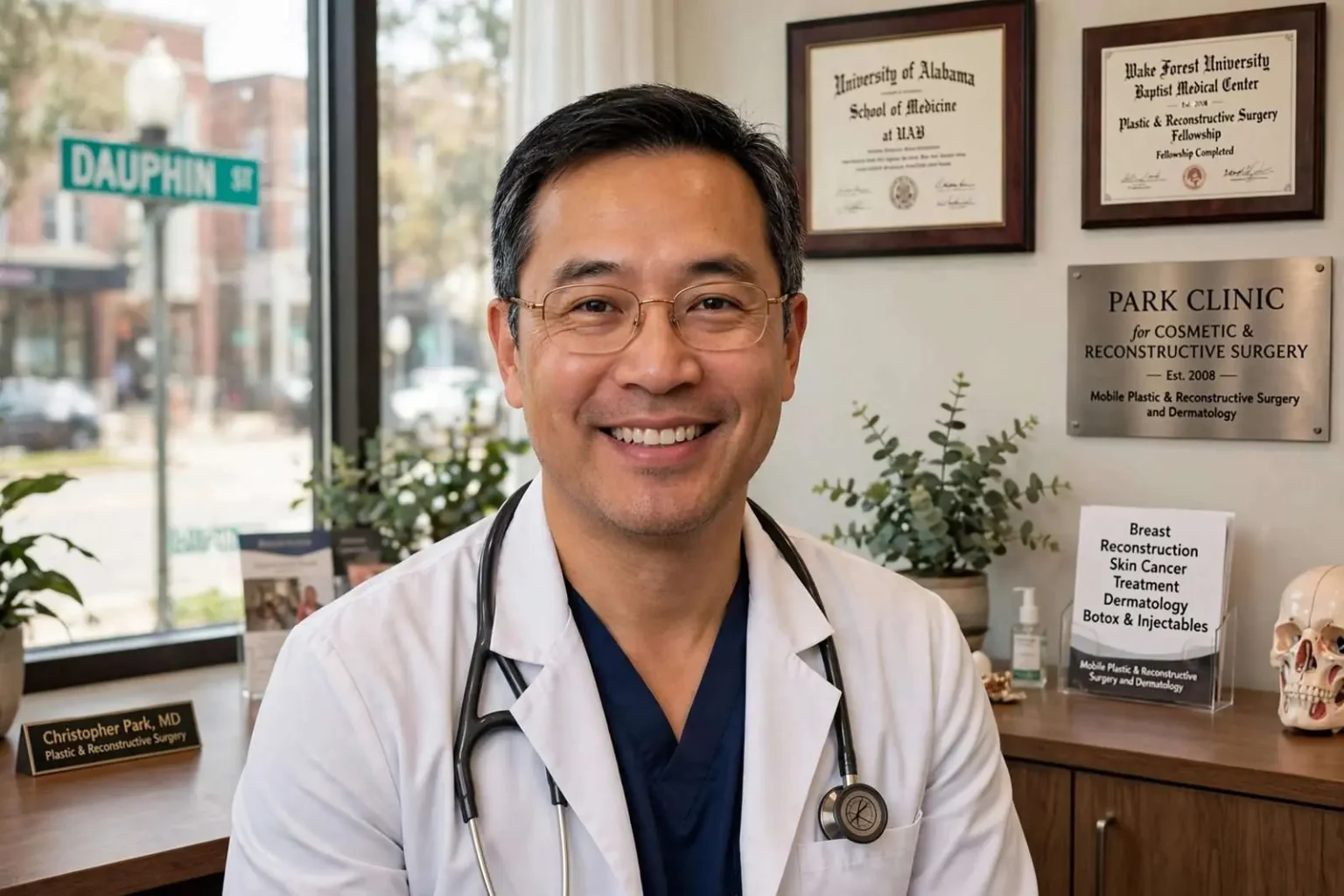
Dr. Christopher Park has held an unusual title longer than almost anyone in Mobile — one that makes a room full of adults giggle every time it’s announced. The Mobile native and St. Paul’s graduate has again been named the city’s “Best Boob Doc,” an honor he’s collected for much of the past decade in the local best-of balloting that readers use to crown their favorites across dozens of categories. The award’s name draws a laugh every year, but the career behind it is anything but a joke: it reflects nearly two decades of medical training and a practice built substantially on surgery for cancer patients.
Park, who opened the Park Clinic for Cosmetic and Reconstructive Surgery after 17 years of education and training, attended the University of Alabama School of Medicine at UAB before completing further training at Wake Forest University Baptist Medical Center. That path — from medical school in Birmingham to specialty training at one of the Southeast’s major academic medical centers — placed him among the surgeons in the region with formal fellowship-level preparation in plastic and reconstructive surgery, a field whose demand has grown steadily as both elective aesthetics and post-cancer reconstruction have become more widely sought.
Today he practices through Mobile Plastic & Reconstructive Surgery and Dermatology on Dauphin Street, offering everything from reconstructive work to skin cancer treatment and nonsurgical services like peels, Botox and fat injections. The Dauphin Street location places the practice in the heart of Mobile’s medical district, among the hospitals, specialty clinics and physician offices that anchor the city’s healthcare economy, and the combination of surgical and dermatological services under one roof reflects how the specialty has evolved — with many patients moving between skin cancer care, reconstructive procedures and cosmetic treatments over the course of a lifetime.
The serious work behind the award’s name
While the award name draws laughs, Park said most of his breast-related work is far more serious: reconstruction for breast cancer patients and procedures helping mothers restore their bodies after childbirth have become the heart of his practice since he opened it in 2008. Breast reconstruction after cancer treatment is a field where surgical skill carries enormous personal weight — patients arrive after mastectomy or lumpectomy, often mid-treatment, entrusting a surgeon with both physical recovery and the emotional return to a sense of normalcy. The work requires coordination with oncologists and general surgeons, multiple operative stages and months of healing, and it has become one of the most consequential corners of plastic surgery.
The post-childbirth side of the practice has grown alongside broader national trends, as procedures combining breast surgery with abdominal repair have moved from celebrity gossip to mainstream conversations between mothers and their doctors. Park’s patient base reflects that shift: women who once would have considered such surgery an extravagance now schedule consultations the way earlier generations scheduled any other medical appointment, often at the encouragement of friends who have been through the process themselves.
The demand keeps climbing, he says, because cosmetic surgery has shed its taboo. Where patients once kept visits secret, friends now book group consultations together. “It’s almost normal at this point, whereas it used to be this ‘hush hush’ thing,” Park said. The normalization has changed the texture of the practice in visible ways — consultation schedules that once relied on discreet scheduling now run like any other appointment book, and the stigma that once kept patients from asking questions has given way to the kind of word-of-mouth referrals that, in a city the size of Mobile, ultimately decide who wins awards like the one Park keeps collecting.
The hospital work few patients see
Beyond his private practice, Park performs reconstructive surgery for area hospitals in cases of physical trauma and for patients needing plastic surgery following other operations — the lesser-known side of the field, he notes, that keeps him busiest. Trauma reconstruction covers some of the most demanding work in the specialty: injuries from vehicle crashes, industrial accidents and other emergencies that leave patients needing immediate surgical repair, followed over months by the staged procedures that restore function and appearance.
The reconstructive side of plastic surgery also follows patients out of operating rooms where other specialists have done the primary work. A cancer surgeon removes a tumor and the plastic surgeon rebuilds what was taken; a general surgeon completes an abdominal operation and the plastic surgeon closes what cannot close on its own. Patients rarely schedule this work themselves — it arrives as a referral in the middle of a medical crisis — which is why even longtime Mobile residents who know Park’s name from the awards ballot may not realize how much of his week is spent in hospital operating rooms rather than at the cosmetic clinic on Dauphin Street.
The dual nature of the specialty — elective aesthetics on one side, medically necessary reconstruction on the other — has long defined plastic surgery’s identity, and practitioners like Park occupy both worlds in the same weeks. The skills overlap heavily: tissue handling, scar placement, an understanding of how skin heals and how the body ages. But the patient relationships differ sharply, and surgeons in the field often describe the reconstructive work as the part that gives the rest of the practice its meaning.
Why voters keep choosing him
As for why voters keep returning him to the winner’s circle? Park credits a simple focus: implants may be straightforward, but lifts and augmentations are “more of an artistry.” The distinction he draws is one surgeons in the field recognize immediately — placing an implant follows a defined technical process, but shaping a result that suits a particular patient’s body, healing pattern and goals requires judgment that only develops across thousands of cases. In cosmetic surgery, where the outcome is the point rather than a step toward recovery, that artistry is what patients compare in reviews, before-and-after photos and recommendations to friends.
Being the go-to surgeon for cancer reconstruction, he believes, is what earns patients’ trust across the board — even when the trophy’s name gets a chuckle. The logic is sound from a patient’s perspective: a surgeon whom oncology practices trust with post-mastectomy reconstruction has already demonstrated the operative judgment that elective patients want, and the reputation flows in both directions. In Mobile’s medical community, where referrals travel along personal relationships built over years, a surgeon’s standing with hospital colleagues shapes the practice as much as any advertisement.
The repeated award also reflects something about the local best-of tradition itself. Mobile’s annual reader balloting rewards longevity and consistency as much as novelty, and a practice that has served the city since 2008 — through the growth of the medical district, the expansion of cosmetic dermatology and the rise of post-cancer reconstruction as an expected part of breast cancer care — has had years to accumulate the kind of loyal patient base that votes early and often.
Mobile’s medical landscape and the specialty’s growth
Park’s practice sits within a healthcare market that has grown into the largest between New Orleans and Pensacola, anchored by hospital systems that draw patients from across south Alabama and the Mississippi Gulf Coast. That regional draw matters in plastic surgery, where patients routinely travel past closer options to reach a surgeon with a particular reputation. Mobile’s medical district along Dauphin Street and the surrounding blocks concentrates specialists, imaging centers and outpatient surgery facilities in walking distance of each other, creating the density of referral relationships that a reconstructive practice depends on.
The specialty itself has changed markedly since Park finished his training. Nonsurgical treatments — botulinum injections, chemical peels, fat grafting — have grown from niche offerings into the entry point through which many patients first meet a practice, often years before any surgical decision. Skin cancer care has expanded with an aging sun-belt population, making dermatological screening and excision a steady part of a coastal practice’s calendar. And breast reconstruction following cancer treatment has moved from a rarely discussed option to a standard part of the conversation patients have from the day of diagnosis, supported by laws requiring insurance coverage of post-mastectomy reconstruction.
For a community the size of Mobile, having fellowship-trained reconstructive surgeons in town changes real outcomes. Patients who once faced long trips to Birmingham, New Orleans or Atlanta for staged reconstruction can now coordinate most of their care locally, near their oncologists and families. That proximity shortens the recovery calendar, reduces travel during treatment and keeps follow-up appointments within reach — practical advantages that patients navigating cancer care describe as decisive.
What the honor means going forward
For Park, the accumulated best-of titles have become a durable feature of his practice’s identity — less a marketing campaign than a community verdict renewed annually. In a specialty where patients choose their surgeon through personal referral and reputation, the repeated recognition functions as a public signal that the practice has kept its standing with the same community that has watched it grow since 2008. The giggle-inducing name has, if anything, worked in his favor: it is memorable, it belongs to Mobile’s shared vocabulary of local awards, and it opens the conversation that lets him explain what the work actually involves.
The practice’s future follows the demographics of the Gulf Coast. An aging population will keep skin cancer screening and reconstruction busy; the normalization of cosmetic procedures shows no sign of reversing; and breast reconstruction demand tracks with cancer diagnoses that the region’s growing medical infrastructure continues to treat closer to home. Park’s patients, meanwhile, continue the pattern that has defined the practice — arriving through referrals from friends, family physicians and oncologists, and leaving as the next year’s word-of-mouth.
The “Best Boob Doc” title will probably keep drawing a laugh at award announcements, and Park has made his peace with that. The honor’s substance, as he tells it, is simpler: a Mobile native who trained at UAB and Wake Forest came home, built a practice on the serious end of the specialty and stayed long enough for the city to claim him as its own. That is the part of the story — the reconstruction suite, the trauma calls, the cancer patients — that the trophy’s name only hints at, and the part his patients already know.


