Mobile Native Josh Donaldson Left Off Twins Playoff Roster With Calf Injury
A calf injury left Mobile-area native Josh Donaldson off the Minnesota Twins' roster for their AL playoff series against Houston.
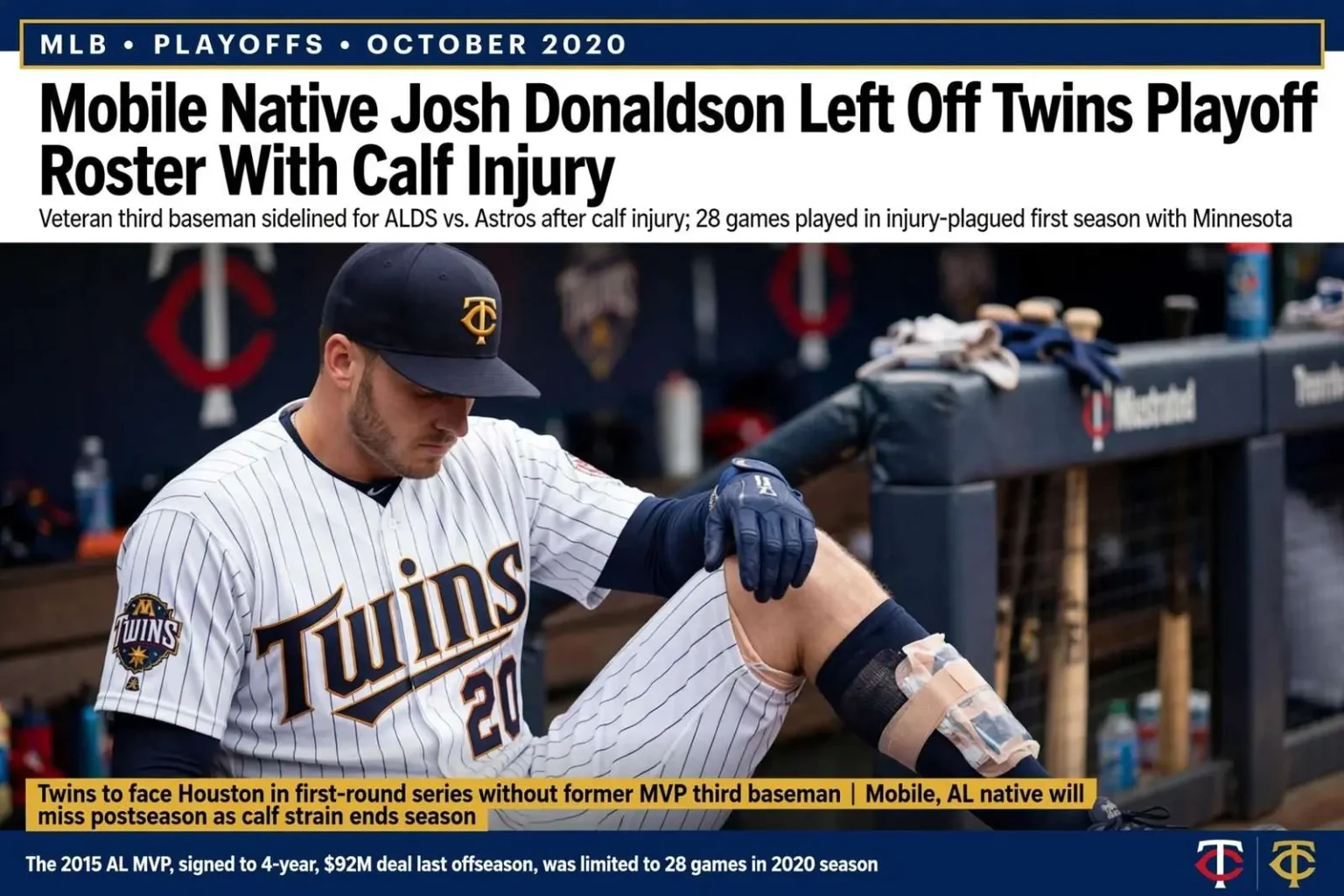
Mobile-area native Josh Donaldson will miss the Minnesota Twins’ first-round playoff series against Houston after a calf injury kept him off the club’s postseason roster. The announcement closed out a frustrating first season in Minnesota for the veteran third baseman, whose season had already been defined by time lost to injury.
The former MVP third baseman hurt his right calf, and his showing in on-field workouts Monday wasn’t enough to earn a spot for the series. The club made the roster decision with the series set to open, leaving Donaldson to watch a postseason run he was acquired to anchor from the sidelines.
Injuries hobbled Donaldson throughout his first season in Minnesota, limiting him to just 28 games. A calf problem had cost him significant time during the summer, and the roster decision reflected the reality that a hitter who has not been able to stay on the field cannot be counted on in a short postseason series.
He had joined the Twins in the offseason on a four-year, $92 million free-agent contract, the kind of commitment that signified Minnesota’s intent to contend. The deal made Donaldson the centerpiece of the Twins’ infield and one of the highest-profile free agents the club had ever signed.
A Career Built in the Mobile Area
Donaldson’s baseball story begins on the Gulf Coast. He grew up in the Mobile area, where he starred in high school baseball and emerged as a draft prospect out of a region that has produced a remarkable share of major-league talent, from Hall of Famers to MVPs. His path through junior college and Auburn University carried him into professional ball and, eventually, into one of the most accomplished careers any Mobile-area position player has had.
His ascent to stardom came in Oakland and then Toronto, where he won the American League Most Valuable Player award in 2015 after leading the Blue Jays to their first playoff appearance in more than two decades. At his peak, Donaldson was among the game’s most complete players — a middle-of-the-order power bat combined with elite defense at the game’s most demanding infield position.
That resume is what made the Twins’ signing possible, and what made his absence from their postseason roster such a blow. Minnesota was paying for the player who had anchored championship-caliber teams, and through 28 games the club had seen only glimpses of him.
The Injury That Ended His Season
Calf strains are among the most stubborn injuries in baseball, particularly for a third baseman who needs to explode laterally and a hitter who generates power from his lower half. The injury recurs easily when a player returns too soon, which is why clubs handle calf issues with escalating caution as a season progresses and the games become more expensive to lose.
Donaldson’s season had followed that pattern from the start. The calf problem cost him stretches of the summer, and every attempted return carried the same risk that sidelined him again. By the time the postseason arrived, the question was less whether he could play than whether he could play at anything near the level the roster spot demanded.
The on-field workouts that preceded the roster deadline were the final test. Postseason rosters are set at the start of each series, and clubs weigh what a star player can contribute even at diminished capacity against what a healthy reserve adds. Monday’s workouts apparently did not convince Minnesota’s staff that Donaldson could help — the honest answer in a series where every inning matters.
For a player of his standing, sitting out a playoff series is the sharpest kind of disappointment. Donaldson had built his reputation on October performance, and the Twins had signed him precisely for the postseason at-bats he would not get.
The Matchup With Houston
The Twins drew a difficult first-round opponent in the Astros, a franchise that had turned itself into the American League’s model organization and a perennial October presence. For Minnesota, a club whose seasons had repeatedly ended early in the postseason, the short series represented another chance to change that narrative — with or without their third baseman.
The first-round format compresses everything. A best-of-three series leaves no time to wait out a slumping star or ease an injured one back into the lineup, and every roster decision gets magnified. Leaving a former MVP off the roster for such a series signals how limited the club believed him to be.
Donaldson’s absence shifted the infield picture for the series. Minnesota entered the postseason built around the combination of its young core and the veteran presence Donaldson was meant to provide in the middle of the lineup and at the hot corner. Without him, at-bats and defensive innings went to others, and the club’s margin for error shrank accordingly.
The Season in Context
The $92 million commitment looked very different after one season of 28 games. Free agency is built on projections of games and performance over the life of a contract, and a first season lost largely to injury does not change the underlying talent — but it does burn a year of the deal and push the pressure of expectations onto the seasons that remain.
Donaldson’s track record offered the Twins reasons for patience. Players returning from a lost season have repeatedly bounced back when the injury is managed correctly, and a healthy version of the player Minnesota signed changes the club’s lineup in ways that 28 games could not erase. The front office’s calculation, however, was for the future — the present postseason had to be played without him.
For the third baseman himself, the offseason ahead carried a familiar agenda for a veteran coming off injury: full recovery, a return to strength work without the season’s clock running, and the reset that spring training provides. His history suggested the ability to return to form was there; the calf simply had other plans for the fall.
Mobile’s Major-League Pipeline
Donaldson’s place among Mobile-area major leaguers is part of a longer Gulf Coast tradition. The region has produced Hall of Famers, MVP winners, and All-Stars across generations, a product of year-round playing weather, a deep amateur baseball culture, and a pipeline that runs from neighborhood fields through high school programs and onto the national stage. Players from the area carry that identity with them, and Donaldson has spoken over the years about what the region’s baseball culture gave him.
His route through it is worth remembering: high school baseball in the Mobile area, a junior-college stop that rebuilt his draft stock, a season at Auburn, and a draft selection that began a professional climb through the minor leagues. He did not arrive as an instant star — his path to the majors included position changes, trades, and years of development before his breakout made him one of the game’s premier players.
That arc is part of why his postseason absence resonates back home. Gulf Coast fans have watched his entire trajectory, from a local prospect to an MVP to a veteran signing a nine-figure contract, and the injury that kept him off Minnesota’s roster was one more turn in a career that has never followed a straight line.
What the Roster Decision Meant
The Twins’ decision, made public as the series against Houston approached, was the practical endpoint of a season of setbacks. Roster spots in a first-round playoff series are too scarce to devote to a player who cannot contribute, and the club chose certainty over hope — the standard calculus of October baseball, however painful it is for the player involved.
For Donaldson, the season ended with numbers that tell only part of the story: 28 games, a right calf injury that would not fully heal, and a Monday workout that could not change the club’s mind. The four-year, $92 million contract he signed the previous offseason remained the framework for seasons still ahead.
The Mobile-area native’s first Minnesota season closed without the October at-bats he was signed to deliver — a footnote to a postseason series that went on without him, and the baseline from which his push to return would begin the following spring.
How Postseason Roster Decisions Get Made
Postseason rosters in baseball are set fresh at the start of each round, which gives clubs a chance to add or drop players between series — but it also forces a decision on injured stars at the moment the games begin. A player either is healthy enough to be one of the best 26 options the club has, or he watches from wherever his recovery takes him.
Clubs gather the evidence for that decision in the days before the deadline: batting practice, fielding drills, running tests, and the medical staff’s read on how the body is responding. Monday’s workouts were Donaldson’s opportunity to demonstrate he could run the bases, cover third base, and swing without restriction. Falling short of that standard — as the roster decision indicates he did — ends the debate for that series.
The calculations run deeper than health alone. A short series against an opponent like Houston leaves little room for a rusty bat, and managers prefer players who have been competing daily, however modest their numbers, over a bigger name who has not played in weeks. It is a cold assessment, and it is applied to MVPs the same as to anyone else.
Calf Injuries and the Long Recovery
The right calf strain that defined Donaldson’s season is an injury with a well-earned reputation among ballplayers. The muscle group powers every sprint, every lateral push at third base, and every transfer of weight in a swing, and returning before it fully heals risks a re-tear that costs even more time. Clubs manage the injury conservatively for that reason, often well past the point the player feels ready.
Multiple recurrences over a season, as Donaldson experienced, are the telltale sign of an injury that was never fully cleared — each attempted comeback restarting the recovery clock. By the postseason, the medical reality was a lower half that had not been tested by game speed in weeks, in a format where every play runs at full effort.
The path forward was the same one trainers lay out in these cases: extended rest, a graduated strengthening program, and a return only when the muscle can handle repeated maximum efforts. Whether that arrives by spring training or earlier, the club’s investment and the player’s history both pointed to a return — with the first Minnesota season standing as the injury tax paid along the way.