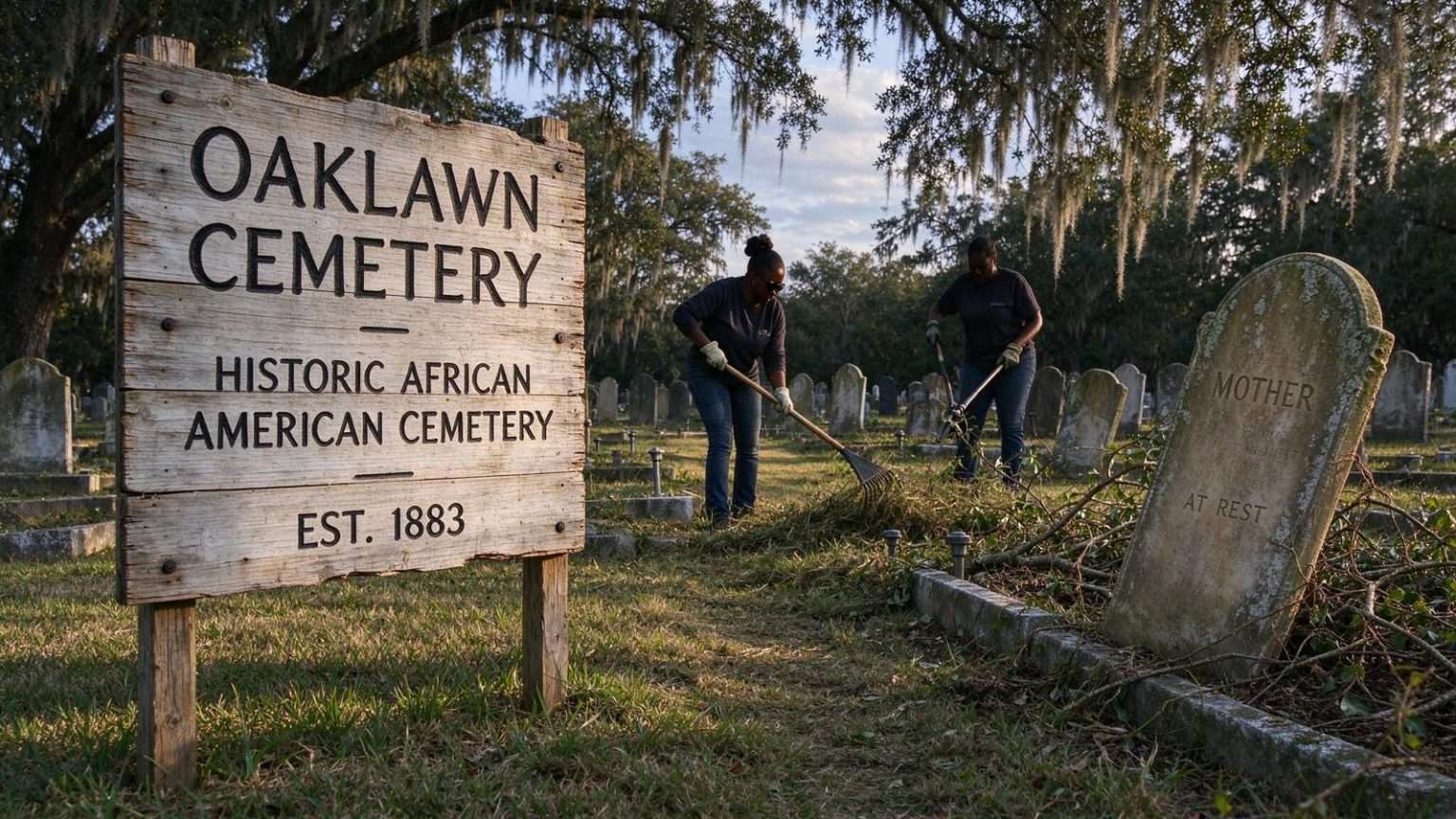
MOBILE, Ala. — A Mobile nonprofit is working to bring new life and visibility to Oaklawn Cemetery, a historic burial ground that has endured years of neglect but holds deep significance for the city’s African American community. The cemetery is the final resting place for thousands of people, including numerous Tuskegee Airmen and Buffalo Soldiers, the pioneering Black aviators and soldiers whose service spanned some of the most consequential chapters in American military history.
The organization leading the cleanup, One Simon Two Rubys & A Hamp, takes its unusual name from four of the ancestors of its executive director, Ana Wright, who are buried at the site. The name is itself an act of remembrance, keeping the family members who inspired the work present in the name of the group that now labors over their graves and the graves of thousands of others.
“Because Oaklawn has always received such negative attention, I was like, I need to get the signs up and beautify it so that people can see the vision that I see, and it could become something more than it’s already been described as,” Wright said. Her vision, she explained, is a cemetery that families can visit with pride rather than sorrow, where headstones stand upright above mowed ground instead of disappearing into brush.
The challenge is substantial. Like many historic Black cemeteries across the South, Oaklawn has struggled for decades with overgrowth, fallen markers and the slow disappearance of grave locations from living memory. Old cemeteries depend on constant, modest care — mowing, clearing, resetting stones — and when that care stops, nature reclaims the ground quickly, erasing the visible evidence that generations of families were buried there at all.
A personal discovery sparked a mission
Wright’s connection to Oaklawn began as a personal search for family history. “Found out that my great-great-grandmother, my maternal grandmother, grandmother, grandmother, is buried here,” she said. “I thought it was just going to be able to come find her. But then when I got here and realized it was overgrown, I then purchased tools and unearthed my great-great-grandmother. And then once I found her, I found seven other family members.”
That discovery inspired Wright to expand her efforts beyond her own family, with the goal of helping other Mobile residents locate and honor their ancestors buried at Oaklawn. What began as one woman’s genealogy project has grown into an organized volunteer effort, with work days that draw neighbors, descendants and community groups to the grounds with rakes, clippers and mowers.
But because the cemetery is abandoned private property that receives no maintenance from the city, upkeep has historically fallen entirely on the families of those buried there — a burden that has left many graves overgrown and difficult to find. The legal situation is a familiar one for old burial grounds: as funeral homes and churches that once maintained cemeteries closed or moved on, ownership and responsibility became tangled, and the grounds drifted into limbo where no public agency is obligated to send a crew.
For families scattered by time and distance, that arrangement is often impossible to sustain. Descendants may live in other states, may not know exactly where a plot lies, or may simply lack the tools and strength to clear decades of growth. Each neglected season compounds the problem, as vines and brush conceal markers that would otherwise lead relatives back to their ancestors.
Volunteers reclaim family plots
Denise Whitfield, a volunteer with the Oaklawn Cemetery cleanup effort, said restoring access to family plots carries deep personal meaning. “I mean, my family members here, I want to make sure that they is visible,” Whitfield said. “If someone comes over to visit them or whatever, they can find them and see them and know where they rest.” For her and other volunteers, the work is an extension of the same obligation that led their families to bury loved ones there in the first place.
The volunteers’ labor follows a pattern familiar to cemetery restoration groups across the country. Clearing a single family plot can take hours of cutting and raking, and finding an unmarked or sunken grave often depends on reading subtle signs — a depression in the ground, a corner of a concrete vault, the remnant of a metal marker. Once a plot is found and cleared, volunteers photograph and document it so the location is not lost again.
Documentation matters as much as the physical cleanup. Burial records for old cemeteries are frequently incomplete or scattered, and in many cases the only surviving record of who is buried where exists in family Bibles, funeral home ledgers and the memories of elders. Volunteers like Wright and Whitfield effectively rebuild the cemetery’s map plot by plot, creating the kind of finding aid that public cemeteries take for granted.
The history resting at Oaklawn
The presence of Tuskegee Airmen and Buffalo Soldiers among the burials gives the grounds a significance that reaches well beyond Mobile. The Tuskegee Airmen were the Black military pilots trained during World War II at Tuskegee Army Air Field in Alabama, men who served with distinction in a segregated military and whose record helped press the case for integration of the armed forces. Buffalo Soldiers were members of the Black Army regiments formed after the Civil War, soldiers who served on the frontier and in conflicts through the early twentieth century under conditions of open discrimination.
That men of both traditions rest at Oaklawn ties the cemetery to the broad sweep of African American military service, and to a generation of veterans who returned to cities like Mobile after their service and helped build the community institutions, churches and neighborhoods of the twentieth century. For historians and educators, grounds like these are primary sources — places where the story of segregation, service and perseverance is written in stone.
Historic Black cemeteries in Mobile and across Alabama carry this dual role: they are sacred family ground and they are archives. When they fall into neglect, the community loses both at once — families lose the ability to visit ancestors, and the city loses the physical record of the people who built its Black neighborhoods, churches, schools and businesses through eras when their contributions were rarely recorded elsewhere.
The volunteers at Oaklawn are keenly aware of that historical dimension. Clearing brush from a veteran’s grave, they say, is not only an act of family devotion but a correction of the record, an insistence that the people buried there mattered to the city and still matter now.
What comes next for the cemetery
Wright’s near-term goals are practical: signage that identifies and dignifies the entrance, continued clearing of overgrown sections, and outreach that helps more families discover whether their own relatives rest at Oaklawn. The signs she described matter more than they might first appear. A clearly marked, maintained entrance changes how a cemetery is perceived by passersby, neighbors and potential volunteers, replacing the impression of abandoned land with evidence of active care.
The longer-term hope, she said, is that Oaklawn becomes “something more than it’s already been described as” — a place where school groups can learn about the Tuskegee Airmen and Buffalo Soldiers, where genealogy researchers can trace family lines, and where Mobile’s African American community can hold ceremonies, memorial services and commemorations without embarrassment about the condition of the grounds.
Community support will determine how far the effort can go. Cemetery restoration groups typically rely on donated equipment, disposal services for brush and debris, volunteer labor from churches and civic organizations, and eventually professional help for the heavier work of resetting leaning headstones. Every season of sustained care makes the next season easier, because ground that is mowed and cleared can be inspected and maintained in a fraction of the time it took to reclaim.
The Oaklawn effort also fits into a broader wave of attention to historic Black cemeteries in Alabama and across the South, where descendants’ groups and nonprofits have been rediscovering and restoring burial grounds that were allowed to fade after the communities around them changed. Each project tends to follow the arc now underway at Oaklawn: a personal search for an ancestor, the shock of finding the grave unreachable, and the decision to organize rather than accept the loss.
For the families involved, the reward is measured in individual moments — a relative standing at a grandmother’s grave for the first time in decades, a veteran’s stone visible above the grass again, a name read aloud that had been buried in brush. Wright’s own family tally, from one great-great-grandmother to eight ancestors found, captures the scale of what patient volunteer work can recover, one plot at a time.
Anyone with family connections to Oaklawn, the volunteers say, is welcome to come out during scheduled cleanup days, walk the grounds and help document what remains. In a cemetery maintained by the families of the buried rather than any government or institution, every additional pair of hands is not just labor but a guarantee that the memory held there will continue to be tended.