
Mobile Officers and City Leaders Trade Badges for Kickballs on Day 4 of Youth Violence Prevention Week
Mobile police and city leaders joined families for Celebrity Day kickball during Youth Violence Prevention Week's fourth day of community events.
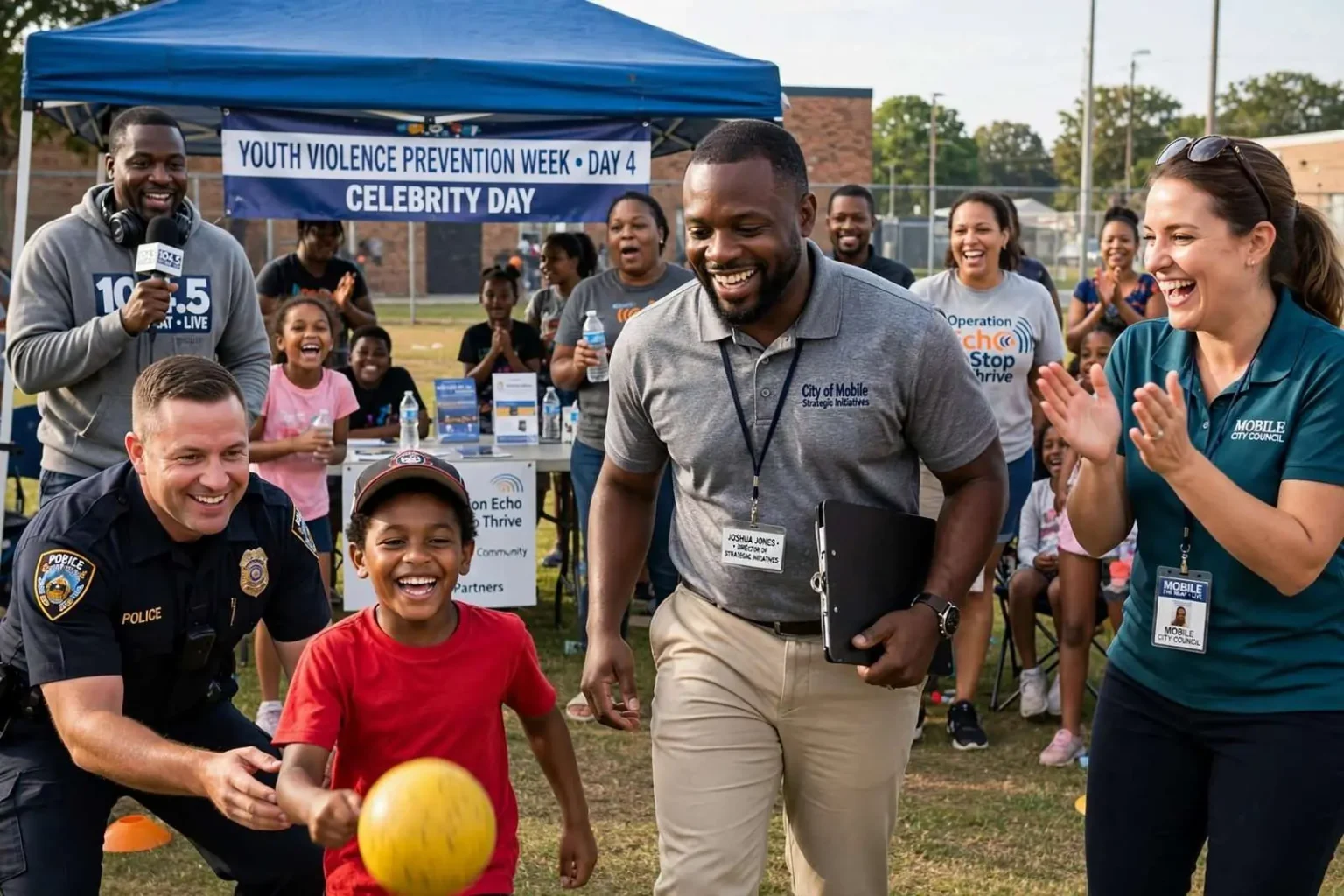
Some of Mobile’s most recognizable faces traded their official duties for a kickball field this week, all in the name of connecting with the city’s young people. Day four of Youth Violence Prevention Week was Celebrity Day, and Mobile police officers joined council members, radio personalities and other city figures — including Joshua Jones, the city’s director of strategic initiatives — for a kickball game alongside local families.
The game turned a school-week afternoon into a community event with a serious purpose behind the lighthearted setting. Youth Violence Prevention Week, observed in cities across the country, is built on the idea that prevention starts with relationships — that young people who know the officers, officials and mentors in their communities are less likely to see them only at moments of crisis. The kickball field stripped away the uniforms and the dais and put everyone on the same team.
Operation Echo Stop Thrive and several partner organizations put the week together to give Mobilians a chance to see community leaders outside their usual roles. The week’s calendar mixes recreation with education and outreach, and organizers describe the events as a coordinated effort to reach young people where they are rather than waiting for trouble to arrive first.
A Neutral Zone for Real Connection
“Most times they see us in our official capacities,” said Jones. “As a law enforcement officer, anytime we responded to a scene it was at the worst moment of someone’s life. So this is an opportunity for us to engage them in a neutral zone, neutral environment, pure fun, pure laughter, and competitiveness.”
That framing gets at the heart of why cities hold events like this one. For many young people, the most sustained exposure to a police officer comes during a traffic stop, a family emergency or a call to their neighborhood — encounters that are stressful by definition, no matter how professionally they are handled. Community policing research and practice have both converged on the same conclusion: departments that build positive, routine contact with young residents earn the trust that makes cooperation, reporting and mentorship possible later.
The kickball format lowered the barriers further. Children who might never approach an officer on the street were happy to chase a rolling ball past one, argue a call with a council member and laugh at a radio personality covering the wrong base. The competition was real, and so was the point — the adults on the field were reachable, human and playing to lose on purpose.
Parents Say the Event Fills a Real Need
Parents who brought their children said the event filled a real need. Shawn Hesley, who attended with his kids, called it an excellent way for the community to come together and for children to see who makes decisions for the city.
His observation points to a second audience beyond the children on the field. Parents watching from the sidelines saw the people who set policy for their city in an approachable setting, and the conversations that happen on those sidelines — about schools, safety, programs and opportunities — are part of what weeks like this are designed to spark. An event that connects families to each other, and families to city government, does double duty.
The young participants gave it good reviews as well. “I just wanted to come and participate because my football season ended a long time ago and I needed something to keep me hype,” said Myles Hesley.
That enthusiasm is more practical than it sounds. Youth advocates point out that organized activity — sports, clubs, programs with adults present — is one of the strongest protective factors against the risks that violence prevention programs exist to address, particularly in the after-school and evening hours when young people are most likely to be unsupervised. A midweek field full of children who showed up because they wanted something to do is, in that light, exactly the outcome the week is after.
One Day in a Longer Week
Organizers say Celebrity Fun Day was only one piece of the week. Additional events remain on the calendar through the rest of Youth Violence Prevention Week, and Jones said turnout has exceeded expectations.
“Engagement has been amazing,” he said. “The response from the public, the response from the youth. The response from the parents who are just curious and interested to know what’s going on and how we’re attacking this issue.”
The attendance numbers matter to more than morale. Violence prevention initiatives live and die on participation — a program that cannot draw families has no audience to protect — and a week that exceeds its own turnout expectations gives organizers evidence to bring to funders, partner agencies and the city council when they ask for continued support. Strong attendance also multiplies the week’s effects, since each family that attends connects to the network of organizations staging the events.
The Broader Push Against Youth Violence
Youth Violence Prevention Week itself is a national observance, but its Mobile incarnation is run by a coalition rooted in the city. Operation Echo Stop Thrive grew out of the city’s work with young people at risk of gun involvement, pairing enforcement-adjacent outreach with the softer tools of mentorship, recreation and opportunity. Its partner organizations — nonprofits, faith groups, schools and neighborhood associations — supply the volunteers, venues and relationships that make a weeklong schedule possible.
The approach reflects a shift in how cities confront youth violence. The traditional toolkit — curfews, sweeps and prosecution — has been joined by programs that treat violence as a public health problem: identify the young people most at risk, interrupt the conflicts before they turn deadly, and change community norms so that shooting is no longer an expected response to disrespect. Events like Celebrity Day sit at the norms-and-relationships end of that spectrum, and organizers are quick to say they are not a substitute for the harder interventions, but a complement to them.
Mobile has made youth outreach a visible part of its public safety strategy in recent years, with city hall figures expected to show up — in gymnasiums, at cookouts, on kickball fields — and not just at podiums. Jones, who moved into city government after a career in law enforcement, embodies that expectation: his job description includes strategic initiatives, but on Celebrity Day it included playing kickball in the sun with somebody’s kids.
What the Week Leaves Behind
A week of events ends, but organizers design the calendar to leave connections behind. Families that attend meet the organizations that run after-school programs, mentoring matches and summer jobs pipelines; young people meet the officers and officials they will encounter again at school assemblies and neighborhood meetings; and the leaders themselves get a read on what the city’s youth are asking for.
The city’s young people, for their part, got a midweek afternoon of ordinary childhood — a ball, a field, adults willing to be beaten by ten-year-olds and a crowd cheering for everyone. In the vocabulary of violence prevention, that ordinariness is the achievement. Every relationship formed on the field is one less stranger on both sides the next time a crisis or a crossroads arrives, and that is precisely how a city, one week and one game at a time, tries to get ahead of the violence it cannot arrest its way out of.
Organizers said they will take stock when the week closes and begin building toward the next round of events, using what the turnout told them about where Mobile’s families are and what they will come out for.
How the Day Played Out
The game itself unfolded with the mix of chaos and comedy that celebrity kickball games almost guarantee. City officials who spend their weeks in meetings found themselves running bases in front of a crowd that cheered their misses as loudly as their hits. Police officers who usually direct traffic took direction from team captains half their age. The score, by all appearances, mattered far less to the adults than to the kids keeping count.
Radio personalities on the field doubled as emcees, keeping the crowd engaged between plays and drawing parents into the cheering sections along the baselines. The informal atmosphere meant the event worked simultaneously as recreation, entertainment and introduction — a family that came for a game left knowing the names and faces behind several city programs they had never heard of.
For the officers involved, the game continues a style of engagement that departments nationwide have adopted under names like community policing and athletic leagues. Basketball games, football camps and barbecues between officers and residents have become fixtures in cities working to rebuild trust, and Mobile’s version plugs directly into that playbook. The evidence base for such programs is still developing, but practitioners point to an intuitive mechanism: a child who has laughed with an officer over a dropped fly ball is more likely to approach that officer — or any officer — when something is wrong.
Looking Ahead
As the remaining days of Youth Violence Prevention Week unfolded, organizers turned from the field to the rest of the schedule, with each event designed to reach a different slice of the city’s young people and their families. The week’s structure — a different theme each day — keeps attention on a problem that rarely makes headlines until it is too late, and gives partner organizations a stage to recruit volunteers, mentors and program participants.
Whether the week’s energy carries into the months ahead is the question that will determine its real impact. Jones’s assessment — engagement from the public, the youth and the parents alike — gives the coalition a foundation, and the sight of city officials sweating through a kickball game sent the week’s simplest message: the people who run Mobile are willing to show up for its children, even without a podium in sight.


