Mobile Opens Applications for Third Cohort of C251 Citizens Academy
The City of Mobile is accepting applications through Feb. 24 for its six-week C251 Citizens Academy, with just 30 spots for residents.
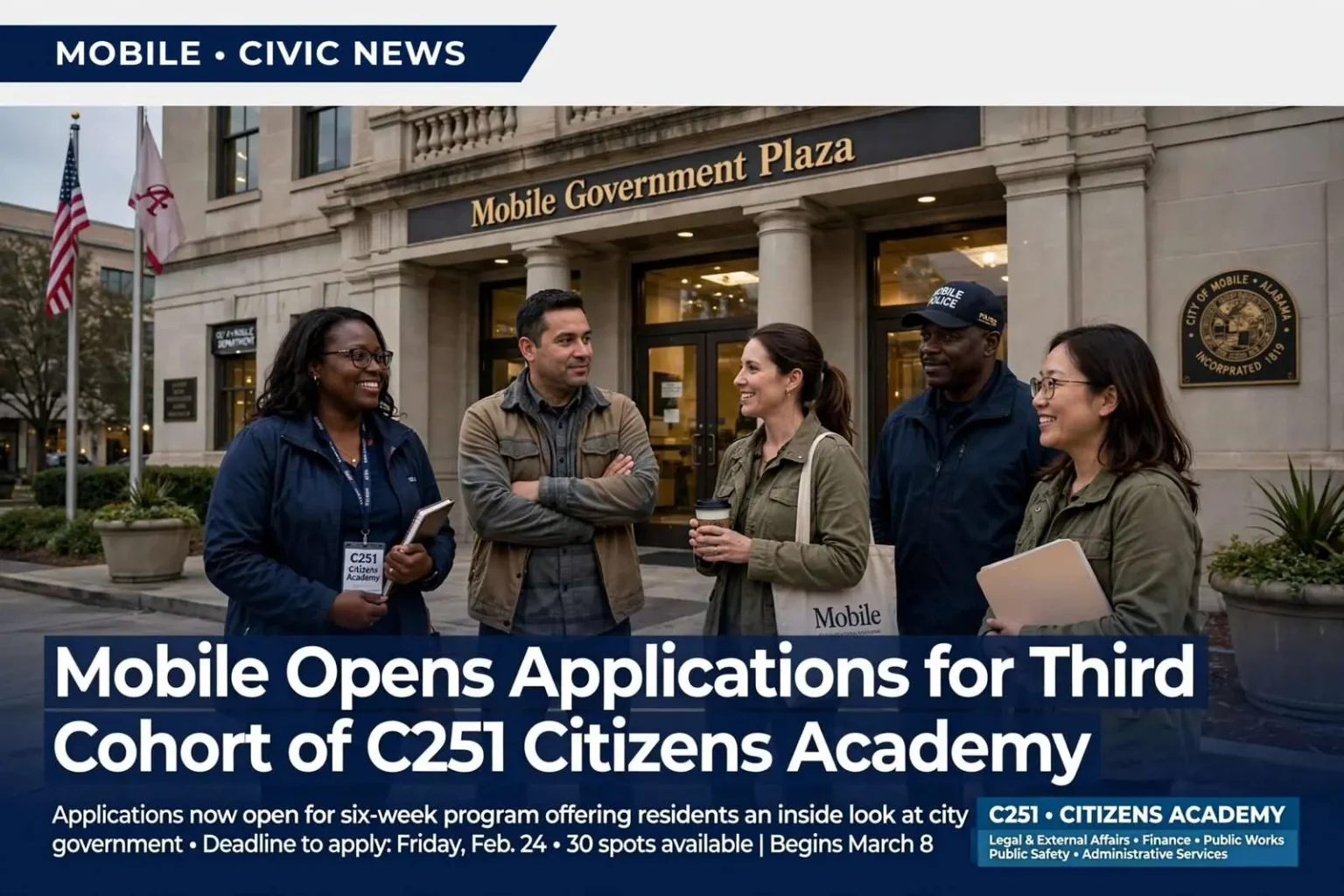
Ever wondered how Mobile’s city government actually works? The city is giving 30 residents a closer look. Applications are now open for the third cohort of C251: Citizens Academy, a six-week program the city says offers Mobilians a chance to learn how their government and its departments function directly from the teams that run them. The deadline to apply is Friday, Feb. 24, and with only 30 spots available, competition is likely.
Weekly sessions begin March 8, each devoted to one part of city government. Legal & External Affairs, Administrative Services, Finance, Public Works and Public Safety all get their turn, giving participants a structured tour of the machinery behind the services they use every day, from permits and payroll to potholes and police response. Mayor Sandy Stimpson credited the city’s Community Affairs Department with building a program that highlights how departments operate.
“Even if you’re a lifelong Mobilian, there’s always more to learn about how public services are organized and delivered,” he said.
What Participants Can Expect
The six-week format is designed to fit around working schedules, with one evening session per week rather than a demanding full-day commitment. Each session is hosted by a different department, and the content goes beyond the presentations residents might see at a council meeting: participants tour facilities, meet the staff who run daily operations and learn how decisions move from a resident’s request through the departmental process to actual delivery. The academy’s name, C251, references Mobile’s area code, signaling the program’s identity as a citywide civic experience rather than the project of any single district.
For the third cohort, the city is again limiting enrollment to 30 residents, a number that keeps the groups small enough for facility tours and direct question-and-answer sessions with department leadership. Previous cohorts have drawn applicants from across the city’s districts, and the application process is deliberately selective in structure if not in spirit: the online form asks several questions, including why applicants want to participate and how they’re involved in the community, so the city can assemble a class of engaged residents rather than simply the first 30 names received.
Why Citizens Academies Matter
Citizens academies have become a staple of municipal government across Alabama and the nation for a simple reason: most residents interact with city government only at moments of frustration, a missed garbage pickup, a pothole, a permit question. A structured program that shows the inside of the system changes that dynamic. Residents who complete such programs tend to become more effective advocates for their neighborhoods because they know which department handles what, how budgets are built and who to call first.
For the city, the benefit is a standing pool of informed residents who understand how services are organized and delivered. Alumni of citizens academies frequently go on to serve on boards and committees, volunteer in city programs and run for local office, and they carry into their neighborhoods an accuracy about how government works that rumor and social media rarely provide. Mobile’s Community Affairs Department built C251 with exactly that pipeline in mind, giving residents the knowledge that makes civic participation productive.
The departmental lineup for the academy covers the full span of city operations. Legal & External Affairs handles the city’s legal matters and its relationships with other governments and outside organizations. Administrative Services houses the internal functions, human resources, information technology and the operational support that keeps 2,000-plus municipal employees working. Finance manages the budget, accounting and revenue functions that fund every other service. Public Works is the department residents see most, streets, drainage, traffic engineering, garbage collection and fleet maintenance. Public Safety encompasses police, fire and the emergency communications that tie them together.
Seeing each of those operations up close gives participants context that no press release can. A resident who watches Public Works crews coordinate a drainage repair, or hears Finance staff walk through how sales tax revenue is allocated, comes away with a practical understanding of the tradeoffs that shape every budget season. That understanding tends to surface at budget hearings and council meetings in later years, where academy alumni ask more precise questions and evaluate proposals against how the system actually operates.
The Stimpson Administration’s Civic Push
Mayor Sandy Stimpson’s administration has emphasized civic engagement initiatives like C251 as part of its broader approach to city management. The message in Stimpson’s comment on the program, that even lifelong Mobilians always have more to learn about how public services are organized, reflects a governing philosophy that treats transparency as an operational asset rather than a public relations exercise. When residents understand the system, the argument runs, they use it better, complain more precisely and appreciate the constraints that shape city decisions.
The third cohort’s launch also shows the program maturing beyond an experiment. Two prior classes have completed the six-week cycle, and the city’s decision to continue the academy signals that the format has delivered value on both sides, for residents who gained insight and for departments that gained a channel to the public. Programs of this kind live or die on that mutual benefit, and the application requirement asking about community involvement is the city’s way of selecting participants likely to carry what they learn back into active civic life.
How to Apply
The application is online, and the questions it asks, why applicants want to participate and how they are involved in the community, are worth answering concretely. Selection for a limited class of 30 favors applicants who can articulate a specific interest and demonstrate existing engagement, whether through a neighborhood association, a school organization, a church or a volunteer role. The deadline of Friday, Feb. 24 is firm, and interested residents should apply well before it, since spots in the second cohort filled quickly.
Those selected will begin weekly sessions on March 8 and spend six weeks moving through the departments that run Mobile, finishing with the kind of practical map of city government that takes most residents years of individual encounters to assemble. For the price of an application and six evenings, C251 offers residents what Mayor Stimpson described: a closer look at how their government actually works, taught by the people who run it, in a class of neighbors who share the same curiosity about the city they call home.
Mobile’s use of a citizens academy fits a pattern that has spread through Alabama municipalities over the past two decades. Huntsville, Birmingham, Montgomery and a host of smaller cities run versions of the same idea, some focused narrowly on police departments, others, like C251, covering the full breadth of municipal operations. The model’s popularity reflects a practical problem every city shares: the gap between what residents assume government does and what it actually does is the source of a large share of civic friction. Closing that gap with structured education is cheaper than the alternative of resolving the same misunderstandings one complaint at a time.
The name C251 itself carries a civic lesson. Area code 251 covers southwest Alabama, including Mobile and the surrounding Gulf Coast communities, and its adoption as the academy’s brand ties the program to a shared regional identity. Graduates often describe the experience as seeing “behind the curtain,” and the city has used photos and session summaries from earlier cohorts to advertise what applicants can expect: tours, demonstrations and conversations with department heads rather than lectures from dais.
The Community Affairs Department’s Role
Mayor Stimpson’s credit to the Community Affairs Department for building the program points to the office that anchors most of the city’s resident-facing initiatives. Community affairs teams in municipal government handle neighborhood outreach, coordinate engagement events, manage relationships with neighborhood and homeowner associations and design programs that connect residents to services. An academy like C251 is a signature project for such a department because it integrates all of those functions into a single multi-week experience, requiring coordination across every operating department of the city.
Pulling off a six-week program across five departmental areas is a logistics exercise: scheduling facility tours that do not disrupt operations, briefing presenters, arranging security for visits to sensitive facilities and collecting feedback after each session. The fact that Mobile has now run the academy to a third cohort indicates the Community Affairs Department has refined that logistics into a repeatable program, which is what separates a durable civic institution from a one-time event.
Who Should Apply
The program’s design makes it valuable to several distinct types of applicants. Newcomers to Mobile get a rapid, accurate orientation to how their new city functions. Lifelong residents, the audience Stimpson addressed directly, get the update on how services have changed as the city has grown and professionalized. Neighborhood leaders get the institutional knowledge that makes their advocacy effective, and prospective public servants get an early look at the range of careers municipal government offers. The 30-seat limit means each cohort will include a mix, and that mix is part of the design, since participants learn as much from each other’s questions as from the presenters.
Applicants considering the Feb. 24 deadline should also understand the commitment involved. Six weekly sessions beginning March 8 means six evenings given over to city government, plus whatever preparation participants choose to do. Employers across Mobile have generally accommodated the schedule for employees selected for the program, recognizing the value of having staff who understand how the city works, and the certificate that comes with completion carries genuine standing in local civic circles.
An Investment That Compounds
The long-term return on programs like C251 accrues in ways that are easy to overlook while a cohort is underway. Each class of 30 graduates adds to a growing body of residents who know how Mobile’s budget is constructed, how public safety is coordinated, how streets and drainage are maintained and how the city’s legal and administrative functions support everything else. Those residents spread that knowledge informally, in neighborhoods, workplaces and family conversations, multiplying the program’s effect well beyond its direct enrollment.
The third cohort’s application window is open now, the deadline is Friday, Feb. 24, and the sessions begin March 8. For residents who have ever wondered how Mobile’s city government actually works, the answer the city is offering is simple: apply, and find out directly from the teams that run it.