
Mobile Orders Outside Review of Police Policies After Teen Killed in Pre-Dawn Raid
Mayor Stimpson taps ex-U.S. Attorney Kenyen Brown to review MPD use-of-force policies after a SWAT officer killed a teen during a pre-dawn warrant raid.
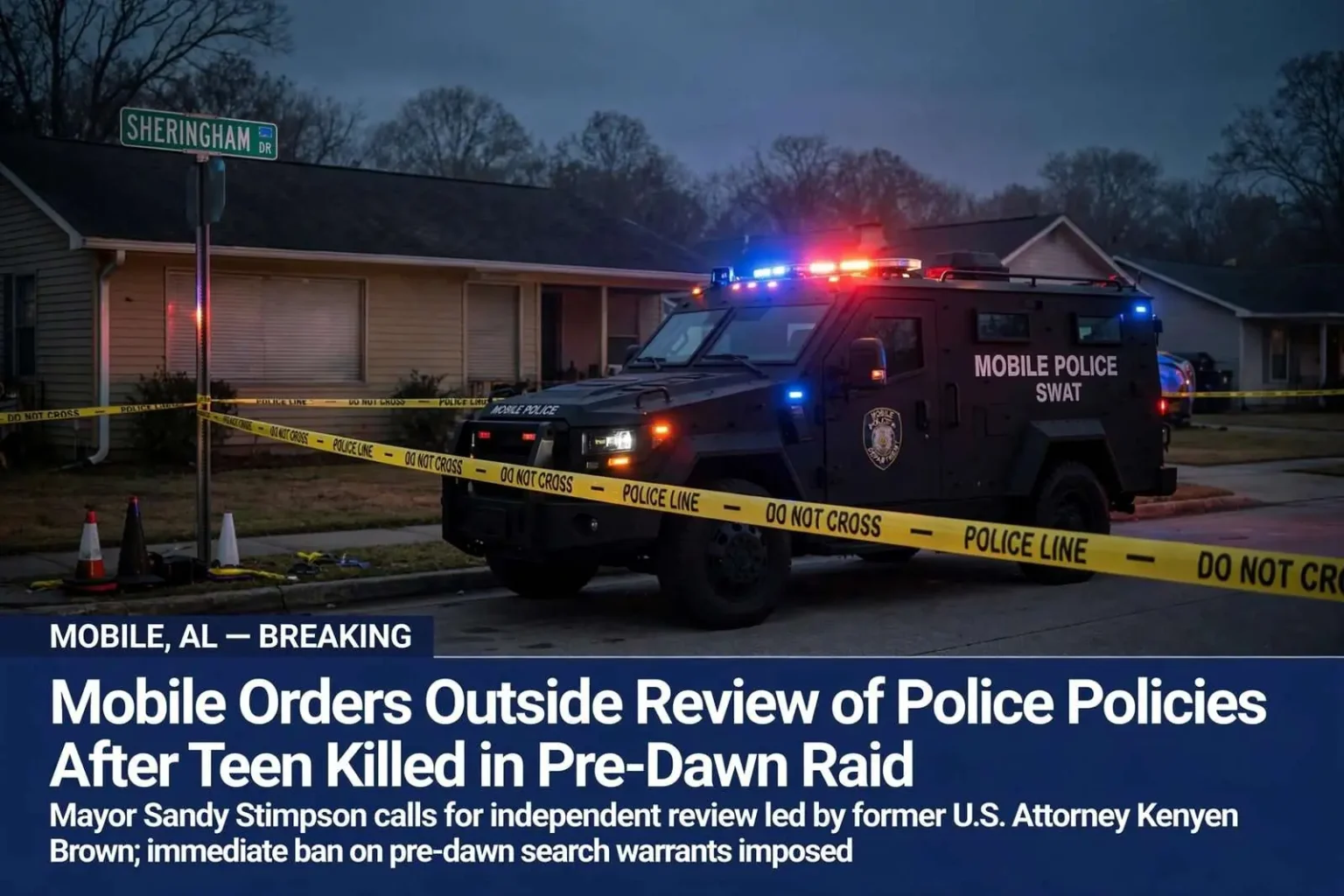
Mobile Mayor Sandy Stimpson has called for an independent review of the Mobile Police Department’s use-of-force policies, procedures and training after a 16-year-old boy was shot and killed by a SWAT officer during a pre-dawn raid on a Sheringham Drive home. The mayor’s move came within hours of the raid itself, an unusually fast response that signaled how seriously City Hall regarded the shooting and the questions surrounding it.
Stimpson asked former U.S. Attorney for the Southern District of Alabama Kenyen Brown to lead the review. Brown will examine evidence from prior incidents as well, including body camera footage, and is expected to issue a public report with findings and recommendations within 90 days. The scope — policies, procedures and training rather than a single incident — makes the review broader than the shooting that prompted it.
According to police, officers from MPD’s Narcotics Unit and SWAT Team were serving a search warrant based on neighbor complaints about drug activity, supported by video and photographic evidence. Chief Paul Prine said officers announced themselves before entering — no-knock warrants are illegal in Alabama — and that inside the home, which held five or six residents including a child as young as 8, they encountered the teenager in a hallway pointing a laser-sighted handgun at an officer.
An officer fired at least once, striking the boy in the lower torso; he died at a hospital. Prine acknowledged the central question: “The question will always be and certainly understandable as to whether or not… the individuals or the occupants of the home knew it was the police.” He defended morning service for narcotics warrants, saying the combination of drugs and potential violence makes timing a safety consideration.
The immediate policy change
In response to the shooting, Stimpson imposed an immediate ban on pre-dawn search warrants unless there are documented exigent circumstances requiring them. The directive changes MPD practice from the mayor’s office down, and it addresses precisely the circumstance of this raid — a warrant served in darkness, at a home full of sleeping residents, where the people inside may not have understood what was happening until officers were in the hallway.
Pre-dawn warrant service has long been controversial nationally. Residents roused from sleep by entries they cannot immediately identify face a split-second uncertainty that officers on the other side of the door cannot fully resolve, and the encounter that results can turn fatal for either party. Alabama law already prohibits no-knock warrants, requiring police to announce themselves, but an announcement outside a door at 4 a.m. does not guarantee comprehension inside a dark house with children asleep in it.
The mayor’s ban does not eliminate narcotics warrant service; it moves it to daylight hours and permits pre-dawn exceptions only when documented circumstances demand them. How strictly that exception is applied, and how the department documents its justifications, are the kinds of implementation questions the 90-day review is positioned to address in its recommendations.
What the raid found — and what it didn’t
Police said the search turned up marijuana and two weapons. DeAngelo Adjessom, the 18-year-old relatives officers had been seeking, was not home during the raid and later turned himself in; he faces marijuana possession and firearms charges. The gulf between the alleged offense and the outcome — a warrant for drugs and weapons charges, and a 16-year-old dead in the hallway — is the arithmetic that made the shooting a citywide controversy within hours.
The boy’s name has not been released, and body camera footage will not be made public until a grand jury reviews it. That sequencing is standard in officer-involved shootings, on the theory that premature release of footage can influence witness accounts, but it leaves the public reliant on the police account at the stage when scrutiny matters most.
The grand jury process itself is the next legal milestone. A grand jury will hear the evidence surrounding the shooting and decide whether the officer’s use of force was justified under the law or whether criminal charges are warranted. The determination is separate from the mayor’s policy review, from any internal affairs investigation, and from any civil litigation the family might pursue — several parallel processes that often move on different timelines.
The independent review and its leader
Kenyen Brown’s selection gives the review its weight. As the former U.S. Attorney for the Southern District of Alabama, Brown led the federal Justice Department’s office in Mobile and built a career prosecuting cases across the same district where the shooting occurred. Choosing an outside figure with federal prosecutorial experience, rather than an internal panel, addresses the credibility problem that haunts police reviews of police: the public is asked to trust conclusions when the reviewers come from the same system as the officers involved.
The 90-day timeline is ambitious for a review that will examine prior incidents as well as this shooting, including body camera footage from each. Brown’s report is expected to include findings and recommendations — the format of a policy audit rather than a criminal proceeding. That means the report may address training gaps, procedure changes, supervisory practice and the department’s warrant service policies, with recommendations that Stimpson and Chief Prine would then be responsible for acting on.
The review’s breadth also means it will look backward beyond the Sheringham Drive raid. Reviews of this kind typically examine patterns: how warrants are sought and approved, how risk assessments are conducted before service, how the narcotics unit and SWAT coordinate, and how use-of-force incidents have been documented and reviewed in the past. Findings about patterns can drive structural change in a way that a single-incident investigation rarely does.
What the chief’s account leaves open
Prine’s account of the raid — announced entry, a teenager with a laser-sighted handgun in the hallway, a single shot — is the police version of events, delivered while the grand jury and the independent review have yet to weigh the evidence. The chief’s own words identified the unresolved question: whether the occupants knew it was the police. A 16-year-old pointing a gun in a dark hallway suggests either that he did not know, or that he chose to arm himself against an intruder; both possibilities raise hard questions about pre-dawn drug warrant service even if the officer’s split-second decision is ultimately judged lawful.
The chief’s defense of morning warrant service — that drugs and potential violence make timing a safety consideration — reflects the standard police rationale for early service: suspects are home, awake less, and evidence is secured before it can be destroyed. The counterargument, now embodied in the mayor’s ban, is that the safety of officers and suspects inside must be weighed against the safety of sleeping residents who may meet the entry with confusion and, in some homes, with a weapon.
Both positions can be sincerely held, and the review will have to reconcile them: when, how and under what documentation narcotics warrants should be served in a city where drug enforcement continues and where the risks of darkness have now been demonstrated in the starkest way possible.
What Mobile residents should watch
Three developments will shape the aftermath. The grand jury’s decision on the shooting, expected after it reviews the evidence and the body camera footage, will determine whether the officer faces criminal charges. Brown’s report, due within 90 days, will determine what policy changes the city commits to. And the council and the mayor’s office will face the question of what oversight follows — whether the recommendations come with public reporting on their implementation.
For the family on Sheringham Drive, the parallel processes offer different things: the grand jury addresses accountability for the shooting, the review addresses the policies that put officers in that hallway, and civil remedies, if the family pursues them, address compensation. None of them will be quick.
The shooting has already produced one concrete change — the ban on pre-dawn warrant service absent documented exigent circumstances — within hours of the raid. Whether the 90-day review produces deeper structural change in how MPD serves narcotics warrants and reviews use of force is the question Mobile will be watching as Brown’s report takes shape.
How narcotics warrant service works
The raid on Sheringham Drive followed the standard structure of a narcotics warrant operation, and understanding that structure clarifies what the review will scrutinize. A search warrant begins with an affidavit — here, neighbor complaints about drug activity supported by video and photographic evidence — presented to a judge, who must find probable cause before signing. Once signed, the warrant is executed by officers chosen for the operation, and in cases assessed as higher risk, the SWAT team is brought in alongside narcotics investigators.
Each step in that chain involves judgment calls that reviews of this kind typically examine: how the evidence was gathered and weighed, how the risk of the location was assessed given the number of residents inside, how the entry was planned, and how the announcement was made. The presence of five or six residents, including a child as young as 8, is the kind of fact that risk assessments are supposed to account for — the more people inside a home, the greater the chance that an entry encounters someone who is neither a target nor a threat.
The laser-sighted handgun at the center of the police account adds another layer. A weapon with a visible laser creates an unambiguous threat picture for officers at the moment they perceive it, but it also illustrates the weapon culture that narcotics units encounter in homes across the city — a house where an 18-year-old is wanted on firearms charges and where weapons were found in the search. The review will have to weigh the danger officers face on such entries against the risks created by the entries themselves.
The wider national context
Mobile is not the first city to confront these questions, and the mayor’s response places it in a national conversation about warrant service. Cities across the country have restricted or abolished pre-dawn and no-knock entries after high-profile deaths, and several states have tightened statutes since. Alabama’s existing prohibition on no-knock warrants already placed the state among those limiting surprise entries; the mayor’s ban goes further by pushing service into daylight except when exigency is documented.
Independent reviews led by former prosecutors have become a common middle path between doing nothing and an outside criminal investigation. They cost less than a federal pattern-or-practice inquiry, they move faster, and their recommendations carry the weight of an author with prosecutorial credibility — provided the city acts on them. That last condition is where residents’ attention should settle once Brown’s report lands: a review’s value is measured by the changes it produces.
For Mobile, the shooting on Sheringham Drive has already reshaped at least one policy, and the 90-day review will decide whether it reshapes more. The department’s narcotics enforcement mission continues; the question now being worked out in public is how that mission can be carried out without another dark-hallway encounter between a sleeping family’s teenager and a SWAT officer’s rifle.


