
Mobile Picks Award-Winning Design Team for the Africatown Welcome Center
Studio 2H Design and MASS Design Group will lead design of Mobile's Africatown Welcome Center, the future hub of the community's heritage tourism sites.
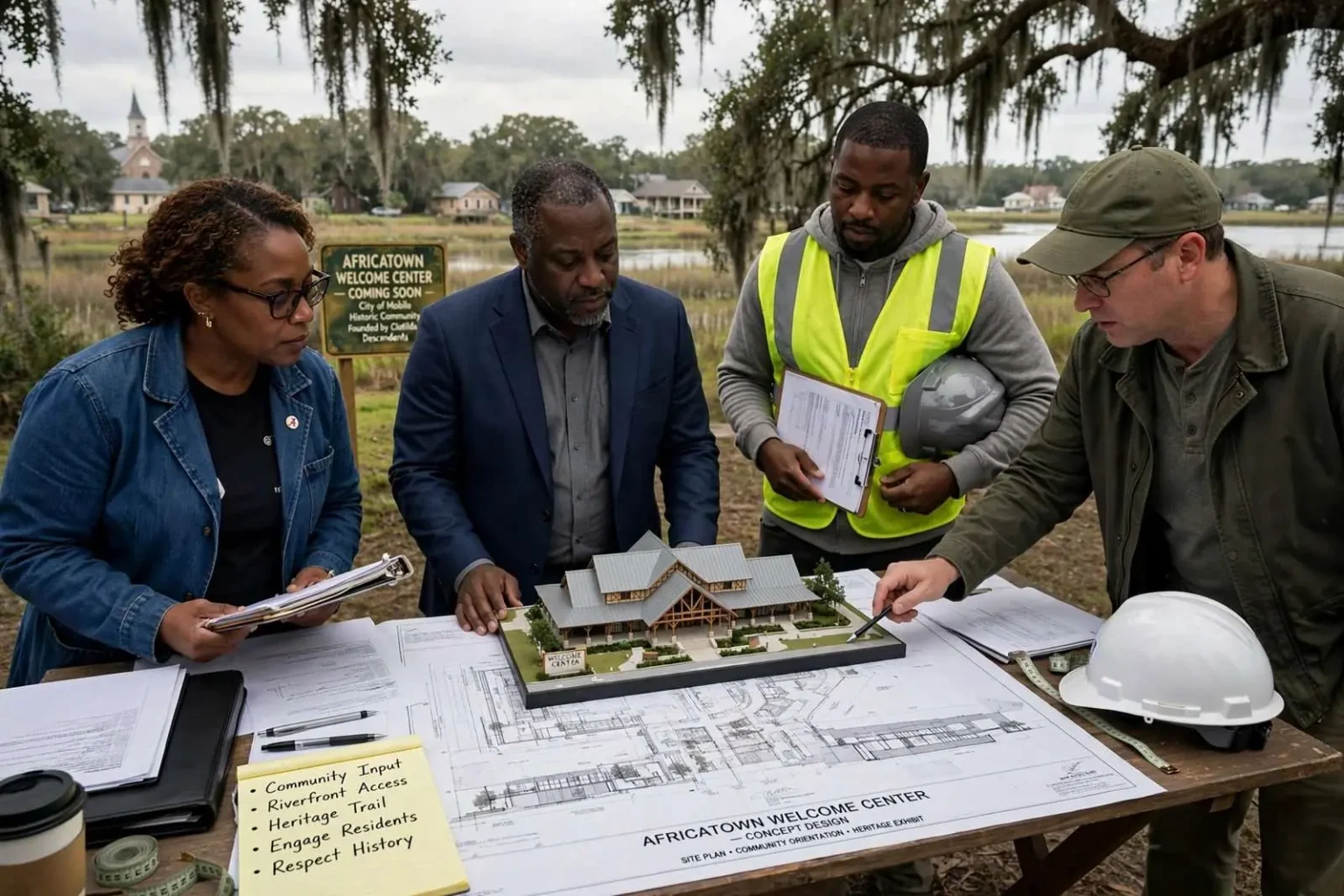
MOBILE, Ala. — The City of Mobile has selected the team that will lead design and engineering for the planned Africatown Welcome Center, bringing together firms behind some of the South’s most celebrated cultural and historical projects. The selection moves one of the community’s longest-sought projects from planning into design, a milestone for the historic community just north of downtown.
The Welcome Center has been envisioned as the front door to Africatown — the community founded by the descendants of the people brought to America aboard the Clotilda, the last known slave ship to reach the United States. A hub for visitors has been a central ask of residents and preservation advocates for years as heritage tourism interest in the area has grown, and the design contract represents the city’s most concrete step yet toward building it.
A Team With Deep Cultural Credentials
Alabama-based Studio 2H Design LLC is the primary recipient of the design and engineering contract. The firm previously handled campus master planning and historical documentation for Birmingham’s Historic Bethel Baptist Church and the Carver Theater, home of the Alabama Jazz Hall of Fame. Both Birmingham landmarks carry deep civil rights and cultural significance — Bethel Baptist Church served as a headquarters for the civil rights movement in Birmingham and was bombed during that era, while the Carver Theater was the center of the city’s Black entertainment district — giving Studio 2H a portfolio built on telling difficult and important Southern histories through buildings.
The roster also includes MASS Design Group — whose work includes the Equal Justice Initiative’s National Memorial for Peace and Justice in Montgomery — along with StudioRotan, MBA Engineers Inc., SARCOR LLC and HM Yonge & Associates. MASS’s memorial in Montgomery, which commemorates the victims of lynching across the United States, drew international attention for its scale and design and established the firm as one of the most prominent cultural architecture practices in the country. The local and regional firms on the roster bring the engineering, site and surveying expertise a project of this kind requires.
“Buildings are the stories of place — this story is long overdue,” said Michael Murphy, founding principal at MASS. “We are humbled to be part of the team working with this amazing community to help build their story.”
“Studio 2H Design and I are honored to collaborate with the City of Mobile and the Africatown Community on this very important project,” added Nolanda Hatcher, co-owner of Studio 2H Design.
The pairing of a Birmingham-based design firm with a globally recognized cultural practice reflects the project’s dual ambitions: it must serve the residents of Africatown as a community building while also interpreting a history that draws visitors from around the world. Teams assembled for projects of this scale typically divide the work, with the lead architect managing the design contract and partners handling engineering, site design and specialty documentation.
Once complete, the Welcome Center is expected to serve as the central hub for a planned network of historical and cultural tourism sites across Africatown — likely one of the first stops for visitors coming to learn the community’s history firsthand. Planners have described a visitor experience that orients guests to the community’s founding story and directs them to related sites in and around the neighborhood, from historic churches and cemeteries to sites along the Mobile River connected to the Clotilda’s story.
“Given their collective experience, it’s difficult to imagine a design team better-suited to take on this important project,” Mayor Sandy Stimpson said.
The Weight of the Africatown Story
The community’s history gives the project a significance that reaches well beyond Mobile County. In 1860, decades after the importation of enslaved people was outlawed, investors secretly financed the schooner Clotilda and smuggled more than 100 captive Africans up the Mobile River into the city. After the Civil War, many of those survivors and their families bought land and founded their own community north of Mobile, which came to be known as Africatown — one of the few communities in America founded and continuously inhabited by the survivors of the transatlantic slave trade itself.
The 2018-2019 search for the Clotilda, and the subsequent confirmation of the shipwreck’s identity in the Mobile-Tensaw delta, brought a surge of national and international attention to the community. Journalists, researchers and descendants of the survivors have since worked to document the story, and interest in visiting Africatown has grown accordingly — attention residents have welcomed even as they have pressed city, county and federal partners to make sure the community itself benefits from heritage tourism rather than being bypassed by it.
That dynamic is precisely what a Welcome Center is meant to address. By giving visitors a designated starting point — with exhibits, orientation and staffing — the hub can channel tourist traffic deliberately through the community, supporting local businesses and giving residents control over how the story is told. Planning work for the wider tourism network has involved conversations with the community, and the design phase will give residents further opportunity to shape what gets built.
The project also joins a broader slate of investment tied to the area. Africatown has been the focus of environmental remediation, heritage signage, cemetery preservation and riverfront access efforts in recent years, much of it driven by partnerships between the city, county, state agencies and community organizations. The Welcome Center is intended to tie those threads together into a coherent visitor experience.
What Comes Next in Design
With the team selected, the design and engineering phase moves into action. That work typically begins with site analysis and community engagement, progresses through schematic and design development, and concludes with construction documents that allow the city to bid the work. Cultural projects of this scale commonly take well over a year in design before ground breaks, and funding for construction is often staged separately from design.
The firms bring complementary strengths to that process. Studio 2H’s experience documenting historically significant buildings informs how new construction can coexist with historic sites in the neighborhood. MASS Design Group has built its reputation on memorials and museums that confront painful history — work the firm has described as architecture in service of justice — and its involvement signals an ambition for the Welcome Center to meet the national standard set by projects like the Montgomery memorial.
For the Africatown community, the announcement lands as both progress and a reminder of how long the project has been anticipated. Residents have heard plans discussed for years, and the measure of success they have described is practical: a building that opens, welcomes the world, and keeps the community’s story in the community’s hands.
City officials have not announced a construction timeline for the Welcome Center, and details such as the site, square footage and cost will be resolved as the design work advances. The city has said it will continue working with community stakeholders as the project develops.
Heritage tourism has become a meaningful economic engine in communities across Alabama that chose to confront their histories directly. Montgomery’s civil rights landmarks, Birmingham’s institutions and Selma’s bridge-crossing anniversary events each draw hundreds of thousands of visitors a year, money that flows into hotels, restaurants and neighborhood businesses. Africatown’s story — singular in the nation — positions Mobile to participate in that same current, and the Welcome Center is the infrastructure on which that participation depends.
Community Voice at the Center
From the earliest planning conversations, Africatown residents and descendant families have emphasized that the community’s story must be told with the community, not merely about it. The Clotilda Descendants Association and neighborhood organizations have been central voices in shaping the vision for heritage sites, and city officials have repeatedly described the Welcome Center as a project that belongs to the community first. Murphy’s remark that the team was “humbled” to help the community build its story echoed that framing.
The roster’s mix of firms also reflects a practical truth about Gulf Coast construction: cultural design vision has to be matched by engineers who know local soil, floodplain and permitting conditions. MBA Engineers, SARCOR and HM Yonge bring the regional technical knowledge that keeps a riverfront-area project moving through Mobile County’s regulatory environment, while StudioRotan adds design capacity to the team.
For visitors, the eventual experience is expected to follow a familiar cultural-site pattern: orientation exhibits that establish the history of the Clotilda and the founding of the community, staff to answer questions and guide itineraries, and connections to partner sites across the neighborhood. For residents, the center doubles as civic space — a building that belongs to the neighborhood and hosts community life, not just tourism.
As design work proceeds, watch for community meetings where the team presents concepts and collects feedback — a step the firms’ past projects have treated as essential rather than ceremonial. The quality of that engagement, residents have said, will determine whether the Welcome Center is perceived as the community’s building or merely one built in its name.
The city has characterized the team selection as the first major step of the project’s next phase, with additional milestones to be announced as design advances.


