
Mobile Police Arrest 16 in Undercover Prostitution Sting
Mobile police arrested 16 people during Operation Snag, an undercover vice operation targeting street-level prostitution linked to violent crime.
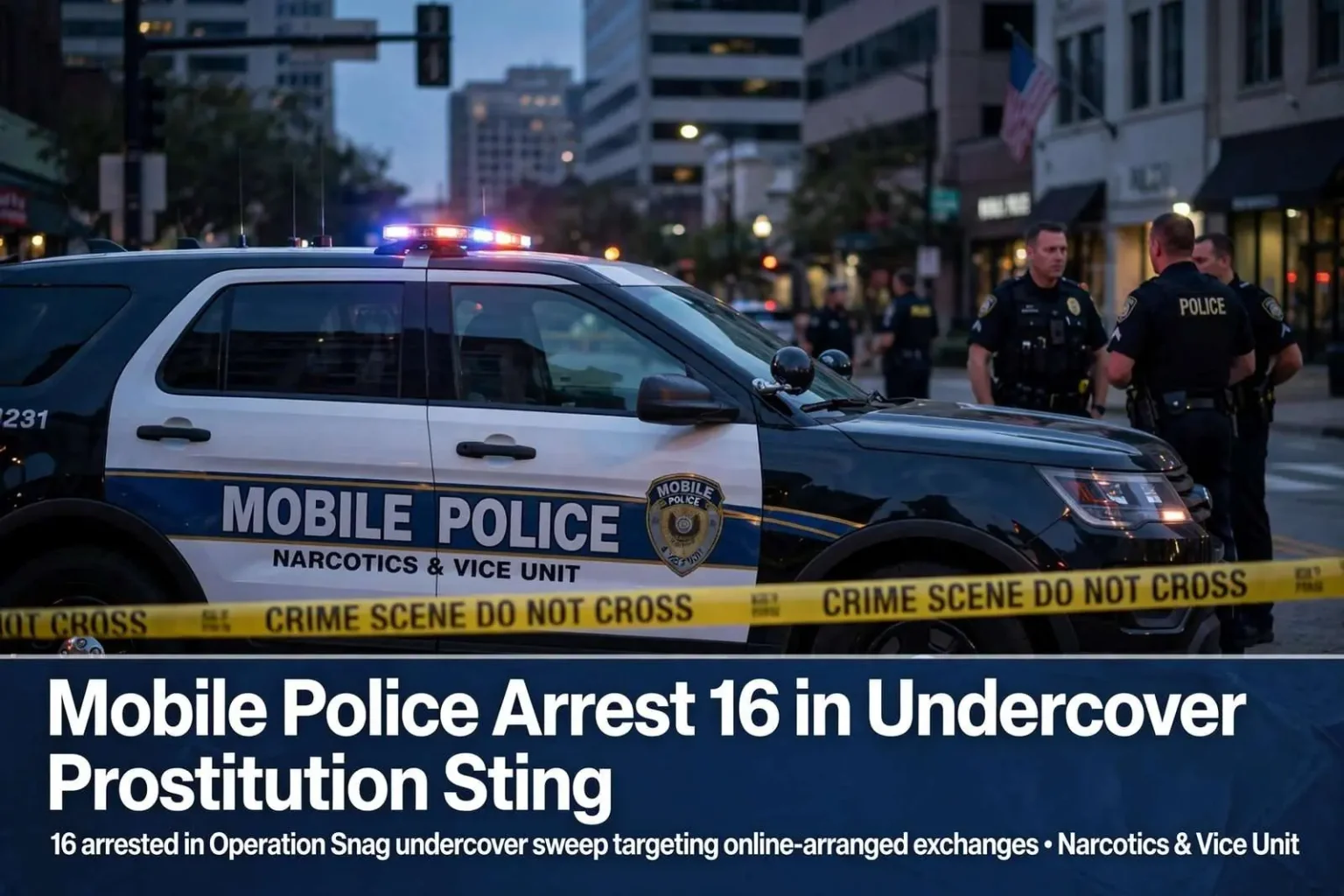
Sixteen people are facing misdemeanor prostitution charges after an undercover Mobile Police Department operation that relied on officers arranging exchanges through websites.
The arrests came out of Operation Snag, a sweep run this week by the department’s Narcotics and Vice Unit. Officers posed as prostitutes during the operation, which police described as an effort to curb street-level prostitution that is frequently tied to more serious offenses.
Maj. John Barber of the Mobile Police Department said the unit pursues these cases because illegal sex transactions so often escalate into robbery or worse. “We have worked many cases over the years where deals go bad,” Barber said, describing scenarios in which a person expecting to purchase sex is instead met by multiple suspects intent on robbing them — incidents he said have ranged from shootings to homicides.
Barber said police see the operation as a way of attacking the larger crimes connected to the illegal sex trade rather than simply writing up misdemeanors. The 16 arrests were all misdemeanor prostitution charges, and no additional offenses were announced in connection with the sweep.
How the operation worked
Operation Snag relied on a method that has become standard practice for vice units across the country: officers advertising or responding through websites where commercial sex is arranged, then scheduling meetings that end not in a transaction but in an arrest. The approach allows a small unit to generate numerous cases in a compressed period without waiting for street-level complaints.
During this week’s operation, officers posed as prostitutes, arranging exchanges with would-be buyers online and completing the contact in person, at which point arrests were made. The sixteen people arrested face misdemeanor prostitution charges under Alabama law, which classifies the offense as a misdemeanor punishable by up to a year in jail for a first conviction.
The Narcotics and Vice Unit, the branch of the Mobile Police Department that runs such operations, handles investigations into vice activity — gambling, alcohol violations, human trafficking indicators and commercial sex — alongside its narcotics caseload. Sweeps like Operation Snag are typically planned in advance, run for a defined period, and repeated when the unit judges that the activity has rebounded.
Police did not release the names of those arrested or describe where the arranged meetings took place, and no additional offenses were announced in connection with the sweep.
Why police target the buyer side
Vice operations of this kind increasingly focus on the demand side of commercial sex, arresting buyers rather than only sellers. The logic, as Barber’s comments reflect, is that reducing the market reduces the street activity, the associated violence and the exploitation that often sits behind it.
Nationally, law enforcement agencies have shifted toward that demand-focused approach in part because of the recognition that many people selling sex are themselves victims — of coercion, trafficking, addiction or economic desperation — and that arresting them repeatedly does little to address the underlying conditions. Arresting buyers, by contrast, is intended to attach consequences to the market itself.
Barber framed the unit’s motivation in terms of the violence that shadows illegal transactions: robberies staged as dates, shootings arising from disputed deals, and homicides that begin as commercial arrangements. Every arrest made before such a transaction occurs, in the department’s view, is an intervention in that chain.
The online marketplace for commercial sex
The shift of commercial sex from street corners to websites has reshaped vice policing over the past two decades. Arrangements that once concentrated in visible, patrol-able districts now happen through classified sites, apps and social media, making the activity harder to detect through traditional means — and making online undercover work the primary tool available to units like Mobile’s.
That shift has consequences for where the activity occurs. Instead of clustering in known districts, transactions now unfold in hotel rooms, short-term rentals and private residences across the city, which disperses both the activity and its associated risks. For investigators, each case begins with digital evidence — profiles, messages, phone records — rather than a visible street presence.
The internet-based method also changes the profile of who is arrested. Operations targeting online-arranged commerce tend to sweep in buyers from across the metro area rather than from a single neighborhood, and Mobile’s sixteen arrests reflect that wider catchment even though the unit described the target activity as street-level trade.
Vice policing in Mobile
The Narcotics and Vice Unit’s operations are a recurring feature of Mobile policing, with periodic sweeps aimed at commercial sex, gambling and narcotics activity. Maj. John Barber, who spoke for the department on the results, has served as a public face of the unit’s work, explaining its operations in terms of the violent crime that vice enforcement is designed to prevent.
Units of this kind operate with a dual mandate: enforcing the law against commercial sex and watching for signs of human trafficking, which investigators distinguish from consensual commerce by the presence of coercion, force or minors. Larger operations routinely screen those arrested for trafficking indicators, and cases presenting such signs are referred to specialized investigators and federal partners.
The sixteen misdemeanor arrests from Operation Snag contained no announced trafficking charges, but the screening that accompanies such sweeps is part of why departments continue to run them. Each contact also generates intelligence — names, locations, patterns — that vice units bank for future operations.
The misdemeanor charge
Under Alabama law, prostitution is a Class A misdemeanor, the most serious misdemeanor classification, punishable by up to a year in jail and fines. The sixteen people arrested in Operation Snag face that charge, and their cases will move through Mobile’s municipal or county court system depending on where and how the charges are filed.
First offenders in such cases are frequently offered diversion or court programs in lieu of jail, and prosecutors weigh the facts of each arrest individually. The misdemeanor classification reflects the offense’s status in state law, though police emphasize that the activity’s real-world consequences — the robberies, shootings and homicides Barber described — far exceed the charge’s formal weight.
No additional offenses were announced in connection with the sweep, meaning none of the sixteen faced felony charges from this operation. The department did not say whether further operations are planned, but sweeps of this kind are typically repeated as part of the unit’s ongoing enforcement calendar.
The violence behind the trade
The department’s rationale for the operation centers on the violent crimes that cluster around illegal sex transactions. Barber’s description of “deals go bad” reflects a pattern documented in case files across the country: arrangements made online or on the street can be staged by groups who plan to rob the buyer, and those encounters turn dangerous when the victim resists or when weapons come out.
Mobile has seen such cases over the years — robberies that began as arranged meetings, and homicides in which the trail led back to a commercial sex arrangement. Detectives working those cases found that the transactions’ clandestine nature made victims reluctant to report them and witnesses reluctant to talk, which allowed the violence to continue unchecked.
By running operations that intercept buyers before transactions occur, the unit aims to disrupt that pattern at its source. Each arrest, in the department’s framing, is also a robbery or shooting that did not happen that night — an argument vice commanders have made for decades and one that Barber invoked in explaining Operation Snag’s purpose.
What happens to those arrested
The sixteen people arrested in the sweep face the misdemeanor charge through the local court system, where each case will be handled on its own facts. Defendants in first-offense misdemeanor prostitution cases commonly receive outcomes that include fines, probation or diversion programs, depending on their records and the disposition prosecutors and judges choose.
Police did not release the demographic details of those arrested, and the department’s announcement focused on the operation’s total rather than individual cases. Under standard procedure, those arrested would have been processed, charged and released pending court dates unless other circumstances required detention.
The department also did not announce any recovery operations connected to the sweep — no indication that any of the contacts raised trafficking concerns that led to further charges or rescues. That absence was noted in the department’s summary only as the absence of additional offenses, and the sixteen arrests stand alone as the operation’s result.
The broader debate over vice enforcement
Operations like Operation Snag sit within a national debate over how communities should address commercial sex. Advocates for stricter enforcement argue that street-level trade erodes neighborhood safety and enables exploitation, while opponents of arrest-based approaches contend that criminalizing the transaction pushes the activity into more dangerous shadows and burdens vulnerable people with records.
Departments like Mobile’s occupy a middle position in practice — continuing to make arrests while emphasizing the violence-prevention rationale and screening for trafficking. Barber’s comments placed the unit’s work squarely in that enforcement tradition: the goal is not the misdemeanor paperwork itself but the robberies, shootings and homicides the paperwork interrupts.
For residents, the visible result is a statistic — sixteen arrests from a week’s work by a single unit. The department’s measure of success is different: fewer dangerous transactions completed, fewer ambushes staged, and fewer cases where a bad deal ends in a hospital or a morgue.
Looking ahead
The Narcotics and Vice Unit’s calendar continues beyond Operation Snag, and the department has historically repeated such sweeps as intelligence and staffing allow. Buyers arrested in this operation will move through the courts in the coming months, and the unit will compile what it learned — patterns, locations, names — for the next round.
Police encourage anyone with information about commercial sex activity, and especially about suspected trafficking or exploitation, to report it to the Mobile Police Department. Tips about coercion, minors or force are routed to investigators equipped to respond, and the department treats those cases as among its highest priorities.
Sixteen misdemeanor charges are the tally from this week. The department’s stated ambition is that the number means something larger — sixteen transactions that never happened, and whatever violence might have trailed behind them.


