
Mobile Police Arrest Suspect in South of Dauphin Apartments Homicide
Mobile police charged Nathan Bartholomew with murder in the shooting death of Mandrell Henley at South of Dauphin Street Apartments.
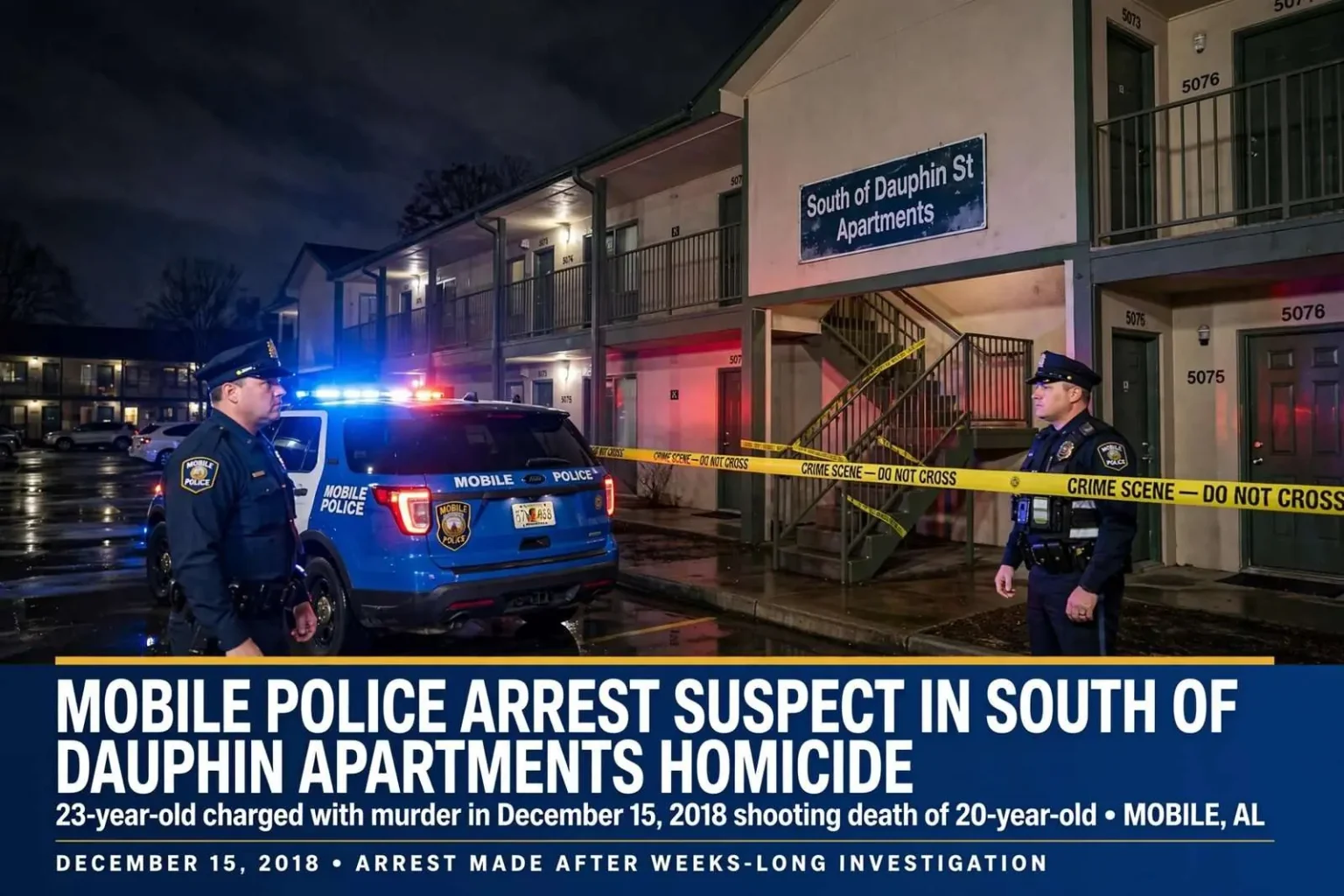
MOBILE, Ala. — Mobile police have made an arrest in the killing of a 20-year-old man found shot to death inside the South of Dauphin Street Apartments. Investigators charged Nathan Bartholomew, 23, with murder in the death of Mandrell Henley, capping a weeks-long investigation into the December shooting that began when officers were called to the complex early on the morning of December 15, 2018.
Henley was discovered shot inside a bedroom at the apartment complex, and police announced the arrest as Bartholomew was being escorted to Mobile Metro Jail for booking. The announcement put a name on a case that had hung unanswered over the complex near downtown since mid-December, and it marked the first public step in what will now unfold as a prosecution in Mobile County’s courts rather than an investigation by the police department’s homicide unit.
How the case unfolded
According to investigators, officers responded to the South of Dauphin Street Apartments early on the morning of December 15, 2018, and found Henley shot inside a bedroom of an apartment. He was pronounced dead at the scene, and detectives from the department’s homicide unit took over the case, beginning the methodical work that follows every killing: processing the scene, canvassing the complex for witnesses, collecting surveillance video and tracing the movements of everyone close to the victim in his final hours.
Weeks passed before the arrest. That timeline is typical for homicide investigations, which rarely resolve in a day. Detectives rebuild a timeline from phone records, physical evidence and interviews, then present what they have to prosecutors, who decide whether the evidence supports a charge. In this case, investigators identified Bartholomew as the suspect and charged him with murder in Henley’s death. Police announced the charge as Bartholomew was escorted to Mobile Metro Jail, the booking facility where arrestees in Mobile County are processed into custody.
The department has not released details about what led up to the killing or whether investigators believe additional people were involved. Officials frequently hold back such specifics in the days after an arrest to protect the integrity of the prosecution — details known only to the killer can be used to test confessions, and releasing theories publicly can complicate jury selection later. What police did make public was the identity of the suspect, the victim, and the charge.
The presumption Bartholomew now carries
A murder charge is an accusation, and Bartholomew is presumed innocent unless and until prosecutors prove the case in court. That principle applies to every defendant regardless of the gravity of the charge, and it will shape every stage of what follows: an initial appearance before a judge, the appointment of defense counsel if he cannot afford one, and eventually decisions about bail, evidence and trial.
Prosecutors in the Mobile County District Attorney’s Office will review the investigators’ file, and the case will move through Alabama’s court system, where murder is a felony that can carry a sentence of decades or life in prison upon conviction. Defense attorneys, meanwhile, will examine everything from the forensic evidence to witness statements, and any weaknesses in the state’s case will surface through that adversarial process. Most homicide cases take many months, and often more than a year, to reach resolution.
The complex and its neighborhood
The South of Dauphin Street Apartments sit in the area just west and south of downtown Mobile, a district of apartment communities and older neighborhoods that sits blocks from the city’s legal and business core. The complex’s location puts residents near major arteries into downtown and within sight of the skyline, but the area has long contended with the safety challenges that follow pockets of poverty in otherwise improving parts of the city.
Henley’s death was one of a number of homicides Mobile recorded in December 2018, a month when the city, like many mid-sized Southern cities, continued to wrestle with gun violence concentrated among young men. Twenty years old at the time of his death, Henley became part of a demographic that police officials, pastors and community groups have repeatedly identified as the most likely victims — and offenders — in the city’s shootings.
The arrest was the product of weeks of homicide work that rarely makes headlines. Detectives returned to the apartment complex repeatedly, re-interviewing witnesses whose memories sharpened with time and pulling evidence from the scene that only specialists can interpret. Search warrants and arrest warrants in Alabama require sworn affidavits laying out probable cause, so by the time Bartholomew was taken into custody, investigators had assembled a case file substantial enough to persuade a judge that the charge was warranted.
Mobile’s homicide unit carries one of the heavier caseloads in Alabama, and its detectives work the full arc of each case — from the first call at 3 a.m. through the preliminary hearing months later. Clearance rates for killings in Mobile have tracked with a pattern familiar nationwide: cases with cooperative witnesses and clear connections between suspect and victim move quickly, while cases where witnesses stay silent can sit unsolved for years. Arrests like this one, announced weeks after the fact, represent the department’s argument that persistence pays.
Witnesses make the difference
In apartment-complex shootings, investigators are almost entirely dependent on the people who live nearby. Someone heard arguing, someone saw a car, someone’s doorbell camera caught a figure in the parking lot. Police appeal for those witnesses in every case, and the department and local prosecutors have long stressed that witnesses can report information through Crime Stoppers of Mobile if they fear being identified, with cash rewards offered in exchange for tips that break cases.
The hesitation is understandable — fear of retaliation is the reason many killings go unsolved — but police officials argue the risk cuts the other way when suspects remain free. Community meetings after high-profile shootings in Mobile have repeatedly featured the same message from investigators: the case files are only as strong as what neighbors are willing to share, and anonymity is available for those who ask for it.
For the complex itself, an arrest after weeks of uncertainty typically brings relief of a limited kind. Residents knew a 20-year-old man had been found shot to death in a bedroom a short walk from their own doors, and until an arrest was made, the assumption that a killer was still at large weighed on daily routines. Detectives’ cars in the parking lot and yellow tape in a stairwell give way, gradually, to something closer to normal life — though for the people who heard the morning of December 15 unfold, the case does not really leave.
Two families and a courtroom ahead
Every homicide produces two grieving households. Henley’s family lost a son at 20, in the place where he lived, with no warning and, for weeks, no answer about who was responsible. Bartholomew’s family now confronts a murder charge against a 23-year-old facing the possibility of decades in prison. Neither family’s path runs short: trials, plea negotiations and appeals stretch on, and the truth-finding of a courtroom can take longer than the investigation that feeds it.
The case now moves into the court system as prosecutors prepare charges against the suspect, and the department has not said whether investigators believe additional people were involved — a question that could yet produce further developments. For now, the arrest stands as the milestone it is: a homicide that had been an open question since December 15 has a suspect in custody, charged, and headed before a Mobile County judge, where the evidence gathered over weeks of detective work will finally be tested in the open.
The South of Dauphin Street Apartments case also sits inside a longer conversation Mobile has been having about gun violence in its core neighborhoods. City officials, faith leaders and neighborhood associations have organized around violence interruption, mentorship and better lighting and code enforcement in the areas ringing downtown, arguing that enforcement alone cannot steady streets where young men keep dying. Arrests answer one case at a time; the harder work, community leaders often say, happens in the years between killings, among teenagers before they pick up a gun.
Mobile Metro Jail itself has long been one of the landmarks of the local justice system, the facility where virtually every felony arrest in the city ends its first day. The image of a suspect in handcuffs being escorted from a police cruiser into booking is the most public moment an arrest produces, and departments time such announcements deliberately, both to document custody and to demonstrate to the public that a case has moved forward.
For Mandrell Henley’s family, the weeks between December 15 and the arrest likely passed the way they do for every homicide family in Mobile: funeral arrangements made while detectives asked questions, a home with a bedroom no one touches, and the patience demanded of people who know nothing will bring a 20-year-old back. Victim advocates with the district attorney’s office and local support organizations walk families through that stretch, explaining what an arrest means, what a preliminary hearing is, and why the wheels of a murder prosecution turn as slowly as they do.
The weeks-long investigation that ended with Bartholomew’s arrest will now be tested by defense counsel and, eventually, a jury or a plea. If the case goes to trial, the witnesses who lived through that December morning will be asked to tell their stories in open court. If it resolves by plea, the details the department withheld — what led up to the killing, whether others were involved — may come out in the sentencing record. Either way, the file that detectives built in the weeks after December 15, 2018, becomes the foundation on which the outcome rests.
An arrest does not close a homicide; it opens the second half of one. But for the investigators who worked the case, the residents of the South of Dauphin Street Apartments who waited out those weeks, and the family of Mandrell Henley, the charge against Nathan Bartholomew represents the answer they have been waiting for since the morning a 20-year-old man was found shot inside a bedroom — and the start of the process that will decide what follows.


