
Mobile Police Believe Remains Found on Marcus Drive Are Missing 21-Year-Old; Two Men Charged With Murder
Mobile Police believe remains found on Marcus Drive are those of missing 21-year-old Tracie Dennis; two men were charged with murder.
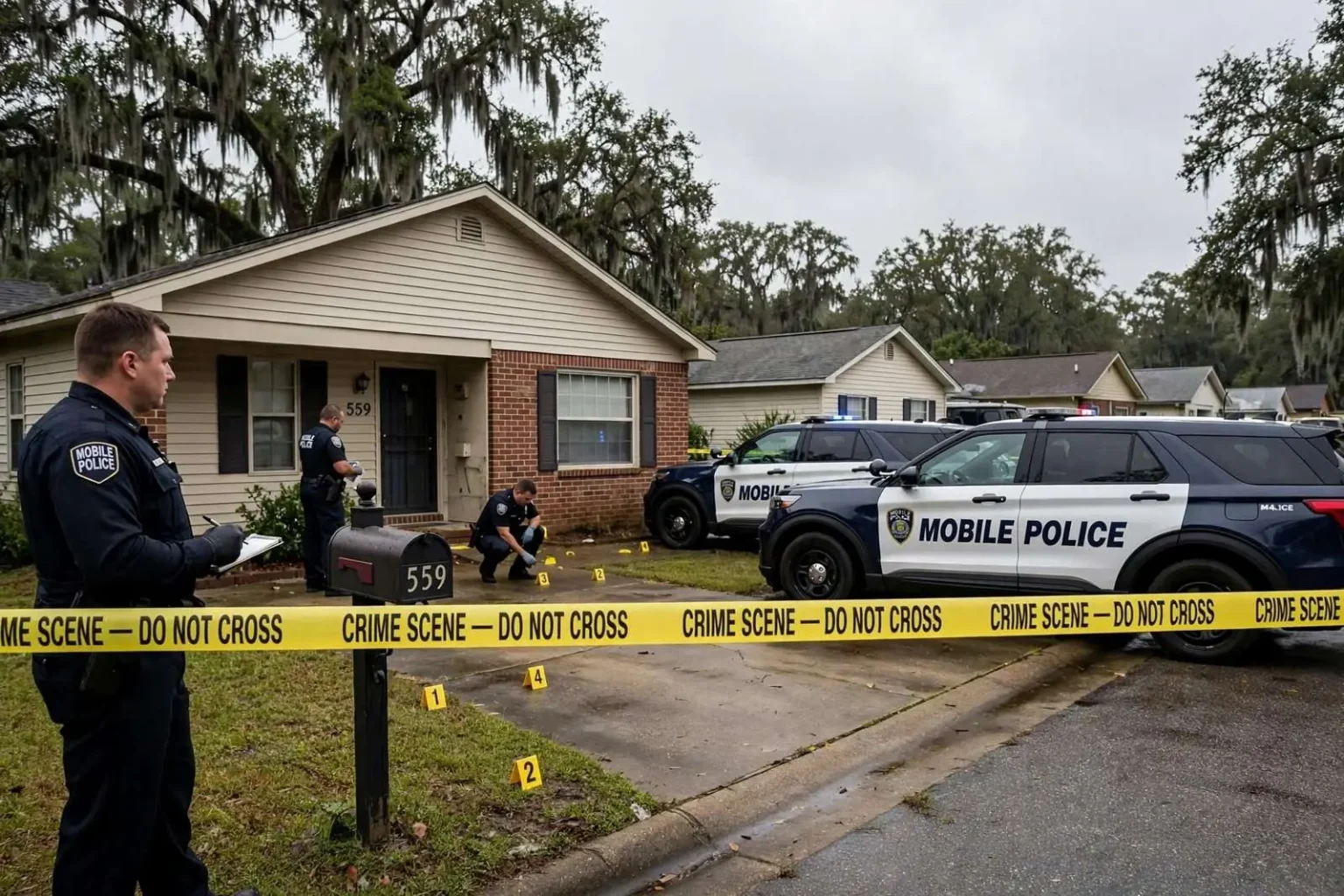
MOBILE, Ala. — Mobile Police say remains discovered in the Marcus Drive area likely belong to Tracie Dennis, a 21-year-old man who had been missing since Monday, and two men have been charged with murder in connection with his death. The discovery ended a week of uncertainty for Dennis’s family, who had spent the days since his disappearance searching for answers, and it transformed a missing-person case into a homicide investigation with suspects already in custody — more than 300 miles away in Florida.
Investigators determined early on that Dennis was likely killed inside a home in the 559 block of Marcus Drive on Monday night. Detectives working the scene found extensive evidence inside the residence, and Public Safety Director James Barber did not mince words about what investigators believed they had found. “There’s a lot of blood evidence here but we definitely believe we have the crime scene,” Barber said. The house on the quiet residential block became the center of the investigation as police cordoned the area, processed the interior and searched the surrounding neighborhood for evidence connected to Dennis’s disappearance.
The recovery of remains in the Marcus Drive area, days after the young man was last heard from, confirmed the fears of a family that had spent the week hoping for a different outcome. Police moved quickly to piece together Dennis’s final known movements, tracing his connections to the address where the evidence was found and identifying the people investigators believed were involved in what happened inside the home.
Two Arrests in Jacksonville
Police announced Saturday the arrests of David Manuel Cordero Hernandez, 32, and Marcos Javier Morales Oslan, 21, who were taken into custody in Jacksonville, Florida, after allegedly fleeing there. The arrests capped a rapid multi-state pursuit: in the span of less than a week, investigators went from a missing-person report to a crime scene to murder charges, working with agencies across state lines to track two men they allege left Mobile in the aftermath of the killing. Jacksonville, the sprawling northeast Florida city anchoring the interstate corridor between Mobile and the Atlantic coast, became the endpoint of that flight.
Coordination between Mobile police and Florida authorities made the apprehension possible, with investigators obtaining charges and communicating the suspects’ descriptions and likely movements to law enforcement partners to the east. The two men were expected to be returned to Mobile early the following week to face the charges here, a process that involves extradition formalities and transport arrangements between the two states’ corrections and law enforcement systems.
For detectives, the arrests marked a milestone but not a finish line. Both suspects face murder charges in the death of a 21-year-old whose remains had not yet been definitively identified, and the case file continues to grow as evidence from the Marcus Drive home, the recovery site and the suspects’ movements is cataloged and tested.
A Dispute Over Money, Police Say
Investigators said Dennis had done work for the two suspects and was owed money by them — a financial entanglement that, according to police, sat at the center of what happened. “They all knew each other — we believe they did some work together and money was the motive,” Barber said. The account painted the killing not as a random act of violence but as the outcome of a relationship gone wrong: a young man who knew the people he was visiting, doing business with them, and allegedly killed over what he was owed.
That familiarity, detectives noted, is one of the most consistent patterns in homicide work — victims and suspects connected by work, family, friendship or money, with violence erupting inside those relationships rather than from strangers. The Marcus Drive case followed the pattern closely: the crime scene was a home, the suspects allegedly fled together, and the alleged motive traced back to a debt. For investigators, establishing the work relationship between Dennis and the two suspects became a key thread in reconstructing Monday night — when Dennis was at the house, who else was there, and how a money dispute escalated into a killing.
Barber described the case as very active and said it remained unclear whether additional people could face charges. That open question — whether others participated, assisted or knew of the plan — kept the investigation broad even after the two arrests, with detectives continuing to interview witnesses and examine evidence for the roles of anyone else connected to the home on Marcus Drive or to the suspects’ flight to Jacksonville.
A Neighborhood and a Family Waiting for Answers
The case unsettled the Marcus Drive area, where residents watched investigators work the house in the 559 block for days and saw the neighborhood become a reference point in the city’s crime reports. Violent crime inside a residential block — particularly one allegedly involving a dispute over money between people who knew each other — renews familiar anxieties about safety on Mobile’s streets and the reach of the disputes that can turn deadly in any neighborhood of the city.
For Dennis’s family, the week’s developments delivered the worst possible answer to the question that had hung over them since Monday. The 21-year-old was remembered by those who knew him as a young man starting out, and the circumstances of his death — allegedly killed over money he was owed for work he had done — struck those close to the family with particular cruelty. The family now faces the identification and recovery process, funeral arrangements and a legal process that will stretch over months and years as the two suspects move from Florida custody back to Mobile and into the court system.
Police urged anyone with information about the case — particularly anyone who saw activity at the Marcus Drive home or knew of the suspects’ movements in the days after the killing — to come forward, noting that active investigations remain open to additional evidence and additional charges.
From Mobile to Jacksonville and Back
The suspects’ alleged flight from Mobile to Jacksonville will now reverse itself, as David Manuel Cordero Hernandez, 32, and Marcos Javier Morales Oslan, 21, await transport back to Alabama to face murder charges. The extradition process between Florida and Alabama follows established legal channels — governor’s warrants, court appearances in the holding state, and coordinated transport by law enforcement — and officials expected the two men to be returned to Mobile early the following week. Once here, they will make initial court appearances in Mobile County’s system, where murder charges carry the weight of the state’s most serious penalties short of the death penalty cases that prosecutors must decide separately.
The speed of the arrests — from a Monday-night killing to Saturday’s announcement of two suspects in custody across state lines — reflected the investigative push the case received. Mobile police detectives worked the crime scene on Marcus Drive while others traced the suspects’ connections and movements, and the collaboration that put the two men in custody in Jacksonville drew on the network of communication among Gulf Coast and southeastern law enforcement agencies. Cases that cross state lines in hours rather than weeks are the exception, and the department’s leadership pointed to the outcome as evidence of what the investigation extracted from the evidence available in the case’s earliest days.
What Comes Next in the Case
The legal road ahead runs through several stations: definitive identification of the remains recovered in the Marcus Drive area, formal charging documents, initial appearances and bond proceedings for both defendants, and eventually preliminary hearings where the evidence — the blood evidence inside the home, the recovery of the remains, the financial relationship and the flight to Florida — will be laid out in open court. Prosecutors will also weigh whether the investigation implicates anyone beyond the two men already charged, a question Public Safety Director James Barber left explicitly open when he described the case as very active.
For the city, the case joins the grim arithmetic of Mobile’s homicide statistics, another young life ended allegedly over money in a dispute between acquaintances. Community leaders in the areas most affected by violent crime have long pressed for interventions that reach the disputes before they turn deadly — the arguments over debts, relationships and disrespect that accumulate into the city’s annual toll. The Marcus Drive case, with its weeklong arc from missing person to murder charges, illustrates both how quickly those disputes turn fatal and how directly the consequences reach the families left to pick through them.
As the suspects return to Mobile and the courts take over, the home in the 559 block of Marcus Drive and the family of Tracie Dennis will carry the case’s heaviest weight — one household marked by what investigators found inside it, and one family facing the process of burying a 21-year-old son whose disappearance ended in the worst answer possible.


