
Mobile Police Chief Lawrence Battiste Tests Positive for COVID-19
Mobile Police Chief Lawrence Battiste tested positive for COVID-19 and quarantined, with the department saying he was expected back at work within the week.
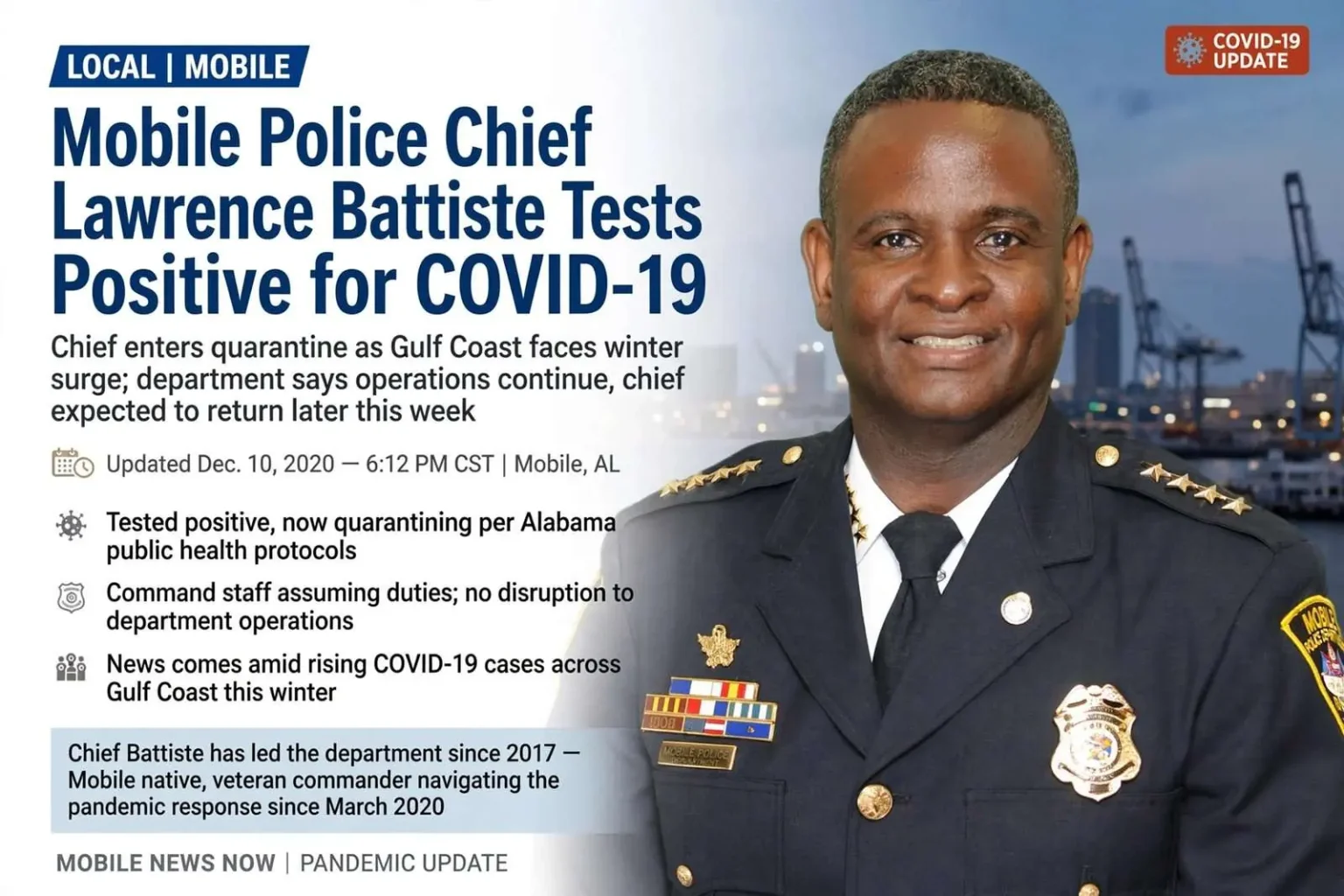
Mobile Police Chief Lawrence Battiste tested positive for COVID-19 and had been in quarantine, according to the Mobile Police Department. The department said the chief was expected to return to work later that week. The announcement came during a period when Gulf Coast communities were contending with rising coronavirus cases heading into the winter of 2020, and it underscored how thoroughly the pandemic had reached into every corner of public life — including the leadership of the city’s police department.
The department confirmed the chief’s positive test as Battiste entered quarantine, following the public health protocols that guided workplaces across Alabama throughout the pandemic. Despite the chief’s absence from the office, the department emphasized that day-to-day operations would continue without interruption, with the command staff absorbing the chief’s responsibilities until his expected return later that week.
Battiste, a Mobile native and veteran of the department he led, had served as chief since 2017, guiding the force through a period of reform initiatives, crime-fighting strategy shifts, and — beginning in March 2020 — the greatest public health emergency in a century. His positive test placed him among the millions of Americans who contracted the virus during the pandemic’s accelerating winter surge.
A Department Operating Through the Pandemic
The Mobile Police Department’s work changed dramatically after the coronavirus arrived in Alabama in the spring of 2020. Officers adjusted to new protective measures, patrol responses were modified to limit close contact where possible, and precinct operations adopted masking, distancing, and screening practices that would have been unthinkable a year earlier. The pandemic added a layer of complexity to every call, from domestic disputes to traffic stops, while the department continued to answer its normal volume of police work.
Departments across the Gulf Coast faced the same calculations. Police agencies could not shut down, so they operated in waves of exposure precautions, quarantining affected officers and redistributing shifts to keep adequate coverage on the street. A positive test for the chief himself illustrated the reach of the virus — leadership was not insulated from the risks that officers faced daily in courthouses, hospitals, and neighborhoods.
The timing of the announcement, during the winter surge of late 2020, coincided with the most dangerous stretch of the pandemic to that point. Case counts across Alabama were climbing as cooler weather pushed activities indoors, hospitals in Mobile and across the region were managing growing patient loads, and public officials were urging residents to wear masks, distance where possible, and take the approaching holiday season’s risks seriously.
Who Is Lawrence Battiste
Lawrence Battiste brought deep roots to the chief’s office. A Mobile native and a graduate of the city’s public schools, he rose through the ranks of the Mobile Police Department over a career spanning decades before being named chief. His tenure placed him at the center of the city’s conversations about public safety, community policing, and the relationship between residents and the officers who serve them.
As chief, Battiste emphasized community engagement alongside enforcement, appearing at neighborhood meetings, churches, and civic gatherings across the city. He led the department through high-profile challenges — periods of elevated violent crime, debates over policing practices sweeping the nation, and the pandemic itself — and his visibility made him one of the most recognizable figures in Mobile city government.
When the chief’s positive test was announced, well-wishes poured in from officers, city officials, and residents alike. In the pandemic’s climate of uncertainty, the news served as a reminder that no one was exempt, and the department’s message that the chief was expected back at work later that week offered a hopeful note in a difficult season.
Winter 2020 on the Gulf Coast
The winter of 2020-2021 was a harrowing period for Gulf Coast communities. After months of relative caution in the spring and a summer of fluctuating numbers, the region entered the winter facing its worst surge yet. Mobile County’s case counts rose steadily, area hospitals reported mounting strain, and health officials pleaded with residents to celebrate the holidays cautiously.
Public agencies adapted as best they could. City halls operated with reduced capacity, schools cycled between in-person and remote instruction, and first-responder agencies implemented their own exposure protocols to keep their workforces intact. Police departments, fire departments, and EMS agencies became essential test cases in keeping critical public services running while their employees, like everyone else, contracted and recovered from the virus.
Against that backdrop, the report that Mobile’s police chief had tested positive and was quarantining was both routine and sobering — routine, because by that point the virus had touched organizations everywhere; sobering, because it showed that even the most careful public institutions could not fully hold the pandemic at bay. The department’s steady message — operations continuing, the chief expected back later that week — reflected the resilience that Gulf Coast communities would need as the winter surge stretched on.
Leadership During a Crisis
Leading a police department through a pandemic required constant adaptation. Chiefs across Alabama had to balance officer safety with the obligation to maintain service, navigate shifting guidance from public health authorities, and manage the operational disruption that came whenever officers or commanders had to quarantine. Departments instituted return-to-work protocols, tracked exposures, and at times relied on overtime to fill shifts depleted by isolation requirements.
For Mobile, having a chief with Battiste’s institutional experience helped steadied the ship. Officers and command staff knew the department’s culture and operations, and communication during the pandemic leaned heavily on the trust a leader builds over years. The department continued its community programs where it could, adjusted others, and kept the public informed through its usual channels even as its leadership worked through the same disruptions facing every household in the city.
The chief’s own illness, brief as his absence was expected to be, gave the department’s workforce a visible example of the moment: the guidance applied to everyone, from rookie officers to the chief of police. Public health messaging throughout the pandemic repeatedly emphasized that point, and the sight of a city’s top law enforcement official quarantining like anyone else drove it home more effectively than any press conference.
The Pandemic’s Toll on Public Safety Agencies
Police departments were far from alone in navigating the crisis. Fire departments and ambulance services along the Gulf Coast absorbed enormous pressure during the winter surge, responding to rising call volumes while protecting their own crews. The strain showed in overtime budgets, in fatigue, and in the daily improvisation that kept essential services functioning when colleagues were out sick or in quarantine.
Vaccination campaigns were just beginning during the winter of 2020-2021, offering a light at the end of a long tunnel. Health care workers in Mobile received the earliest doses, and first responders followed in the priority groups that states established. Until wider distribution took hold, though, agencies continued to rely on the tools they had — masking, distancing, testing, and quarantine — to keep their people healthy and their services running.
The pandemic’s effect on police work extended beyond health measures. Crime patterns shifted as the pandemic wore on, with some categories of offenses rising in cities nationwide, and departments had to adjust deployment while managing the same pandemic constraints. Chiefs like Battiste found themselves managing two overlapping crises at once: the public health emergency and the ordinary — and sometimes extraordinary — demands of urban policing.
Recovery and Return
The department’s expectation that Chief Battiste would return to work later that week matched the experience of most working-age adults who contracted the virus during that period, when recovery at home with quarantine was the common course. Departments maintained testing protocols for returning employees, and commanders coordinated with public health guidance to time the return safely. Command staff in the meantime carried the department’s daily briefings, with the depth of leadership within the force allowing operations to continue through the transition.
In the weeks that followed, the winter surge crested and eventually receded, though the region’s pandemic journey continued through 2021 with new challenges and, ultimately, widespread vaccination. Mobile, like cities across the country, gradually restored the rhythms of public life that the virus had interrupted — and the police department, like its counterparts, emerged from the crisis having learned lasting lessons about flexibility, communication, and the importance of a healthy workforce.
The episode stands as a small but telling marker of a moment in Mobile’s history: the winter when the city’s police chief, like so many of the residents he served, tested positive for COVID-19, quarantined at home, and planned his return to work — while the department he led kept the streets of Mobile covered, and Gulf Coast communities braced through the hardest stretch of the pandemic yet.


