Mobile Police Department announces winners of trauma-healing songwriting contest
The Mobile Police Department announced the winners of the Project THRIVE songwriting competition, who will perform at the SouthSounds festival.
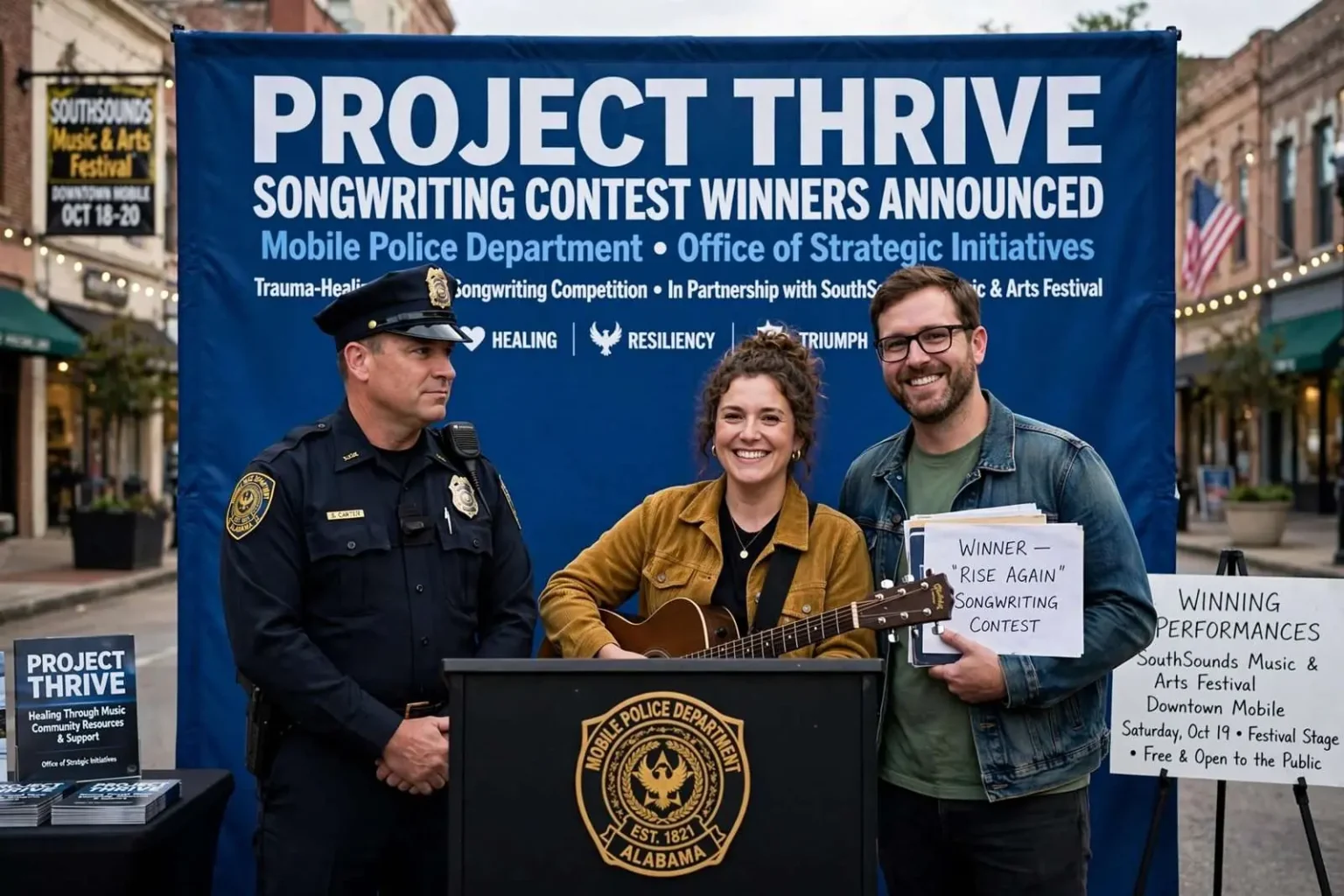
MOBILE, Ala. — The Mobile Police Department has announced the winners of a local songwriting competition aimed at helping the community heal from trauma. The Project THRIVE Songwriter Competition selected its winners, who will each perform on stage at the SouthSounds Music & Arts Festival. Project THRIVE, led by the Mobile Police Department’s Office of Strategic Initiatives, joined SouthSounds to hold the contest as part of an effort to make Mobile a trauma-informed community through music. Organizers said the chosen songs are meant to lift traumatized victims by offering messages of healing, resiliency and triumph.
The competition invited songwriters from across the Gulf Coast to submit original material dealing with themes of overcoming hardship, and the response gave organizers a catalog of entries that spoke directly to the experiences of people who have lived through violence, loss, disaster and other forms of trauma. Rather than judging entries purely on technical craft, organizers looked for songs that carried an honest message about the road from pain to recovery. The winning entries will now move from the submission pile to a much larger audience, with each winner taking the stage at SouthSounds, one of the most visible showcases for emerging music in the region.
Project THRIVE is the umbrella name for the police department’s broader effort to change how Mobile responds to trauma. The initiative operates out of the Office of Strategic Initiatives, a unit the department uses to run programs that go beyond traditional enforcement work. The idea behind a trauma-informed community is straightforward: trauma is widespread, it shapes how people behave, and a city that understands it can respond in ways that reduce harm instead of adding to it. That philosophy touches everything from how officers interact with residents in crisis to how schools, churches and neighborhood groups support people after a tragedy.
Music fits into that mission because of the way it reaches people who might never walk into a counseling office or attend a community meeting. A song about surviving hard times can travel through a city in ways a pamphlet cannot, played on a phone, shared between friends, or performed live in front of a crowd. Organizers said the chosen songs are meant to lift traumatized victims by offering messages of healing, resiliency and triumph, and the songwriting contest was designed to find local voices that already carried those messages and give them a platform.
How the contest came together
The partnership between Project THRIVE and SouthSounds grew out of a shared interest in using the city’s creative community as a resource for public well-being. SouthSounds Music & Arts Festival has spent years building a reputation as a launching pad for new artists, filling downtown Mobile venues with performers from across the Southeast and drawing audiences that come specifically to hear something they have not heard before. Pairing the festival with a trauma-healing songwriting contest gave the event a new dimension and gave Project THRIVE access to an audience it might not otherwise reach through a traditional outreach event.
Under the arrangement, the festival provided the stage while Project THRIVE provided the framework and the purpose. Songwriters submitted entries built around themes of healing and resilience, and a selection process identified the songs judged most likely to connect with people carrying the weight of traumatic experiences. The winners announced by the Mobile Police Department will each perform during the festival, turning what could have been a simple awards announcement into a live moment shared with thousands of music fans in downtown Mobile.
For the winning songwriters, the performance slot represents more than exposure. Many writers draw on their own histories when they write about overcoming adversity, and organizers framed the contest as a chance for those artists to transform private pain into something that helps strangers. A song that describes coming through grief or rebuilding after loss can tell a listener that survival is possible, and that message lands differently when it comes from someone in the crowd’s own community rather than a distant celebrity.
The contest also reflects a wider movement among law enforcement agencies to address the root conditions that drive crime rather than only reacting to it. Cities across the country have adopted trauma-informed frameworks in recent years, training personnel to recognize the effects of adverse experiences and building partnerships with health providers, schools and arts organizations. Mobile’s approach through Project THRIVE places the police department in the role of convener, bringing together groups that already do healing work and amplifying them rather than duplicating their efforts.
Why music and trauma recovery go hand in hand
Research on trauma has long noted the connection between creative expression and recovery. Writing, performing and listening to music can help people process experiences that are difficult to put into ordinary conversation, and group musical events create a sense of shared experience that isolates trauma’s natural opposite. A festival performance built around songs of survival gives both the artists and the audience a moment of collective acknowledgment, an admission that hard things happen in Mobile and that people here come through them.
Organizers said the chosen songs are meant to lift traumatized victims by offering messages of healing, resiliency and triumph, and those three words describe a progression that mirrors how recovery actually works. Healing begins the process, resiliency carries a person through the long middle stretch, and triumph marks the point where the experience no longer defines the person’s future. Songs that capture any part of that arc can serve as a lifeline for a listener still stuck in an earlier stage of it.
The Mobile Police Department’s Office of Strategic Initiatives has made this kind of creative partnership a signature of Project THRIVE. The office coordinates the department’s non-enforcement programs, and the songwriting competition joins a portfolio of efforts aimed at making the city safer by making it healthier. Department leaders have argued publicly that public safety and community wellness are the same long-term project, and events like this one put that argument into practice in a form residents can actually attend and enjoy.
SouthSounds, for its part, has historically spread performances across multiple downtown venues, giving attendees the experience of walking from stage to stage through the heart of Mobile. Adding a set of trauma-healing contest winners to that lineup means festivalgoers who came for entertainment will also hear music rooted in the real experiences of their neighbors. The festival’s audience skews toward listeners who actively seek out new artists, which makes it a natural fit for songs that have never been heard live before.
What the performances mean for the winners
Each winner’s performance at the festival will mark the culmination of a journey that started with a private act of writing and ends on a public stage. Organizers have described the contest as a way to celebrate local talent while advancing a serious civic goal, and the winning songwriters now carry both honors at once. They will perform as representatives of a community effort, not just as solo acts, and their songs become part of the public record of how Mobile talks about trauma.
For the wider community, the announcement of the winners is also an invitation. Every contest of this kind depends on participation, and organizers hope that hearing the winning songs performed live will encourage other songwriters to enter future rounds. The more voices the competition collects, the more complete a picture it gives of how residents experience hardship and recovery across the city’s neighborhoods, from downtown to West Mobile and out along the Bay.
A larger shift in how Mobile handles trauma
The songwriting contest lands in a city that has spent years building out its trauma-response infrastructure. Mobile has confronted a steady share of the challenges facing Gulf Coast communities, including violent crime, the aftermath of hurricanes, and the economic strain that follows both. Trauma-informed approaches treat those burdens as public health concerns as much as criminal ones, and Project THRIVE’s work through the Office of Strategic Initiatives reflects that framing. The department has emphasized partnerships, prevention and community trust as pillars that support traditional policing rather than compete with it.
Arts-based programming occupies a particular place in that strategy because it reaches residents who may be skeptical of institutions. A neighborhood meeting about violence prevention draws a certain kind of audience; a music festival draws another. By meeting people at a festival stage instead of a podium, Project THRIVE extends its message to listeners who might never otherwise hear it, and it does so in a format built for emotional connection rather than information transfer.
The model also gives local artists a stake in community health. Songwriters who participate become ambassadors for the trauma-informed message, carrying it into venues, studios and social feeds across the area. That distributed form of outreach is difficult for any single agency to replicate, which is why the department chose to partner with an established festival rather than staging a standalone event. The audience was already assembled; the contest simply gave it something new to hear.
Organizers said the chosen songs are meant to lift traumatized victims by offering messages of healing, resiliency and triumph, and the announcement of the winners converts that intention into a concrete schedule. The performances are set for the festival stage, where each songwriter will present the work that earned the selection. For residents of Mobile, the event offers a chance to hear the city’s struggles described honestly and its capacity for recovery celebrated out loud.
Looking ahead
Whether the competition becomes a recurring feature of SouthSounds remains a question for future editions, but the structure is now in place. Project THRIVE has a template for soliciting songs, selecting winners and staging performances, and the festival has demonstrated that a trauma-healing showcase fits comfortably within its format. Cities that have sustained similar programs point to persistence as the key ingredient: the message that healing is possible only works when it is repeated, year after year, in voices the community trusts.
For now, the department’s announcement gives the winning songwriters their moment and gives the public a date with a stage. The songs will do the rest of the work, as songs do, traveling from the festival grounds into listeners’ lives carrying the same message organizers selected them to deliver: that trauma is real in Mobile, that healing is possible, and that the people singing about it are standing in the same community as the people who need to hear it.
Residents who want to support the effort can attend the performances at SouthSounds, share the winning songs once they are released more widely, and learn more about Project THRIVE through the Mobile Police Department’s community programs. The department has framed the initiative as a long-term investment in the city’s well-being, and the songwriting competition is the latest expression of that commitment — proof that public safety work can look like music, sometimes, when the goal is helping a city heal.