
Mobile Police Identify Teen Fatally Shot on Cortney Street South
18-year-old Tycory Crawford died after being shot inside a Cortney Street South home near Pleasant Valley Road; police call it an active homicide.
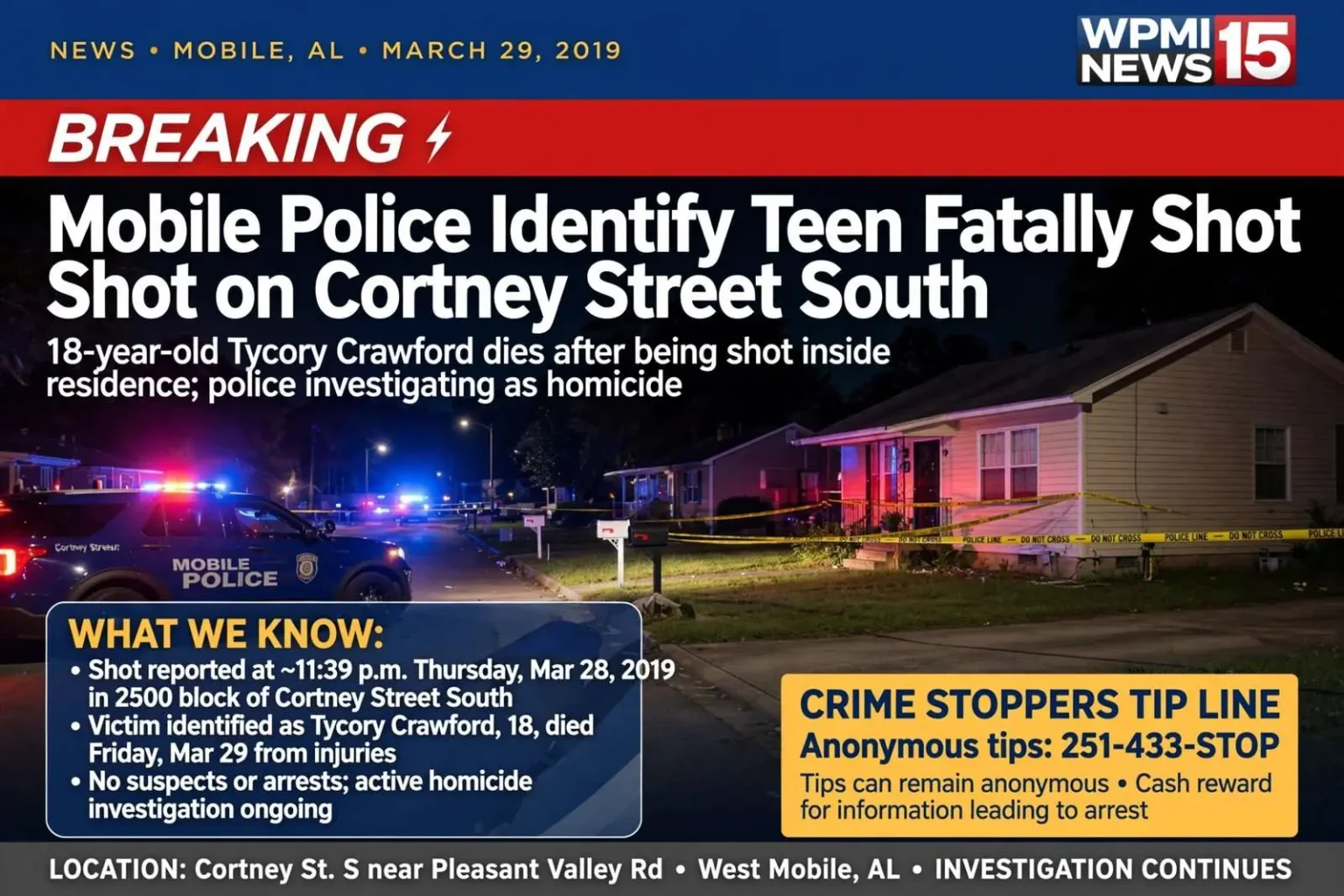
An 18-year-old Mobile man has died after being shot inside a residence on Cortney Street South, and police have identified him as Tycory Crawford.
According to the Mobile Police Department, officers responded around 11:39 p.m. Thursday, March 28, 2019, to the 2500 block of Cortney Street South after a report of a single gunshot. Inside the home they found a male victim suffering from a gunshot wound. He was rushed to a hospital with life-threatening injuries.
Crawford succumbed to his wounds the following day, Friday, March 29, becoming the city’s latest homicide victim. The identification came after authorities withheld the victim’s name in the immediate aftermath of the shooting, a customary step while family members are notified and investigators begin the work of establishing what happened inside the residence.
The shooting occurred near Pleasant Valley Road in west Mobile, an area of the city that mixes residential subdivisions, older neighborhoods, and the commercial corridors along Airport Boulevard and Schillinger Road. A single gunshot reported late on a weeknight typically draws a rapid police response and an immediate canvass of the surrounding blocks, where neighbors are often the best source of what they saw or heard in the minutes around the shot.
Police described the case as an active homicide investigation. No suspects had been announced and no arrests were reported in the immediate aftermath of the shooting, leaving investigators to work backward from the scene inside the home and whatever the medical examination of the victim revealed once he arrived at the hospital.
The sequence of the night, as described by police, placed the timeline in a narrow window: a single gunshot heard or reported shortly before midnight, officers on the scene within minutes, and a victim still alive but gravely wounded when they reached him. In shooting cases where the victim is found inside a residence, detectives focus early attention on who was in the home, who came and went in the hours before, and whether the shot was fired by someone known to the victim.
Investigating a Late-Night Fatal Shooting
Homicide investigations that begin with a lone shot inside a house proceed along well-worn paths. The first hours belong to the crime scene: securing the residence, photographing and collecting physical evidence, recovering any shell casings or firearms present, and documenting the position of the victim and everything around him. Detectives simultaneously begin the witness work, interviewing whoever was in or near the home and knocking on doors along Cortney Street South in search of anyone who heard the shot or noticed movement outside.
The medical side of the case runs in parallel. When a wounded victim reaches a hospital alive, trauma teams attempt to stabilize him, and detectives try to obtain a statement if the victim can speak. Where the victim dies, as happened here the next day, the case adds the formal weight of a death investigation, with the medical examiner’s examination determining the exact cause and manner of death and the trajectory of the bullet becoming part of the physical record.
The first days also bring the records work: checking whether the residence or neighboring homes had cameras, reviewing any prior police calls to the address, and mapping the victim’s recent movements and associations. Investigators in Mobile have repeatedly emphasized that early cooperation from the community — a single credible tip about a vehicle, a voice, or an argument — often breaks cases that would otherwise stall.
Authorities typically urge anyone with information about such cases to contact Mobile police or Crime Stoppers, the regional program that accepts anonymous tips and, in cases where the information leads to an arrest, pays rewards. For homicides in particular, the anonymous channel matters: witnesses who fear retaliation can pass what they know to investigators without putting their names into the case file.
West Mobile and the Geography of the Case
Cortney Street South sits in the western reaches of the city, in the orbit of Pleasant Valley Road, in a part of Mobile that has grown steadily outward from the older core for decades. The neighborhoods there are a patchwork of modest homes and quiet residential streets threaded among the commercial strips that serve one of the city’s fastest-developing quadrants, and serious violent crime in the area tends to register sharply against that otherwise calm backdrop.
Police response times in west Mobile benefit from the area’s patrol infrastructure, with officers able to reach the residential blocks quickly from the arterial roads. The 11:39 p.m. report and the discovery of the victim inside the home indicate the system worked as designed: a call came in, units were dispatched, and officers found the wounded man in time to get him to a hospital, though his wounds proved fatal the next day.
The residence itself became the center of the investigative universe. Shootings inside homes present detectives with a contained but complicated scene, where the questions of who belonged there, who else was present, and what preceded the gunshot are answered only through interviews and forensic work. Neighbors in the 2500 block would have seen the police lights and the tape, and canvassing officers in such cases systematically ask about the hours before the shot: visitors, vehicles, arguments, anything out of the ordinary on a quiet street.
Crawford’s age placed him among the young adults who make up a significant share of homicide victims in American cities, and his death became part of Mobile’s running count for 2019. Homicide totals are tracked closely by police departments and by the communities affected, both because the numbers measure public safety and because each victim represents a family navigating the aftermath of a sudden, violent loss.
How Homicide Cases Move After the First Week
Once the scene work and the first round of interviews are complete, a case like this enters the slower phase of investigation: laboratory analysis of evidence, follow-up interviews, and the steady accumulation of information that either converges on a suspect or does not. Detectives assigned to the case continue working it even when there is nothing new to announce, re-contacting witnesses and chasing the small leads that surface weeks or months later.
Public communication in such cases is deliberately measured. Police typically decline to discuss whether they have identified a suspect, what the relationship may have been between the victim and anyone involved, or what evidence points where, all to protect the integrity of a potential prosecution. That caution can frustrate a community looking for answers, but it reflects the reality that a homicide case must eventually stand up in court.
The family of the victim, meanwhile, carries the case in a different way. Advocates and victims’ services workers emphasize that the period after a young person’s violent death is disorienting for relatives, who must navigate grief, burial arrangements, media attention, and an investigative process that often cannot share details. Support services in Mobile, including those connected to law enforcement and to community organizations, exist partly for that purpose.
For the neighborhood around Cortney Street South, the shooting and its aftermath left the questions that linger in every community where a young life ends inside a house on a quiet block: what happened, whether the person responsible will be found, and whether anyone who knows something will come forward. Police said the investigation remained active, and the standing request was unchanged — anyone with information should contact the Mobile Police Department or leave an anonymous tip through Crime Stoppers, where information about the death of Tycory Crawford could be passed along without a name attached to it.
The Role of Crime Stoppers in Mobile Homicide Cases
Crime Stoppers has long been part of the equation in Mobile’s unsolved killings. The program’s design is simple but effective: it lets people pass information to detectives through an anonymous channel, strips identifying details before anything reaches police, and offers cash rewards in cases where a tip produces an arrest. Departments across the region credit the mechanism with breaking cases where witnesses were willing to talk but unwilling to be seen talking.
In the days after a young victim’s death, that anonymous channel becomes especially important. Investigators know that in most shootings the pool of people who know something — friends, relatives, bystanders — is far larger than the list of people willing to be interviewed openly, and the gap between the two is where cases usually stall. A tip that places a vehicle outside the house, names a visitor from earlier in the evening, or describes a conversation overheard after the shot can redirect an investigation that physical evidence alone cannot carry.
The police department’s standing appeal in cases like this one follows that logic. Detectives do not need a witness who saw everything; fragments are valuable, and each fragment can be checked against the growing file. A single gunshot inside a residence late on a Thursday night almost certainly left traces beyond the scene — in phone records, in doorbell cameras, in the memory of someone on the next street over — and every one of those traces is a potential thread.
For the 2500 block of Cortney Street South and the streets around Pleasant Valley Road, the investigation into the death of Tycory Crawford remained open as of the latest information available. The department had announced no arrests and no suspects, and the case stood where most homicides stand in their early days: a scene processed, a family grieving, a detective’s file growing page by page, and a community holding the missing piece that would explain how an 18-year-old came to be shot inside a home on a quiet west Mobile street.


