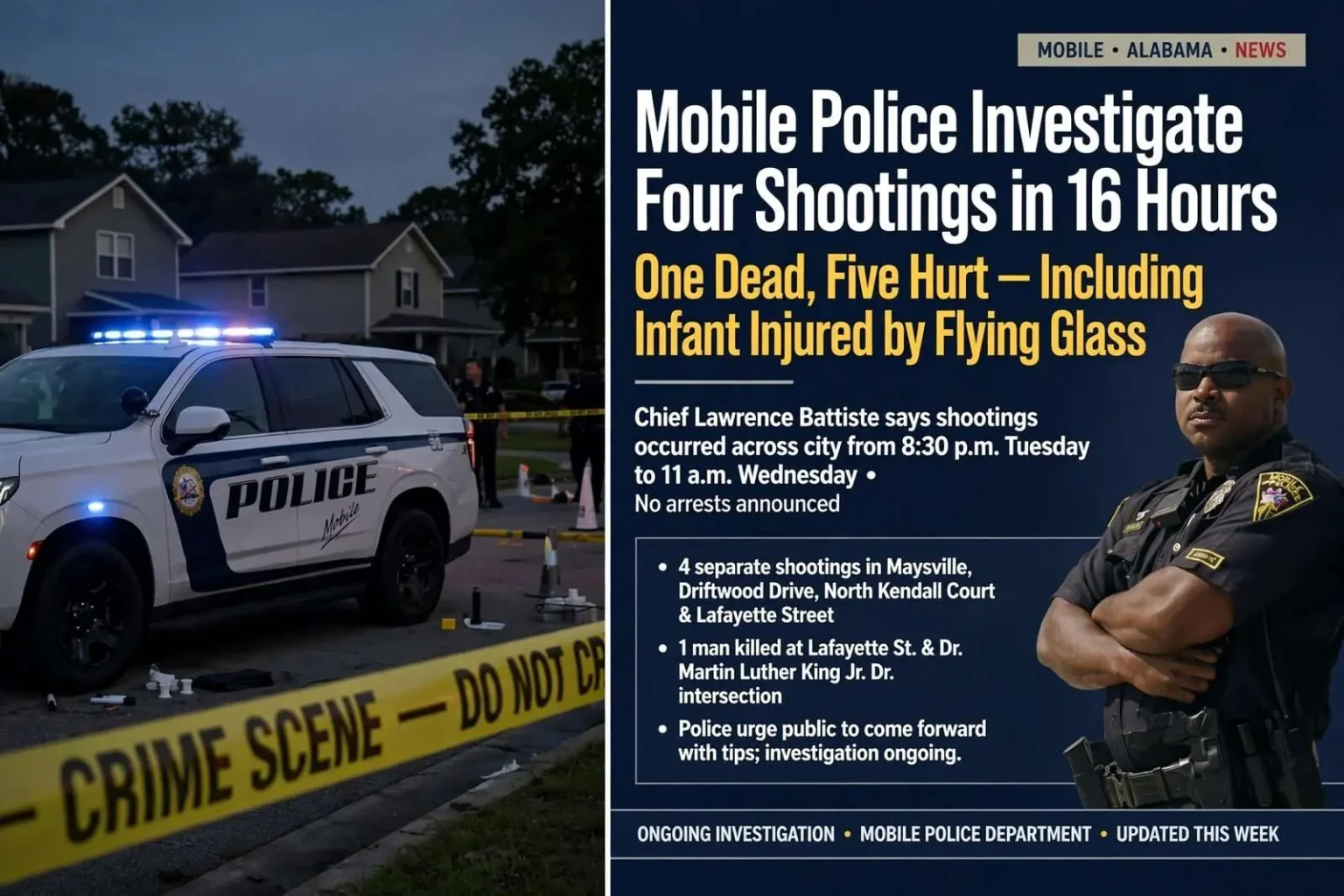
Mobile police are investigating a string of four shootings that unfolded over a roughly 16-hour stretch this week, leaving one man dead and five other people injured, including an infant hurt by flying glass and debris. Mobile Police Chief Lawrence Battiste said the shootings occurred between 8:30 p.m. Tuesday and 11 a.m. Wednesday. While investigators have found no evidence connecting the incidents, Battiste said police are actively examining whether the shootings are related.
The stretch of violence touched three distinct corners of the city and ended with a homicide at one of Mobile’s most recognizable intersections. In between, officers fielded calls that ranged from a youth shooting in a historic neighborhood to gunfire directed at an occupied home with a baby inside. No arrests had been announced in connection with any of the four cases as of the chief’s briefing.
Battiste addressed the shootings during a public briefing, laying out the timeline incident by incident and using the occasion to deliver a broader message about witness cooperation, retaliation and the limits of what police can accomplish without help from the people who live where the violence occurs.
A Timeline That Began in Maysville
The first shooting was reported shortly after 8:30 p.m. Tuesday on Duval Street in the Maysville neighborhood. A 17-year-old and a 20-year-old were taken to the hospital with injuries; both have since been released. No suspect has been identified, and investigators are continuing to follow up on leads.
Maysville sits just southeast of downtown Mobile, one of the city’s oldest residential districts, a grid of modest cottages and shotgun houses that dates back more than a century. The neighborhood is within walking distance of the hospitals and government offices downtown, and like many older urban neighborhoods in Mobile it has experienced the tensions between community investment and street-level crime that police say shape so many of the cases they work.
That the two victims in the Duval Street shooting were teenagers and young adults, and that both survived, offered little comfort to investigators, who note that early, non-fatal shootings often precede retaliatory violence if those responsible are not identified and arrested quickly.
Rounds Fired Into an Occupied Home
Later that night, gunfire erupted on Driftwood Drive, where police say several rounds were fired into an occupied house. Two people were hurt, one critically. Among the injured was an infant who suffered minor wounds from broken glass and debris inside the home.
Shooting into an occupied dwelling is among the most serious firearms offenses on the books in Alabama, and cases involving child victims routinely draw intensified investigative attention. The fact that the infant’s injuries came from glass and debris rather than a direct bullet did not change the calculus for detectives: someone fired multiple rounds at a house where people, including a baby, were sleeping or living.
The critical injury to a second occupant underscored the unpredictability of such attacks. Police did not say whether the home’s occupants were the intended targets, and no suspect information was released. Investigators spent the overnight hours canvassing the street for shell casings, damaged vehicles and any surveillance footage from homes or businesses along the block.
A Morning Call With a Different Answer
Early Wednesday morning, officers responded to reports of shots fired on North Kendall Court. Battiste said that call turned out to involve a self-inflicted gunshot wound rather than an assault. The chief’s decision to publicly distinguish that incident from the other three reflected the care investigators take when sorting a rapid series of shooting calls, since early reports of gunfire frequently arrive fragmented and incomplete.
Self-inflicted wound cases follow an entirely different investigative path than assaults. There is no outstanding shooter to pursue, no canvass for a fleeing vehicle, and the focus shifts to the wellbeing of the person injured and the circumstances that led to the injury. Battiste nonetheless included the call in the department’s accounting of the 16-hour period, both for transparency and because initial radio traffic had treated it as a possible shooting.
The incident also illustrates the workload such a stretch places on patrol officers and detectives. Between late Tuesday evening and midday Wednesday, the department had to staff crime scenes, transport victims, notify families, collect evidence and begin follow-up interviews on three separate criminal cases, all while maintaining regular patrols across a city of roughly 190,000 residents.
A Fatal Morning on Lafayette Street
The fourth shooting was reported around 11 a.m. Wednesday at the intersection of Lafayette Street and Dr. Martin Luther King Jr. Drive, where two people were shot inside a vehicle. One of them, 21-year-old Carey Wheat, was pronounced dead at the scene. The second victim was taken for treatment locally.
The intersection sits along Dr. Martin Luther King Jr. Avenue, the spine of a historic corridor just south of downtown that bears the name of the civil rights leader and runs through neighborhoods with deep ties to Mobile’s Black community. Daytime gunfire at such a visible crossing made the case immediately prominent, and police presence in the area was heavy through the afternoon as detectives processed the scene.
The vehicle in which the two men were shot became a key piece of evidence, and investigators worked to determine whether the occupants were targeted by someone who approached on foot or by gunfire from another vehicle. Police have not announced a suspect or a motive in the killing, which stands as the city’s latest homicide in a year when officials have repeatedly urged residents to help interrupt the cycle of violence.
Homicide investigations in Mobile routinely lean on tips from the public, witnesses who saw a vehicle or a person in the moments before and after the shooting, and camera footage from homes and businesses near the scene. Detectives urge anyone who was in the area around 11 a.m. Wednesday, even if they believe they saw nothing important, to come forward, since small details frequently break cases open.
A Chief’s Plea Against Retaliation
Though Battiste did not connect the shootings to one another, he used the briefing to caution against vigilante justice and to ask residents to come forward with information about violent crime in their neighborhoods.
“Our community will not be held hostage or under siege by individuals who feel like the only way to get things done is by shooting it out in neighborhoods,” Battiste said. “I’m asking the people who typically ask law enforcement what we’re doing, what are they doing in their communities to hold these individuals accountable. If they know who these individuals are, they need to speak up.”
The warning about retaliation reflects a pattern that police in Mobile and across South Alabama describe repeatedly: a shooting is followed days or weeks later by a second one, and investigators find that the victims or suspects in the later case were connected to the first. Interrupting that cycle, commanders say, depends on identifying the shooters in the initial incident before grief hardens into a plan for revenge.
Battiste’s framing also placed responsibility on residents who know who is carrying weapons or dealing with disputes through gunfire but keep that knowledge inside the neighborhood. His message was direct: police can respond to scenes and work cases, but identifying shooters usually requires someone who saw something to say something.
When Victims and Families Stay Silent
Battiste also voiced frustration over witnesses, and even victims, who decline to cooperate with investigators, saying that reluctance can stall cases and allow violence to continue.
“There are oftentimes victims of crime that won’t speak up because they want to take matters into their own hands,” he said. “There are times our investigations are impeded because the victims fail to cooperate with us in sharing information about their assailant. There are families that are complicit because they know who’s responsible.”
Prosecutors and police describe victim non-cooperation as one of the most persistent obstacles in urban gun cases. A survivor may identify a shooter to officers at the hospital, then refuse to sign a statement or appear in court, leaving the case without the testimony needed for an indictment. Families sometimes reach the same decision, calculating that testimony could expose them to retaliation or fracture relationships inside their own community.
The result, according to law enforcement officials, is a small population of repeat offenders who accumulate shootings without accumulating convictions. Each case that collapses for lack of a witness sends the same message to the street: gunfire carries little consequence. Battiste argued that reversing that dynamic is a community project, not merely a police one.
A Longstanding Challenge for the City
Gun violence remains a persistent concern in Mobile and across South Alabama, where local law enforcement agencies routinely emphasize community cooperation as a key tool in solving shootings and preventing retaliatory violence. The Mobile Police Department operates specialized units focused on violent crime and gun offenses, and commanders have repeatedly said that the department’s clearance rates in shooting cases rise sharply when witnesses participate.
The 16-hour span covered by this week’s shootings also stretched across neighborhoods with very different profiles, from the historic streets of Maysville to residential blocks on the city’s east side, a reminder that gunfire in Mobile is not confined to any single district. City leaders have paired enforcement efforts with community programs aimed at young people, job training and conflict mediation, acknowledging that arrests alone have not stemmed the problem.
For now, three of the four cases remain open as criminal investigations, with detectives chasing leads in the Duval Street, Driftwood Drive and Lafayette Street shootings. Anyone with information about these incidents is encouraged to contact the Mobile Police Department. Tipsters who wish to remain anonymous can do so, and officials note that even fragments of information, a description, a vehicle, a name overheard, can be the piece that completes an investigation.