
Mobile Police Search for Missing Seven-Month-Old Twins and Mother
Mobile Police and ALEA issued a missing child alert for two seven-month-old twins believed to be with their mother near Cottage Hill Road in west Mobile.
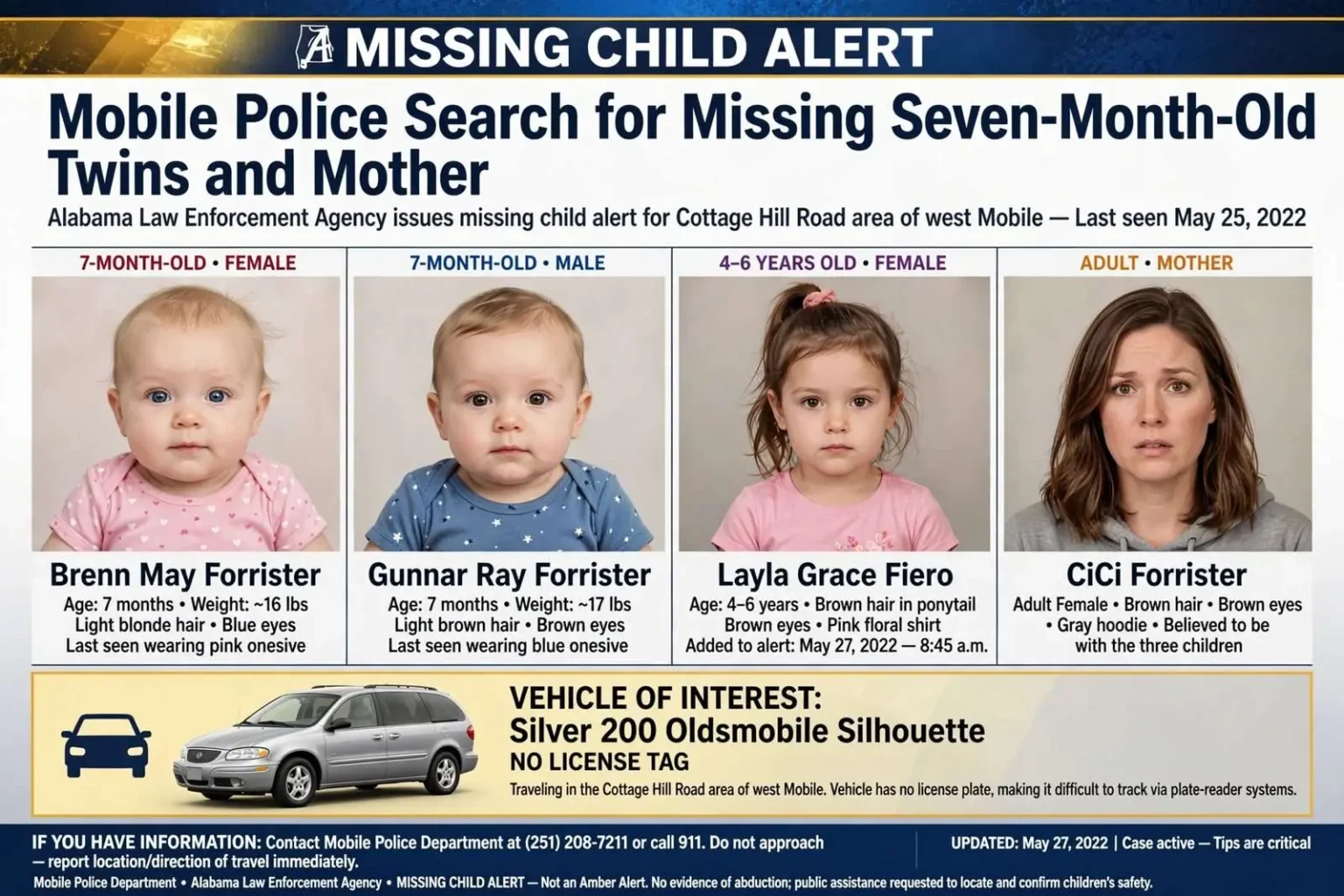
Mobile police and the Alabama Law Enforcement Agency issued a missing child alert for two seven-month-old infants believed to be with their mother in the Cottage Hill Road area of west Mobile. Brenn May Forrister, a seven-month-old white female, and Gunnar Ray Forrister, a seven-month-old white male, were last seen on May 25, 2022, near Cottage Hill Road, a busy east-west corridor that threads through one of the city’s largest residential districts.
Authorities believe the children are with their mother, CiCi Forrister, and may be traveling in a silver 200 Oldsmobile Silhouette with no license tag. The tagless vehicle drew particular attention from investigators because a car without a plate is difficult to track through the routine license-plate-reader systems many departments rely on, which flag vehicles of interest by registration rather than by make and model alone.
The children’s father, who lives out of state, told police he had not seen the twins since Tuesday, May 24, and filed a report on May 27 after being unable to make contact with the family. That gap between the last confirmed sighting and the formal report shaped the early hours of the investigation, as detectives worked to establish a timeline of the family’s movements around the Cottage Hill Road area and to confirm who had seen the children and when.
An MPD news release stated there was no indication the children were in danger, but officers were actively trying to locate them. The distinction matters in how a case moves forward: when there is no evidence of an abduction or immediate harm, police generally handle an episode as a missing or unlocated child case rather than invoking an Amber Alert, which requires a confirmed abduction and a credible threat of serious bodily harm before it can be activated.
Instead, the department turned to the missing child alert framework administered through the Alabama Law Enforcement Agency. That system allows information about a missing child to be pushed to media outlets across the state, posted to official alert channels and circulated among law enforcement agencies from one county line to the next. The threshold is lower than that of an Amber Alert, but the effect is similar in one important respect: it puts a detailed description of a child in front of thousands of eyes within hours of a report being filed.
Cottage Hill Road anchors a section of west Mobile that blends older subdivisions, apartment complexes, churches and commercial strips, stretching east toward Spring Hill and west toward the Theodore and Tillmans Corner communities. The area’s sheer size, and the web of residential cut-through streets that connect its neighborhoods, can complicate a door-to-door canvass, which is one reason investigators leaned on the public early and often for any sighting of the vehicle or the family.
In an update issued at 8:45 a.m., Mobile Police expanded the search to include a third child — a girl between the ages of four and six named Layla Grace Fiero. The addition of an older child changed the scope of the search, broadening the description of the group officers were trying to find and giving the public one more set of details to keep in mind.
Investigators also released a photograph of the mother to aid the public in identifying her. Publishing an image of an adult in a case where no crime had been confirmed is an unusual step, and it signaled how determined the department was to have the public help simply locate the family and confirm that all three children were safe and well cared for.
How missing child alerts work in Alabama
Alabama’s alert structure is built around rapid, tiered distribution. Once a local agency such as Mobile police determines that a child is missing and enters the child into the National Crime Information Center database, the case can be elevated through the Alabama Law Enforcement Agency to a statewide alert. That step triggers notifications to broadcasters, bulletins to patrol officers across county lines and, in many cases, rapid sharing on official social media channels that reach far more people than a single department’s own following.
The tiers matter because each carries different legal requirements. An Amber Alert, the most urgent tier, demands reasonable evidence that a child has been abducted and faces imminent danger of serious injury or death, along with enough descriptive information to make public assistance meaningful. Missing child alerts, by contrast, cover cases where a child’s whereabouts are unknown but no abduction has been established — a category that frequently includes family situations like the one police described in the Forrister case.
For officers on the ground, the first hours of such a case are consumed with verification work: confirming the last-known locations of the children, interviewing relatives and neighbors, checking whether any surveillance cameras along Cottage Hill Road or nearby commercial strips might have captured the family’s movements, and documenting a precise vehicle description. Entry into NCIC also ensures that any officer anywhere in the country who runs the vehicle’s make or checks on the family will see the alert flag attached.
Public response typically plays a decisive role in cases of this kind. Tips generated by alerts are funneled to the investigating agency, where detectives cross-reference reported sightings against the movements already documented. Police stressed that even partial information — a glimpse of a vehicle matching the description, or an adult seen traveling with several young children — could help narrow the search area considerably.
The ages of the children themselves shaped the urgency. Infants of seven months depend entirely on adult caregivers for feeding, changing and sleep routines, and pediatric guidance consistently emphasizes how quickly young babies can be endangered by interruptions in care. Detectives treat any case involving children that young as time-sensitive regardless of whether foul play is suspected.
How to help
Anyone with information about the whereabouts of the children or CiCi Forrister was asked to contact the Mobile Police Department at (251) 208-7211 or call 911. Dispatchers route such tips directly to the detectives handling the case, and police urged callers to provide specific details — the location, the direction of travel, and a description of the vehicle and its occupants — rather than general impressions that are hard to act on.
The Mobile Police Department, the largest municipal law enforcement agency in Alabama, handles hundreds of missing person reports in a typical year, and most are resolved quickly once the person is located and confirmed safe. Cases involving infants and small children receive heightened priority under department practice, with officers instructed to verify a child’s welfare in person whenever possible rather than closing a report based on a phone call alone.
What investigators watch for
When children are believed to be with a parent rather than a stranger, investigators concentrate first on welfare rather than on criminality. Officers work to confirm that the children have shelter, formula, diapers and any medications they may require, and that their living situation is stable. Only after a family is located do authorities sort out whether any underlying legal issue — a custody question, for example — needs to be addressed, and departments typically do not speculate about such matters while a search is underway.
The out-of-state father’s report gave investigators a concrete anchor point: the last confirmed contact with the twins was May 24, when he last saw them. From that point detectives built backward, seeking witnesses along Cottage Hill Road and the surrounding streets who might have seen the silver Oldsmobile Silhouette without a tag during the days between the last sighting and the filing of the report on May 27.
Police also cautioned the public about how the timeline might unfold. Alerts are canceled once a family is found, and departments generally release few further details about the circumstances unless charges are filed or an ongoing safety concern exists. In cases like this one, the stated objective was deliberately narrow — find the children, confirm that they are unharmed, and bring the alert to a close.
A community on watch
For residents of west Mobile, the alert turned an ordinary late-May week into an exercise in community vigilance. Neighborhood social media groups passed along the descriptions of the twins, their older sister and the tagless silver vehicle, and businesses along the Cottage Hill Road corridor kept an eye on their parking lots. That kind of grassroots attention is precisely what the state’s alert systems are designed to generate, and detectives say such tips routinely shorten searches that might otherwise drag on for days.
As of the most recent update, the case remained active, with Mobile police urging anyone who believed they had spotted the family not to approach the vehicle but to call 911 or the department’s tip line immediately. Officials said the fastest way to bring the children home safely was a fast, specific report from a member of the public — a license plate-less car in a driveway, a woman with three young children at a store, or any detail that did not fit.
The department thanked the public for its attention to the alert and reiterated that the tip line at (251) 208-7211 would remain the central channel for information. In the meantime, the descriptions of Brenn May Forrister, Gunnar Ray Forrister and Layla Grace Fiero remained in circulation across the region, carried by the same alert network that Alabama agencies have refined over two decades of missing-child cases.


