
Mobile police seek person of interest in December West Mobile house fire
Mobile Fire-Rescue is asking for help identifying a person of interest near a West Mobile home that caught fire Dec. 14.
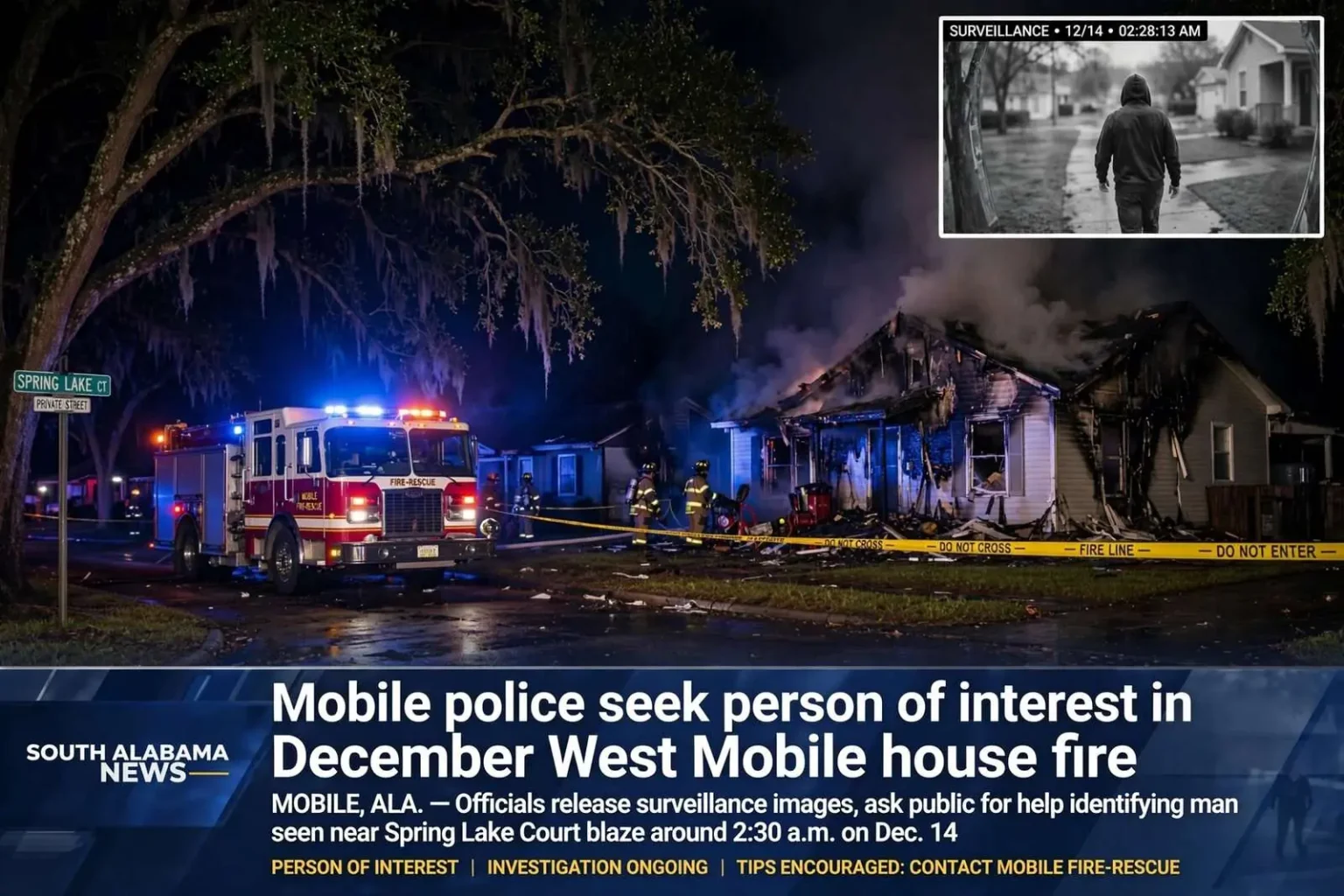
MOBILE, Ala. — Mobile Fire-Rescue is asking for the public’s help identifying a man who may assist in the investigation of an overnight house fire in December. Surveillance photos show a man walking near a home on Spring Lake Court, off Old Government Road in West Mobile, in the early morning hours of Dec. 14. Fire crews responded to a blaze at a Spring Lake Court residence around 2:30 a.m. that morning, and investigators have spent the time since working to determine how the fire started.
Mobile Fire-Rescue released the surveillance images in hopes that someone in the neighborhood — or anyone who recognizes the man pictured — will come forward with information. Officials stopped short of calling the man a suspect, describing him instead as a person of interest who may assist investigators in understanding the events leading up to the fire. The distinction matters: investigators frequently seek to speak with people seen near a fire scene in its final minutes, and a person spotted on camera in the early hours around a burning home may simply be a witness with information that helps piece the timeline together.
The fire broke out around 2:30 a.m. at a residence on Spring Lake Court, a short residential street that branches off Old Government Road in West Mobile. Crews responded during the pre-dawn hours and worked the scene while most of the surrounding neighborhood slept. Details about injuries, the extent of the damage, and whether anyone was displaced were not included in the initial request for help from the public.
The neighborhood and the response
Spring Lake Court sits in the West Mobile corridor, an area of the city characterized by established subdivisions, mature trees, and convenient access to the commercial strips along Airport Boulevard and Schillinger Road. Old Government Road itself is one of the older roadways in western Mobile County, tracing a route that predates much of the modern development around it. The neighborhoods in this part of the city are largely residential, with homes set on modest lots and drainage canals and wooded tracts interspersed between the streets.
A 2:30 a.m. house fire presents particular challenges for responding crews. Darkness slows the visual size-up that firefighters perform on arrival, and sleeping residents may not be awake to meet crews at the curb and confirm whether anyone is still inside. Firefighters arriving in the pre-dawn hours must search the structure as a precaution even when no one is reported home, advancing hose lines and forcing entry while working with limited visibility of the building’s layout.
Mobile Fire-Rescue operates from stations spread across the city precisely so that engine and ladder companies can reach addresses like Spring Lake Court within minutes, regardless of the hour. The department handles structure fires, medical calls, and rescue operations across Mobile’s jurisdiction, and its investigators — the fire marshals who work origin-and-cause cases — typically begin their work at the scene in the hours after the flames are knocked down, well before the public ever hears about the case.
How fire investigators work a case like this
Once a fire is extinguished, the investigation begins with the physical evidence. Origin-and-cause investigators examine burn patterns on walls, floors, and ceilings to trace the fire back to its point of origin, then work outward from that point to identify what ignited and why. Electrical appliances, heating equipment, and human activity all leave distinguishable signatures in the wreckage, and the difference between an accidental fire and an intentionally set one often comes down to carefully documented patterns and laboratory analysis of debris samples.
When investigators cannot immediately rule out a human cause, the case expands beyond the physical scene. Surveillance cameras from homes and businesses near the fire become central evidence, and investigators canvass neighbors for anyone who saw vehicles, foot traffic, or unusual activity in the hours around the blaze. That is the stage where a case like the Spring Lake Court fire enters the public eye — with a request for help identifying someone captured on camera near the scene.
Mobile Fire-Rescue’s decision to release the surveillance photos reflects a standard investigative technique. Camera networks in residential areas have expanded dramatically in recent years, with doorbell cameras and home security systems recording neighborhood activity around the clock. Reviewing that footage gives investigators a way to reconstruct the timeline of a fire: who arrived, who left, and when. A man walking near a burning home in the early morning hours of Dec. 14 may have seen something — a vehicle, a sound, another person — that anchors that reconstruction.
When investigators cannot immediately rule out a human cause, the case expands beyond the physical scene. Surveillance cameras from homes and businesses near the fire become central evidence, and investigators canvass neighbors for anyone who saw vehicles, foot traffic, or unusual activity in the hours around the blaze. That is the stage where a case like the Spring Lake Court fire enters the public eye — with a request for help identifying someone captured on camera near the scene.
Mobile Fire-Rescue’s decision to release the surveillance photos reflects a standard investigative technique. Camera networks in residential areas have expanded dramatically in recent years, with doorbell cameras and home security systems recording neighborhood activity around the clock. Reviewing that footage gives investigators a way to reconstruct the timeline of a fire: who arrived, who left, and when. A man walking near a burning home in the early morning hours of Dec. 14 may have seen something — a vehicle, a sound, another person — that anchors that reconstruction.
The request also illustrates the practical distinction fire departments draw between a person of interest and a suspect. A suspect is someone investigators believe committed a crime. A person of interest is someone whose presence near the scene raises questions investigators want answered — nothing more. In dozens of cases nationally, people identified through surveillance near fire scenes have turned out to be neighbors letting dogs out, delivery drivers on early routes, or residents who fled the home and walked away in shock. Public cooperation in identifying such individuals is what allows investigators to close those questions quickly and focus resources where they belong.
For West Mobile residents, the ongoing investigation is a reminder of how fire cases differ from other criminal investigations. A fire destroys the very evidence that would otherwise tell investigators what happened, so the case is built from what survives — structural patterns, debris analysis, camera footage, and witness recollection. Every additional person who comes forward with even a fragment of information can change the direction of the investigation.
Why public help matters in fire cases
Fire investigators across the country rely on tips to resolve a substantial share of their undetermined-cause cases. National fire statistics have long shown that a meaningful percentage of structure fires each year are classified as having undetermined causes, and a portion of those are later resolved — in either direction — when witnesses come forward. A tip can just as easily clear an innocent explanation as it can expose an intentional act, and both outcomes serve the investigation.
Anyone who recognizes the man in the surveillance photos, or who was in the Spring Lake Court area in the early morning hours of Dec. 14, is encouraged to contact Mobile Fire-Rescue’s investigators. Tips in fire cases can also be submitted through the department’s general lines or the city’s crime-prevention channels, and people who prefer to remain anonymous can do so while still providing usable information — the location, the time, and what was seen.
Residents of the neighborhood who have home security cameras were also encouraged to review their own footage from that morning. Recordings from doorbell cameras, driveway cameras, and vehicle dashcams frequently capture details that the department’s own surveillance does not — vehicles parked on the street, direction of travel, and timestamps that help investigators synchronize the timeline. A voluntary review of Dec. 14 footage by area residents could add materially to the case file.
Fire safety context for the community
Regardless of how the investigation concludes, the Spring Lake Court fire is part of a wider picture of residential fire risk in Mobile. The city and its surrounding county record dozens of residential structure fires in a typical year, with the highest concentration during the winter months when heating equipment is in use and holiday cooking and decorations add to the load. Pre-dawn hours are statistically the deadliest time for house fires, because sleeping residents have the least awareness of developing danger and smoke alarms may be missing, disabled, or silent due to dead batteries.
Fire officials use cases in the public eye to reinforce the basics: working smoke alarms on every level of the home, an escape plan practiced by every member of the household, and a commitment to calling 911 immediately rather than attempting to investigate a suspected fire personally. Neighborhood awareness also plays a protective role — residents who notice and report unusual activity, lingering smoke, or a burning smell at a neighbor’s home have saved lives in communities across the Gulf Coast by triggering early responses.
Mobile Fire-Rescue has not said whether the Spring Lake Court fire remains classified as undetermined, accidental, or suspicious, and no charges have been announced in connection with the case. The department’s request for help identifying the man in the surveillance photos remains active, and investigators have indicated they will follow the evidence wherever it leads.
South Alabama News will continue to follow this story and provide updates as Mobile Fire-Rescue releases additional information.


