
Mobile Psychedelic Outfit 20,000 Leagues Under the Sea Reunites for Blind Mule Show
Mobile psychedelic collective 20,000 Leagues Under the Sea reunites for a Feb. 28 show at the Blind Mule, five months after its 2013 breakup.
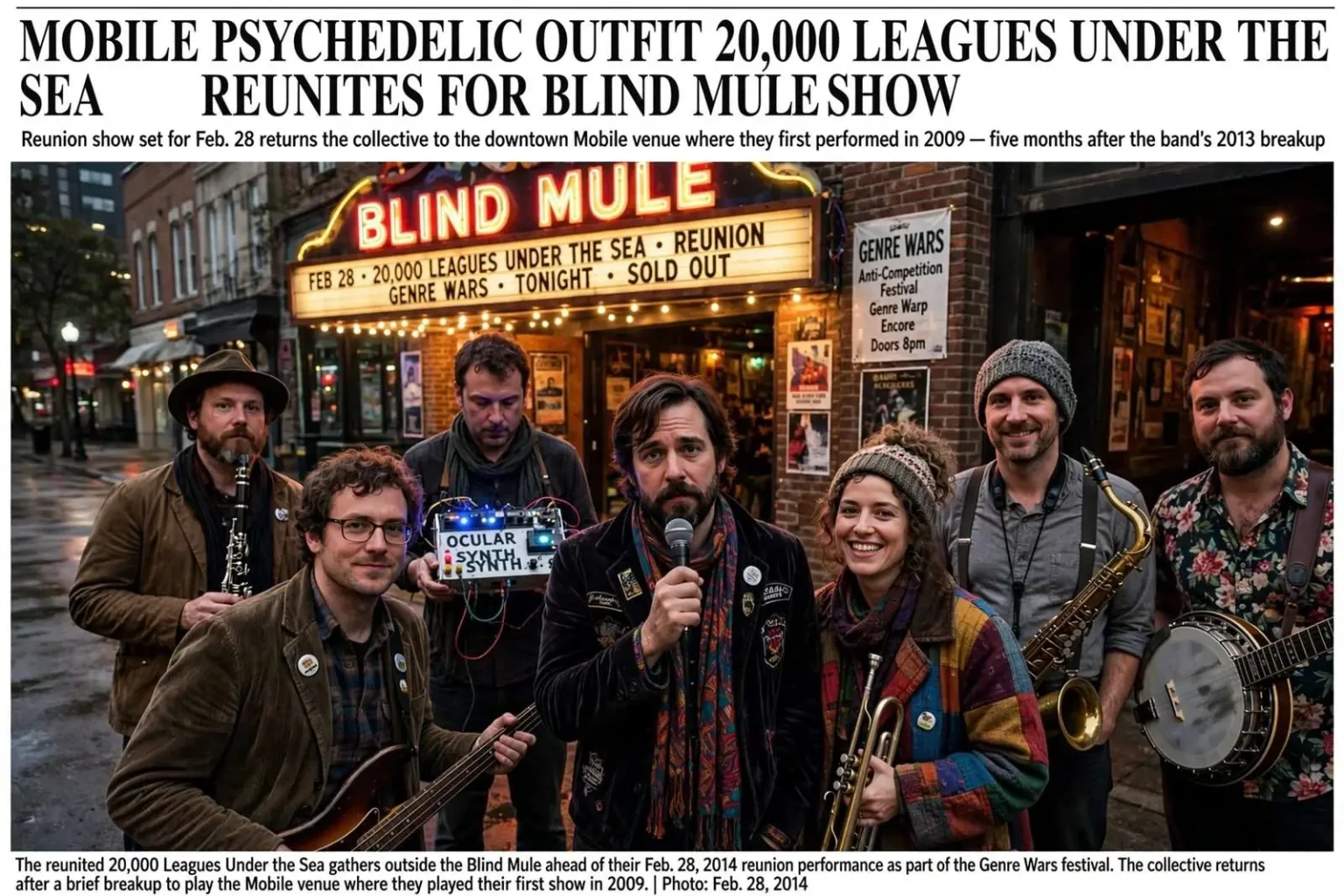
Word that Mobile psychedelic collective 20,000 Leagues Under the Sea was re-forming barely five months after the band’s reported 2013 breakup turned out to be true — and the reunion show was booked for the same room where it all started. Bandleader Nemo Simulacra confirmed the comeback in a Q&A ahead of the February 28, 2014 date at the Blind Mule, the downtown Mobile venue that hosted the band’s very first show back in 2009. Five years, some twenty members and a reported breakup later, the collective was returning to the beginning.
The split, Simulacra explained, came down to logistics as much as music. When the band’s booking handler — his partner at the time — left the picture, he assumed he couldn’t carry on. The band’s whole apparatus, from gigs to rehearsals, had run through that one working relationship, and without it the bandleader treated the project as finished. He launched a new project, Electric Sheep, as an outlet and quickly discovered he had a knack for booking; within months Electric Sheep was playing nearly every weekend, with gigs reaching New Orleans, Austin and Birmingham.
But the songs kept pulling him back. Revisiting the band’s “Patchwork” album, he decided walking away would shortchange the work he, Jonathan and Alan had put into it. “As long as I can open my mouth and make a sound, 20,000 Leagues will be a band,” he said. The line, delivered in the Q&A ahead of the reunion date, doubled as the collective’s new operating principle — a commitment that the band exists wherever its leader and whoever answers the call can make it exist.
He reached out to Jonathan, original bassist Douglas and Alan — “Let’s do it” — and everyone signed on for what he described as new “psychedelic garage jazz” endeavors with more theatrics and wilder stylistic blending than before. The self-description is as good a map to the band’s sound as any: psychedelic in texture, garage in energy, jazz in the freedom it grants its players to wander. The promised theatrics pointed toward a live show with more staging and costume than the band had attempted in its first incarnation.
A Rotating Cast of Twenty
In its first five years the collective cycled through some twenty members and countless guests, including Donna and Jimmy Hall of Mobile rock legends Wet Willie. The Halls’ involvement tied the band to one of the city’s proudest rock lineage — Wet Willie rose out of Mobile in the 1970s to national success with its Southern rock and R&B blend, and Jimmy Hall’s voice remains one of the region’s signature instruments. Guests of that caliber dropping into a psychedelic collective’s shows said much about the band’s standing in the local scene: players showed up because the room invited improvisation.
The roster ran from guitars, bass and drums to saxophone, clarinet, trumpet, french horn, banjo, trombone, organ — and a homemade “ocular synth.” The homemade instrument, built for the band’s stage show, marked the difference between 20,000 Leagues and the average Mobile bar band: an outfit that invents its own gear has left the cover-band economy behind entirely. With a horn section, reeds, keys and strings all rotating through the lineup, the collective’s performances resembled the mutating jams of the psychedelic tradition more than set-list rock.
Simulacra stayed prolific throughout, constantly writing and issuing limited-run demo CDs under the name 12 Ghosts — small pressings of about fifteen copies each, with the strongest material flowing to whichever project fit. The 12 Ghosts archive functioned as the band’s songbook: demos pressed in handfuls, distributed to friends and bandmates, and mined for material when a project needed songs. It is the kind of parallel catalog that underground musicians build when the demand for recordings is small but the flow of writing never stops.
Genre Wars Comes to the Blind Mule
The February 28 homecoming at the Blind Mule doubled as part of Genre Wars, the traveling “anti-competition” festival that asks bands to reveal an unseen side of themselves, capped by a “Genre Warp” encore in which artists take on the tunes — and sometimes the personas — of an entirely different genre. For a band that never held still stylistically, the format fit: 20,000 Leagues’ whole history was an argument that genres are something to be crossed, not guarded, and the festival’s premise handed them a stage designed for exactly that.
The Blind Mule, a downtown Mobile venue known for its small room and its loyalty to local original acts, had hosted the collective’s first show in 2009, and the booking closed a circle the band could not have scripted better. Mobile’s original-music scene has always run on rooms like it — intimate stages where a twenty-member collective can squeeze in, and where the audience stands close enough to be part of the show. Reunion or not, a 20,000 Leagues date at the Mule was, by definition, a full-house night for the scene that grew up around the band.
The timing made the reunion itself a small local story. Five months is not long for a band to be “broken up,” and the turnaround suggested that the December reports of the split had reflected the collapse of the band’s booking arrangement more than any musical falling-out. Simulacra’s Q&A made that explicit: the songs never stopped, the writers never dispersed, and once the right people said yes, the collective simply picked up where the first incarnation ended.
What “Psychedelic Garage Jazz” Sounds Like
The band’s genre-blending is more than a billing. With a rhythm section at its core and horns, reeds and keys layered on top, 20,000 Leagues’ arrangements can stretch from a two-chord garage stomp into horn-driven jazz figures and back within a single song, guided by whoever is soloing and however long the room lets it run. The homemade ocular synth added an electronic gurgle to the mix, and the theatrics — costumes, staging, and a bandleader committed to performance as spectacle — pushed the shows closer to happening-art than concert.
The collective model also explains the depth of the reunion lineup. When a band has cycled through twenty members, a reunion call does not need to find the perfect personnel; it needs enough of the alumni to say yes at the same time. Simulacra’s “Let’s do it” reached Jonathan, Douglas and Alan, and with the core committed, the wider family of past members and guests — the orbit that once included the Halls of Wet Willie — stood ready to drop in as the date approached.
For Mobile audiences, the February 28 show offered a first look at what the bandleader promised would be wilder and more theatrical than the version of the band that existed before the breakup — and, for the Blind Mule, another chapter in its run as the room where the band began, broke and reassembled. Whether the new “psychedelic garage jazz” endeavors would grow into another five years of rotating lineups, limited-run demos and genre-warping shows was, as of the date’s announcement, exactly the question the reunion was staged to answer.
Electric Sheep and the Booking Detour
The detour through Electric Sheep turned out to be more than a placeholder. Playing nearly every weekend — with runs reaching New Orleans, Austin and Birmingham — taught the bandleader the booking side of the business from the inside, the knowledge that had seemed to vanish when the band’s handler left. Austin and Birmingham in particular put the project in front of scenes that trade on psychedelic and garage sounds, and the steady weekend schedule kept Simulacra performing through the months when 20,000 Leagues was officially off the books. By the time the reunion call went out, the bandleader was running his own bookings — the missing piece that had ended the band in the first place.
The 12 Ghosts demos filled the gap on the recording side. Pressings of about fifteen copies each will never chart, but the format suited the material: rough, immediate documents of songs that existed to be tried out, not polished. Mobile has long supported that kind of underground catalog — the Gulf Coast’s bar circuits have produced decades of bands whose recordings circulated hand to hand — and the strongest 12 Ghosts tracks migrating into whichever project fit them meant the songs stayed in play rather than sitting on a shelf.
Mobile’s Psychedelic Tradition
20,000 Leagues grew up in a city with deep musical roots to draw on. Mobile’s scene has produced national acts — Wet Willie chief among them — while sustaining a club circuit where blues, Southern rock, jazz and carnival-season spectacle all coexist. A psychedelic collective with a horn section and a homemade instrument could only have taken shape in a town where audiences expect music to be entertaining in every sense, and the band’s mix of improvisation and theatrics owes as much to Mardi Gras tradition as to the psychedelic canon.
The Blind Mule’s role in that scene made it the natural reunion site. Downtown rooms that book original acts are the infrastructure of a city’s music culture — they are where bands form, break up and re-form — and the Mule’s five-year history with the collective spanned the band’s whole arc, from first show to breakup to comeback. For the February 28 date, the room’s size also guaranteed intensity: a twenty-member lineup with horns, reeds and a homemade synth would fill it to the walls.
The reunion’s premise — new endeavors with more theatrics and wilder stylistic blending — set expectations for a second act rather than a nostalgia exercise. The “Patchwork” album that pulled the bandleader back remained the band’s recorded centerpiece, but the Q&A framed the future in terms of new material and new staging, with the Genre Wars format as the proving ground. Mobile’s scene had seen the band’s first five years; the February 28 show was the first page of whatever came next.


