New Concessionaire Bets $1.5 Million on Mobile Regional Airport Dining
The Hudson Group agreed to spend $1.5 million rebuilding food service at Mobile Regional Airport, replacing a predecessor criticized for shutting down while passengers were still in the terminal.
Travelers passing through Mobile Regional Airport were promised a considerably better meal in the summer of 2006, as airport officials confirmed that food and beverage service at the terminal would change hands after years of complaints about the incumbent operator.
The Hudson Group, a privately held concessions company based in East Rutherford, New Jersey, won a competition earlier in 2006 to replace The Compass Group, a United Kingdom-based operator whose Mobile performance had drawn persistent criticism. Among the most frequent complaints was that Compass sometimes shuttered its counters while passengers were still waiting inside the terminal, leaving travelers with delayed flights and no place to buy so much as a sandwich.
The complaint was small on its face and large in practice. An airport terminal is a captive market: passengers who have cleared parking, check-in and security have nowhere else to buy a meal, and a food counter that closes while the departure board still shows delays converts a minor inconvenience into the defining memory of a trip. For business travelers — the passengers a mid-sized commercial airport most needs to keep — those experiences accumulate into a reputation that the entire region inherits.
Airport concession changes are rare events, driven by contracts measured in years rather than seasons. When they happen, they usually happen for exactly the reasons that surfaced in Mobile: an incumbent whose service declined, an airport authority attentive to passenger complaints, and a competitive process that let new operators bid on the chance to replace them. The 2006 competition gave Mobile’s airport the leverage to demand more than it had been getting.
A $1.5 million rebuild
Hudson committed to spending roughly $1.5 million upgrading facilities at the airport, a substantial investment for a mid-sized regional field. The company was not a stranger to the property: it already operated the airport’s 1,515-square-foot news and gift shop, giving it a foothold and a track record with airport management before the concessions contract came up for bid.
That incumbency in the newsstand business was a quiet advantage. Hudson’s retail operation had already demonstrated its reliability at Mobile Regional — hours kept, shelves stocked, revenue reported — and airport boards weighing concession bids place heavy weight on exactly that demonstrated performance. A bidder with a proven record on the property is a known quantity; a bidder from out of town with no local history is a gamble that requires a premium price to justify.
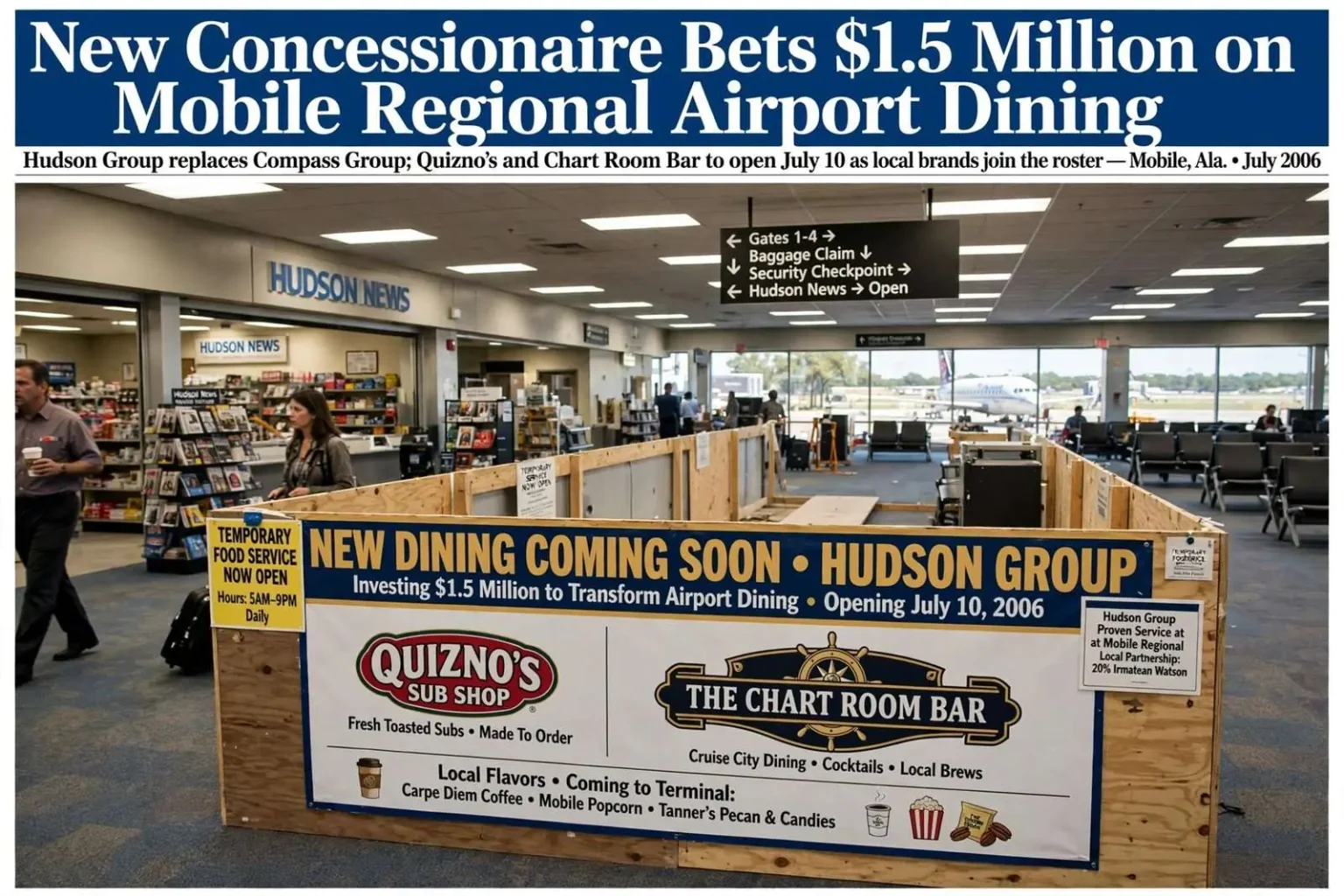
The centerpiece of the first phase was a Quizno’s Sub Shop and a Chart Room Bar, both scheduled to open Monday, July 10, 2006. Because permanent construction would take roughly two months, Hudson planned to operate out of temporary facilities in the interim rather than leave the terminal without service during the build-out.
The interim arrangement was the direct answer to the complaint that had driven the change. An operator that closed its counters during the transition would have recreated, for a season, the very problem the changeover was meant to fix. Temporary service kept food available from the first day of the new contract, even if the surroundings were unfinished, and signaled that the new operator’s first commitment was availability rather than décor.
When finished, the Quizno’s, the Chart Room and Hudson News were expected to occupy about 1,830 square feet of the terminal.
The Chart Room name was a deliberate piece of regional branding — a nod to the nautical culture of a port city, rendered as a bar theme. In the vocabulary of airport concessions, such touches matter: they turn a generic drink counter into a place with a story, and they give visiting business travelers one small, memorable piece of the city they just left.
Local flavor written into the plan
Notably, Hudson did not intend to fill the terminal entirely with national brands. The company arranged for several local companies to offer their specialties alongside the chain outlets, including: Carpe Diem, the Mobile coffee house; Mobile Popcorn; and Tanner’s Pecan and Candies.
That decision reflected a broader shift then under way in American airport concessions, as operators began recognizing that travelers wanted a taste of the city they were visiting or leaving rather than the same food court they could find in any terminal in the country.
The shift had practical roots. Nationwide concession consolidations in the 1990s had filled American terminals with interchangeable chains, and by the mid-2000s both airports and passengers had soured on the uniformity. The airports that rethought their programs — Seattle, Baltimore and a handful of others led the trend — discovered that local brands outperformed both in sales and in reputation, and the national operators responded by building local partnerships into their bids. Hudson’s Mobile plan followed the model: the national operator provided management expertise and capital, while the local brands supplied the character.
The local choices were also commercially sensible. A Mobile pecan-and-candy company and a local coffee roaster sell products travelers can take on the plane — gifts, in effect — which gives the terminal a retail function beyond the meal. Mobile Popcorn and Tanner’s Pecan and Candies were in the souvenir business whether anyone called it that or not, and Carpe Diem’s coffee gave morning travelers a local cup instead of a national one.
For the small businesses involved, an airport concession is a contract unlike any other storefront: steady captive traffic, a professional landlord, and the kind of brand exposure a local shop could never otherwise buy. The arrangement put three Mobile names in front of every departing passenger, whether that passenger lived in Mobile or was visiting it for the first time.
A second phase beyond security
A second phase was slated to begin in mid-September 2006, again starting in temporary quarters, this time near the gate area beyond the security checkpoint. That location mattered a great deal in the post-2001 travel environment: with passengers arriving earlier and screening lines growing longer, concessions on the secure side of the checkpoint had become far more valuable than those in the public lobby.
The security rules adopted after the September 2001 attacks had redrawn the economics of airport food. Before then, passengers could eat in a lobby restaurant and walk to the gate; afterward, everything from water bottles to full meals had to be purchased inside the secure area, because the screening line had become a one-way boundary. An airport with concessions only in the public lobby was, in effect, serving a diminishing share of its own traffic.
The gate-side offering was to include a Cruise City Bar and Grille and a Carpe Diem Cafe in roughly 1,430 square feet. Construction of the permanent units in that phase was expected to take about three months.
The second phase’s names continued the regional theme. The Cruise City Bar and Grille claimed Alabama’s cruise-port identity for a dining room, and the Carpe Diem Cafe extended the local coffee house’s reach to the gate area — the location where a delayed traveler, unable to leave the secure side, most needed a reliable cup. Together the two units more than doubled the food available past the checkpoint, which is where the airport’s passenger hours were actually spent.
The phasing plan — temporary service first, permanent construction behind it — followed the pattern of the first phase and reflected a concession operator’s cardinal rule: revenue continuity. Food and beverage contracts are scored on sales against projections, and a program that closes for months of construction cannot make up the shortfall later. Building around a live operation is harder and slower, but it protects the passenger experience and the contract’s financial baseline at the same time.
A local ownership stake
The arrangement also carried a local ownership component. Irmatean Watson, who served on the Mobile City Council from 1985 to 1993, was listed as a local entrepreneur holding a 20 percent ownership interest in Hudson’s program at the Mobile airport.
Such local participation requirements were common in airport concession agreements of the era, intended to keep a share of terminal revenue in the hands of businesspeople from the community the airport serves.
The rationale behind such clauses was part economic and part political. Airports are public assets built on public land with public financing, and their concession programs are among the few reliable streams of local business revenue attached to them. Requiring or incentivizing local ownership keeps some of that revenue circulating in the community and gives the airport’s oversight boards a stakeholder who answers directly to local business constituencies. Watson’s civic background — eight years on the city council representing Mobile’s districts in the late 1980s and early 1990s — made her participation a bridge between the airport’s management and the city’s political leadership.
The 20 percent stake also illustrated how modern concession programs are financed and structured. The national operator brings systems, purchasing power and staffing; the local partner brings community knowledge, political goodwill and a share of the risk. Hudson’s Mobile program bundled both, in a structure that airport authorities across the country had come to expect.
A long commitment
The concessions contract spanned 15 years, a term long enough to justify the capital Hudson was putting into the terminal and long enough to make the selection consequential for a generation of Mobile travelers. At the time, The Hudson Group operated shops in more than 60 airports across North America.
Fifteen years is a long tenure in airport retailing. The term’s length did two things at once: it amortized Hudson’s $1.5 million investment over a horizon in which the capital could actually be recovered, and it bound Mobile Regional’s passenger experience to the operator’s standards for that entire period. A concession contract of that length is effectively a lease on a city’s front door, which is why selection processes are competitive, deliberated and occasionally contentious.
For Mobile, the change came at a moment when the region was working hard to present itself as a serious business destination. The Port of Mobile was expanding, European aerospace interests were establishing a presence in the city, and civic leaders were keenly aware that for many visitors the airport terminal was the first and last impression of the region. A concessions program that closed early and left passengers hungry undercut that message. A $1.5 million investment, a local coffee roaster and a bar named for the cruise trade sent a rather different one.
The aerospace reference pointed to the European defense and aerospace consortium then circling Mobile — a courtship that would eventually deliver one of the largest industrial projects in Alabama history, and that put the city’s airport on itineraries for executives, engineers and government officials from Europe. Every one of those visitors ate, or failed to eat, at Mobile Regional. The terminal’s food program was, in that light, part of the region’s industrial recruiting apparatus — unglamorous, invisible in economic development brochures, and quietly decisive in the impression a city makes on the people deciding whether to invest in it.
By the time the second phase opened past the checkpoint that fall, Mobile Regional’s concession program had been rebuilt end to end: a newsstand with a proven operator, a hot food and bar program in the lobby, a gate-side restaurant and cafe, three local brands on the shelves, a local owner at 20 percent, and fifteen years of runway to prove the overhaul had been worth it. The complaints that forced the change had a simple shape — closed counters, hungry passengers — and the answer Mobile chose had a simple shape too: keep everything open, spend real money, and let the terminal taste like the city it serves.