
Mobile Residents Can Now Text City Hall Questions Through New Service
City of Mobile launches TextMyGov, a 24-hour texting service where residents can ask questions about trash pickup, city projects and services via SMS.
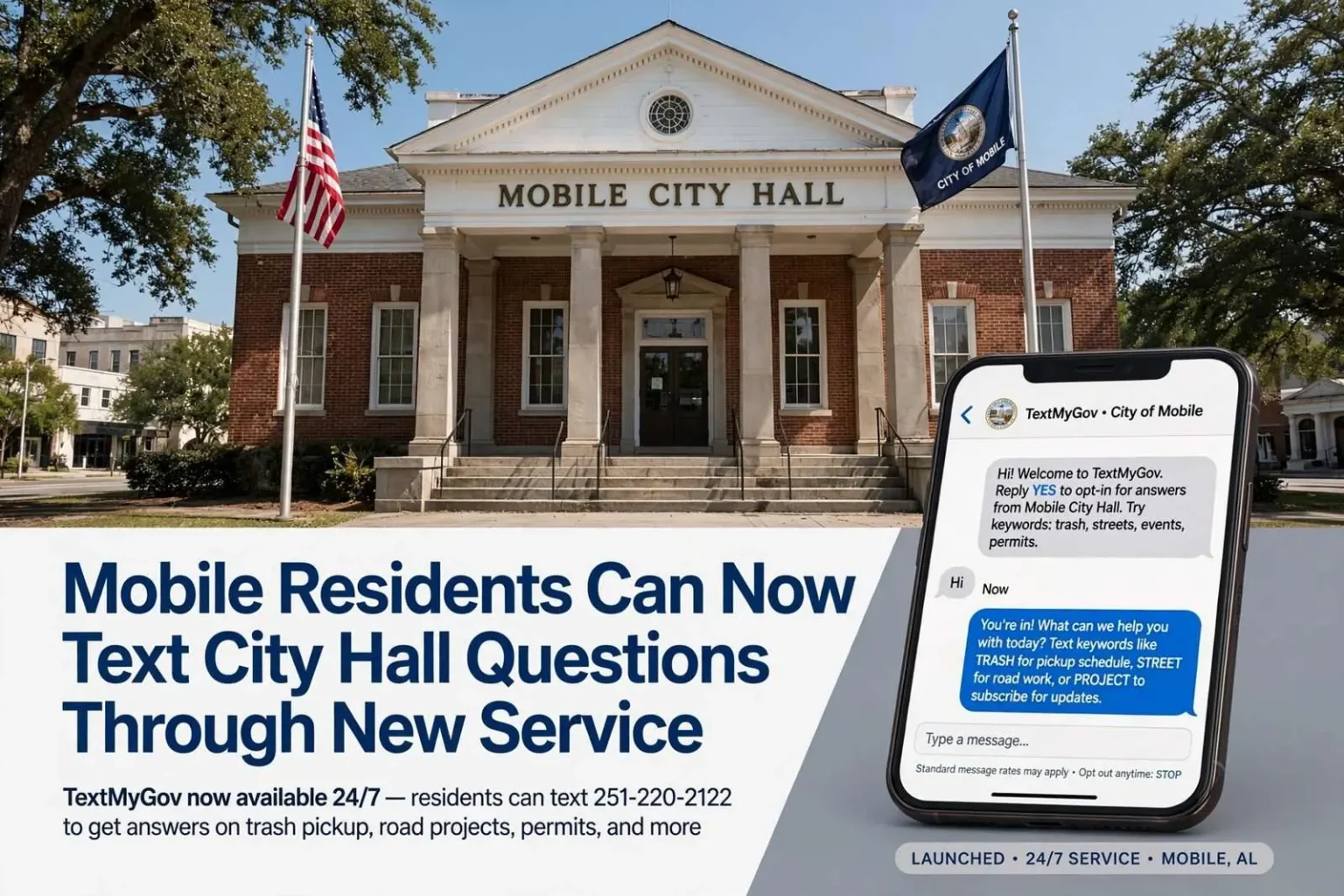
Getting answers from Mobile city government now starts with a text message. The City of Mobile rolled out TextMyGov, a texting service that lets residents ask questions and receive updates on city events, projects and services directly on their phones. The system is available around the clock, allowing Mobilians to submit questions or service requests at any hour without calling a department or navigating the city website.
The launch placed Mobile among a growing number of cities using automated texting platforms to close the gap between residents and municipal government. For callers who have grown frustrated with phone trees, hold times and business-hours limits, the appeal is straightforward: a question typed into the same messaging app they already use, answered by an automated system that recognizes what is being asked and points to the right information or the right department.
How It Works
To get started, residents text “Hi” to 251-220-2122 and reply YES to a confirmation message that verifies their opt-in. From there, the platform recognizes keywords in incoming texts — someone typing “trash,” for example, gets connected immediately with trash collection routes, schedules and rules from the city. The keyword-driven design means residents do not need to know which department handles a given issue; the system routes the question based on the words in the message.
Residents can also subscribe to regular text updates about specific major projects and other areas of interest, with pre-built notification lists already available to join. That subscription model turns the service into more than a question-and-answer line: a homeowner following a road construction project, or a business owner tracking a downtown initiative, can opt in and receive updates as the city posts them, without checking a website or waiting for a press release.
“We want to make it as easy as possible for Mobilians to get the information they need and keep track of things impacting their neighborhoods and businesses,” Mayor Sandy Stimpson said. “We have some major initiatives underway right now, and text updates are a simple and straightforward way to stay up to date on them.”
City officials say they will keep tuning the system so it can answer questions more efficiently over time. As more residents use the service, the keyword library and response content can be refined to cover the questions people actually ask, a process that typically improves an automated platform’s usefulness within months of launch. Council President C.J. Small called the service vital for communicating with constituents and giving citizens a direct line to answers on their cell phones.
Why the city is turning to texting
Text messaging has become one of the most reliable ways to reach residents across age groups, and municipal governments that have adopted similar platforms generally report higher engagement than they get through websites or phone lines. A text requires no app download, no account creation and no memory of a web address — the number is saved once and stays in the phone. For older residents who may not navigate city websites easily, and for younger residents who rarely call anyone at all, texting sits in the middle as a channel almost everyone uses.
The around-the-clock availability also matters for the kinds of questions that come up outside business hours. A resident standing at the curb on a Monday morning wondering whether trash pickup shifted for a holiday, or a driver wondering why a street is closed, can text at that moment rather than waiting until City Hall opens. City staff, meanwhile, are spared a portion of the routine call volume that consumes phone lines in departments across the building, freeing employees to handle more complex requests.
Mobile’s adoption of the platform fits within a broader push under the Stimpson administration to modernize how residents interact with city government, from online service requests to digital permitting. Major initiatives underway in the city — infrastructure projects, downtown development and neighborhood investments — generate a steady stream of public questions, and officials have repeatedly looked for ways to keep residents informed without requiring them to attend a meeting or call a project manager.
What residents can ask
The keyword system works best with simple, direct terms. Questions about trash collection were among the first examples the city highlighted, but the same approach applies across common municipal topics: sanitation schedules, recycling rules, street maintenance, city events, permits and more. A resident who texts a word or phrase the system recognizes is routed immediately to the relevant information; messages that do not match a keyword can still be received, and the city’s ongoing tuning of the system is aimed at expanding what it can handle automatically.
The council’s role in communication
Council President C.J. Small’s endorsement reflected a concern that runs through every district in the city: constituents expect their council representatives to be reachable and informed, and the volume of routine questions can overwhelm district offices just as it overwhelms department phone lines. A texting platform does not replace a council member’s office, but it gives residents an immediate first stop for the factual questions — schedules, routes, dates, rules — that make up a large share of the inquiries any district office fields.
Small described the service as vital for communicating with constituents, and his framing pointed to the broader shift in how city halls everywhere measure responsiveness. The question is no longer only whether the information exists but whether a resident can get it in the moment they need it. A government website with the answer buried three clicks deep, available only to someone who already knows what to search for, functions differently in practice than a channel that meets residents where they already are — on their phones, in a conversation.
Context: Mobile’s push toward digital city services
The TextMyGov launch arrived as Mobile worked through a period of visible citywide investment. The Stimpson administration has pointed to street resurfacing programs, drainage improvements, park renovations and downtown initiatives as evidence of a city in motion, and each of those programs generates its own stream of public questions about timing, detours and eligibility. Notification lists built into the texting platform give the city a way to push updates on those projects directly to residents who asked to follow them, rather than relying on residents to stumble across the news.
Other municipalities across Alabama and the Gulf Coast have adopted comparable systems in recent years, part of a national wave of local governments using commercial texting platforms to modernize constituent communication. The appeal for mid-sized cities like Mobile is the combination of automation and low friction: the system handles routine, repetitive questions instantly, while anything genuinely complex still flows to the human staff best equipped to handle it. The city’s willingness to keep tuning the platform after launch mirrors the approach those other cities have taken — treating the first rollout as a starting point rather than a finished product.
For residents, the practical takeaway is simple. Save 251-220-2122 as a contact, text “Hi,” reply YES to confirm, and the city is reachable by text from then on. Questions can come at any hour, subscriptions to project updates are a few keystrokes away, and the city has committed to improving the system’s answers over time. City officials have encouraged residents to try it with the same everyday questions they might otherwise phone in, on the theory that every keyword the system learns from real usage makes it more useful for the next person who texts.
The service does not replace 911 for emergencies or the city’s other reporting channels for urgent infrastructure problems, but as a front door for information, it puts Mobile’s municipal government one text away, twenty-four hours a day, for anyone with a phone and a question.
Getting the most out of the service
Residents who want to follow more than one project can join multiple notification lists, and city officials have suggested checking back as new lists are added alongside the major initiatives underway. The pre-built lists mean a resident does not need to know which department owns a project to follow it — choosing the topic is enough, and updates arrive on their own once subscribed.
The confirmation step — replying YES after the first text — matters more than it might seem. The double opt-in verifies that the person holding the phone actually wants the messages, keeps the city’s contact list accurate, and prevents stray numbers from being added without consent. Once that exchange is complete, the number stays opted in until the resident chooses otherwise, and standard message rates from the resident’s carrier are the only cost.
City staff have emphasized that the system improves with use, and that residents should not hesitate to text questions even if they are unsure the platform will recognize them. Keywords the system does not yet know are visible to the city, and each unrecognized phrase is effectively a suggestion for the next round of tuning. Over time, that feedback loop is what turns a generic texting platform into one shaped around the specific concerns of Mobilians — which streets flood, when routes change, where events close roads — rather than a one-size-fits-all script.
The launch also gives the city another channel for time-sensitive notices. Weather disruptions, schedule changes and public safety updates that once depended on press releases and website posts can now reach residents directly, within minutes, on the device they are most likely to be looking at. For a city of Mobile’s size, spread across dozens of neighborhoods from Toulminville to Tillman’s Corner, that immediacy is the quiet advantage that has made municipal texting platforms a fixture elsewhere — and the reason city hall’s newest front door now fits in a pocket.


