
Mobile Restaurants Join ‘Cuisine for Kids’ to Benefit the Child Advocacy Center
Mobile restaurants unite for Cuisine for Kids on Jan. 29, donating proceeds to the Child Advocacy Center, which serves more than 2,400 abused children.
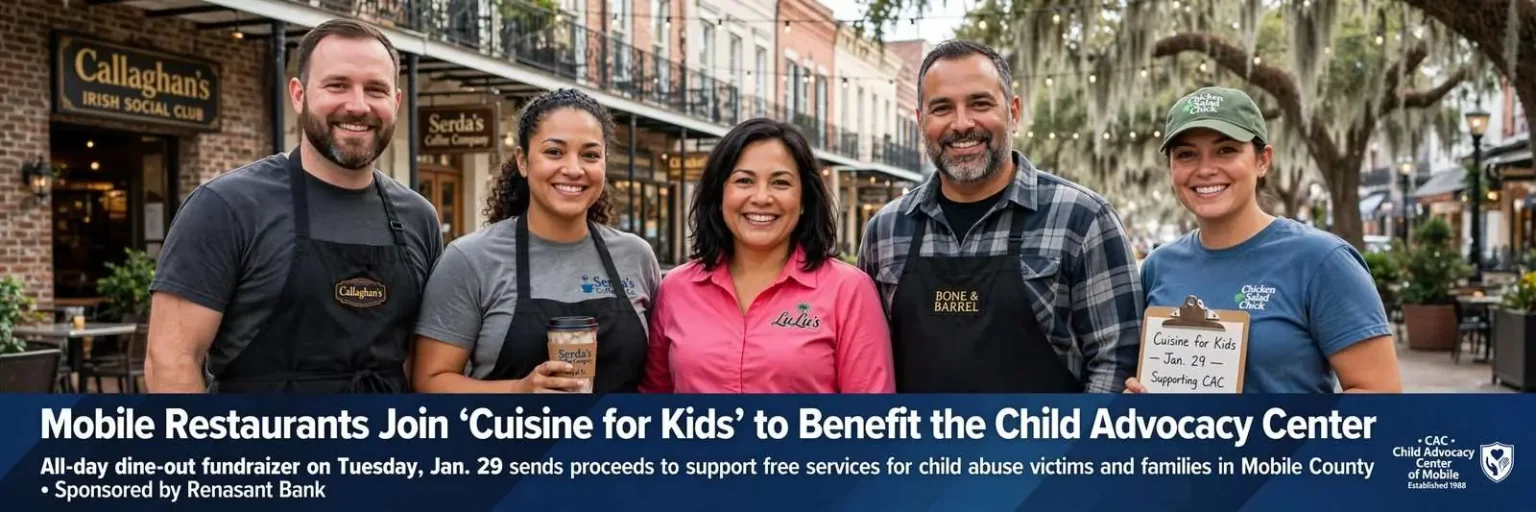
Local restaurants across Mobile are coming together for “Cuisine for Kids,” an all-day fundraising event on Tuesday, Jan. 29, that sends a portion of their proceeds to the Child Advocacy Center (CAC) of Mobile. The event is sponsored by Renasant Bank, and it turns an ordinary Tuesday of breakfasts, lunches, and dinners into direct support for the only agency in Mobile County that provides free services to child abuse victims and their non-offending family members.
The idea behind a dine-out fundraiser is elegantly simple: participating restaurants donate part of the day’s sales, and the community’s normal appetite does the rest. Diners who already planned to eat out can direct their dollars toward the cause simply by choosing a participating location, which makes Cuisine for Kids one of the easiest charitable commitments on Mobile’s calendar — no ticket, no table minimum, no program to sit through. Just lunch, for a purpose.
Participating eateries — from downtown Mobile staples like Callaghan’s Irish Social Club and Serda’s Coffee Company to Gulf Shores’ LuLu’s and neighborhood favorites such as Bone and Barrel, Briquettes and Chicken Salad Chick — will donate part of the day’s sales to help fund services for abused children. The lineup spans the geography and the personality of the Gulf Coast dining scene, from a century-old neighborhood tavern in Oakleigh to a Baldwin County institution founded on the shores of Cotton Bayou.
The Restaurants Behind the Cause
Callaghan’s Irish Social Club, the Oakleigh neighborhood landmark known equally for its burgers and its live music, has long served as a gathering place for the parts of Mobile that care about community institutions. Serda’s Coffee Company, downtown on Royal Street, anchors the morning rush for the central business district and brings the downtown professional crowd into the effort. Each participating business absorbs the cost of its donated share, a decision that reflects both the operators’ ties to Mobile and the event’s practical reach.
The roster stretches beyond the city limits as well. LuLu’s, the Gulf Shores restaurant and entertainment destination founded by Lucy Buffett, gives the Baldwin County side of the bay a stake in the day, while Bone and Barrel, Briquettes, and Chicken Salad Chick carry the fundraiser into west Mobile neighborhoods where family dinners happen most weeknights. Chicken Salad Chick’s participation is a fitting thread through the region’s restaurant economy — the Auburn-born chain has locations across the Gulf Coast, and its inclusion shows how chains and independents can share a fundraising table.
Renasant Bank’s sponsorship supplies the organizational muscle behind the event. The Mississippi-based bank has grown its Gulf Coast footprint substantially in recent decades and has made community reinvestment a visible part of its branch-level identity across the region. Bank-sponsored restaurant fundraisers work because the sponsor handles the coordination — recruiting restaurants, publicizing the event, and channeling the proceeds — while the restaurants do what they do best.
What the Money Supports
The Child Advocacy Center opened in March 1988 and has grown steadily since. It served 270 children in its first year, more than 1,000 by 1995, and over 2,400 children last year — all from Mobile County. Those numbers trace both a grim reality and a durable community answer to it: the demand for coordinated child abuse services has multiplied nearly tenfold over the center’s history, and the center has expanded to meet it.
It is the only social service agency in Mobile County that provides free services to child abuse victims and their non-offending family members, and the only agency charged with coordinating services and interventions in cases of child sexual abuse. That dual role — direct service and system coordination — places the CAC at the center of every serious child abuse case in the county. When a child discloses abuse, the center is where interviews happen once instead of many times, where investigators, prosecutors, therapists, and caseworkers work from the same information, and where non-offending caregivers find support they can afford at the worst moment of their lives.
The advocacy center model itself is an Alabama-born innovation. The concept of bringing a multidisciplinary team under one roof took root in Huntsville in the 1980s and spread nationwide, precisely because the alternative — a child telling a traumatic story over and over to a police officer, then a social worker, then a prosecutor, then a therapist — retraumatized victims and fragmented the evidence. Mobile’s center adopted that model early, and its growth from 270 children in 1988 to more than 2,400 last year parallels the model’s rise as the national standard.
Prevention in the Classroom
The CAC also developed a Child Personal Safety Curriculum now taught in all Mobile County Public Schools. That program moves the center’s work upstream — rather than responding only after abuse is reported, the curriculum gives children the language to recognize unsafe situations, the confidence to say no, and the knowledge of which trusted adults to tell. For a school system serving tens of thousands of students across Alabama’s largest county, a single standardized personal safety curriculum represents prevention at genuine scale.
Classroom prevention and victim services are two halves of the same mission, and the dollars raised at events like Cuisine for Kids support both. Fundraising events like this one keep the center’s services free, which matters because the families who need them most are frequently in financial crisis by the time they arrive. A non-offending parent confronting an abuser’s arrest is often also confronting lost income, legal expenses, and housing instability — the last things that can compete with counseling for a child.
How Diners Can Take Part
Taking part in Cuisine for Kids requires only a decision about where to eat on Tuesday, Jan. 29. Coffee and breakfast at Serda’s, lunch at Chicken Salad Chick or Briquettes, dinner and music at Callaghan’s — a full day of ordinary Gulf Coast meals becomes a day of giving without changing anyone’s routine. Families who want to maximize the impact can plan the day’s meals entirely around participating restaurants, and employers in downtown Mobile can steer the office lunch order toward Royal Street.
The breadth of the restaurant list is deliberate, and it mirrors the breadth of the problem the CAC addresses. Child abuse does not respect neighborhood lines, and neither does the event: from the Oakleigh neighborhood to west Mobile to the beaches of Gulf Shores, the participating businesses collectively cover nearly every corner of the two-county area. The organizers’ bet is that a cause this universal deserves a turnout to match — and that Mobilians, given an effortless way to help abused children, will take it in numbers.
For the Child Advocacy Center, the event lands at a meaningful point on its calendar as well. The center’s services run year-round — forensic interviews, therapy, victim advocacy, prevention education — and community fundraisers supply the flexible support that keeps those programs whole. A successful Jan. 29 translates directly into children served in the months that follow, one breakfast plate and one burger basket at a time.
Why Restaurant Fundraisers Endure
Dine-out fundraisers have become a fixture of Gulf Coast philanthropy for reasons that go beyond convenience. For restaurants, they offer a way to give that costs margin rather than cash flow, builds goodwill with regulars, and often introduces new customers who return long after the event. For charities, they reach people who never attend galas or charity runs — the vast majority of a community that eats out every week. And for the public, they convert the most routine act of the day into a contribution, which is why events like Cuisine for Kids keep getting renewed year after year.
The participation of well-known names matters to that calculus. Callaghan’s, Serda’s, LuLu’s, and Chicken Salad Chick each bring built-in followings, and when regulars see a favorite spot supporting the Child Advocacy Center, the cause gains credibility no advertisement could buy. The event’s sponsors and organizers understand that dynamic: every participating restaurant functions as a billboard for the cause, visible to thousands of diners on the day itself.
The Need Does Not Pause
Behind the restaurant list and the sponsorship logos sits the reason the event exists. More than 2,400 Mobile County children came to the Child Advocacy Center last year, a figure that has climbed relentlessly since 1988. Each of those children arrived at the center’s doors at the moment their family’s life had come apart, and each left having been interviewed once, heard once, and served without charge. The volunteers, therapists, forensic interviewers, and advocates who make that possible depend on the community’s willingness to fund the work.
That is what Tuesday, Jan. 29 actually represents. The proceeds from a day’s worth of po’boys, coffee, chicken salad plates, and burgers flow into a system Mobile built deliberately over more than three decades — a system that has become a model other counties look to, and that operates on the promise that no child abuse victim in Mobile County is ever turned away for inability to pay. Diners who eat at a participating restaurant that Tuesday become part of that promise, with nothing more required than ordering what they were already going to order.
The community’s role does not have to end when the event does, either. The CAC’s work continues every day of the year, and residents who want to stay involved can carry the same spirit forward — supporting the center directly, learning the signs of abuse that its curriculum teaches, and remembering that the agency answering Mobile’s hardest calls was built, funded, and sustained by the same restaurants and families it serves. On Jan. 29, the connection is as close as the nearest plate of food.


