Mobile Rock Band Too Far From Amsterdam Releases Debut EP ‘Proof’
Mobile rock band Too Far From Amsterdam released its debut EP, Proof, and is now recording a new single after drawing record-label interest.
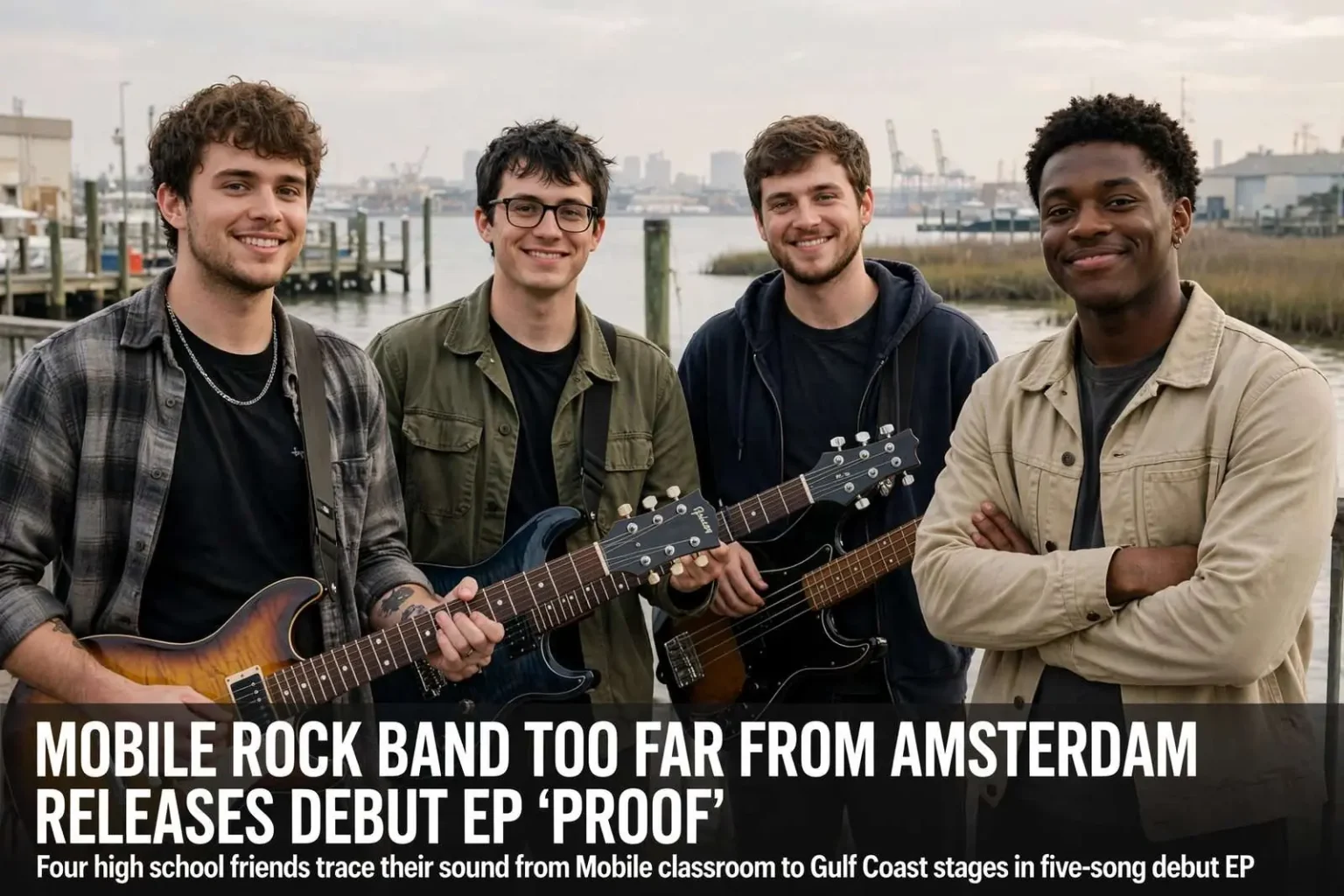
Mobile rock band Too Far From Amsterdam has released its debut EP, Proof, a five-song collection that traces the group’s roots back to a Mobile-area high school classroom. The band came together after guitarist and lead vocalist Arie VandeWaa, rhythm guitarist Mark Parrish and bassist Ben White met as students. Drummer Cameron Alidor, who also contributes backing vocals, rounds out the lineup. The release marks the first formal document of a band that has been building its sound the traditional way — through school-day friendships, garage rehearsals and the local stages of the Port City’s music scene.
Bands that form in high school occupy a particular place in rock’s mythology, and the ones that survive the transition to adulthood tend to share a common history: years of practice spaces that double as bedrooms, first shows played for classmates, and a songbook that matures alongside its writers. Too Far From Amsterdam’s path from a Mobile-area classroom to a released EP follows that arc, with the four members dividing the classic responsibilities — VandeWaa fronting the band on guitar and lead vocals, Parrish and White anchoring the rhythm sections, and Alidor driving the beat while adding backing vocals from behind the kit.
Older songs, recorded a year earlier
Proof compiles songs the band had written and recorded roughly a year before the EP’s release, with the sessions taking place in Fort Walton. That production timeline is common among young bands: a batch of songs is tracked when the studio time becomes available, and the release follows once the group has lived with the recordings, saved for the pressing and digital distribution and built up the local following that gives a debut its launch. The year between sessions and release meant the EP arrived as a look backward — a document of where the band had been as it worked toward a more polished, original sound.
The band said the five tracks reflect its earlier material as the group worked toward a more polished, original sound. Debut EPs often function exactly that way, capturing a band’s formative songwriting while the next phase is already underway. For listeners, the appeal of a release like Proof lies in hearing that formation in real time — the influences not yet fully absorbed, the arrangements still finding their shape, and the sound of four musicians who learned to play together in the same room before they learned to record.
Copies of Proof were made available at the band’s live shows, along with a digital release for fans outside the immediate Mobile music scene. The dual-channel release strategy reflects how Gulf Coast bands of the streaming era actually operate: physical copies sold at shows fund the next round of recording and give local fans something to hold, while the digital release carries the music to listeners in other cities, other states and the playlists of anyone who stumbles onto it. For a young band, every sold copy at a venue merch table and every stream from outside the region is data about where the audience is growing.
Mobile’s music scene has long punched above its weight for a city of its size, producing rock, punk, indie and singer-songwriter acts that tour regionally and beyond. Venues across the city and along the Gulf Coast give young bands stages to learn on, and the circuit of festivals, bar shows and all-ages events provides the repetition that turns school friends into a working unit. Too Far From Amsterdam’s development through that ecosystem — high school formation, local shows, a Fort Walton recording session, a hometown release — follows a route familiar to generations of Gulf Coast musicians.
Label interest sparks new single
The band’s live shows have started attracting outside attention. After a representative from a record label caught one of the group’s performances, the label requested a demo, prompting the band to begin work on a new single called “Kill Us All.” Label representatives still scout clubs and small venues — the place where a band’s actual connection with an audience is most visible — and a request for a demo is the classic next step: an invitation to translate what works on stage into a recorded artifact a label can circulate internally.
For a band working on new material, that request arrives with a built-in deadline and a sharpened sense of purpose. Writing and recording a single for label consideration is different from filling out an EP of older songs: the material is newer, the production standards are higher and the stakes are legible. “Kill Us All,” begun in response to the label’s interest, represents the band’s first work produced squarely in that context — newer songs aimed at proving that the formation documented on Proof was a beginning rather than a peak.
For a group that started as a handful of high school friends, the combination of a completed EP and label interest marks a notable step forward, as Too Far From Amsterdam looks to build on its local following around Mobile and the broader Gulf Coast music circuit. The sequence — form, play, record, release, get noticed — is the industry’s oldest progression, and each stage it survives is one that eliminates most of the bands that started alongside it. A debut EP in circulation and a label asking for a demo put the band at the point where the casual path forks from the committed one.
The band’s name itself has become part of its local identity, the kind of memorable, slightly enigmatic handle that serves a young group well on flyers, festival bills and streaming platforms. Alongside VandeWaa’s lead role, the internal division of labor — Parrish’s rhythm guitar, White’s bass, Alidor’s drums and backing vocals — gives the band a complete four-piece foundation with layered vocal possibilities, a configuration that scales from small club stages to festival setups without personnel changes.
The Gulf Coast circuit as an incubator
The broader Gulf Coast music circuit — stretching from Mobile west through the Mississippi coast venues to New Orleans, and east through Pensacola and the panhandle beach towns — offers regional bands a touring ladder without leaving home waters. A Mobile band can play its hometown, drive an hour to Pensacola, another to Fort Walton or Destin, and reach New Orleans on a weekend loop, building audiences city by city. The Fort Walton recording sessions that produced Proof’s material place the band squarely in that corridor, working with the studios and scenes that serve the whole coast.
That geography matters because label attention increasingly follows regional momentum. A band that can demonstrate sold rooms across multiple Gulf Coast cities, steady local sales at shows and a streaming footprint beyond its home market presents a far stronger case than one with only hometown support. Too Far From Amsterdam’s strategy of pairing show-only physical copies with a wide digital release builds exactly that record, and the label representative’s demo request suggests the strategy was working before the EP was even out.
What comes next for the band depends on the single and the shows to follow. If “Kill Us All” lands the way label interest suggests the live sets have, the band’s next EP or full-length would arrive with an audience already assembled and an industry already watching. If not, the group returns to the circuit that built it, with five songs released, a single in progress and the kind of experience that every Gulf Coast band banked on its way up. Either way, Proof now exists as the record of where Too Far From Amsterdam began — four Mobile-area students who turned a classroom acquaintance into a band, and a band into a record.
The debut EP also serves the practical purpose of giving venues and bookers something concrete to evaluate. A band with a five-song release, live footage and a demo in progress is far easier to schedule than one with only word of mouth, and Proof now functions as Too Far From Amsterdam’s calling card across the Gulf Coast circuit. Bookers from Pensacola to New Orleans can hear the band’s earlier material before adding it to a bill, and festival committees weighing regional acts for next summer’s lineups have a fixed artifact to review rather than a setlist description.
The recording sessions in Fort Walton also connect the band to a stretch of coast with its own studio tradition. The panhandle’s beach towns have long drawn musicians for both the venues and the affordable off-season recording opportunities, and sessions tracked there sit alongside a body of Gulf Coast records made far from the industry’s coastal capitals. For a young band, getting out of town to record — even an hour down the road — imposes the focus that home studios rarely provide, and the year between those sessions and the EP’s release gave the members time to hear their own work with fresh ears before putting it in circulation.
VandeWaa, Parrish and White meeting as students remains the thread that runs through the whole story. High school bands that last tend to be the ones whose members share more than musical taste — they share the daily context that makes rehearsal schedules survivable, ride shares practical and disagreements recoverable. As the members move into adult lives, those logistical bonds become the difference between a band that plays its last show at graduation and one that keeps booking weekends. Too Far From Amsterdam’s progression past its formation — through a recording, a release and now label interest — suggests the classroom bond has held.